Artículo
Where do adaptive shifts occur during invasion? A multidisciplinary approach to unravelling cold adaptation in a tropical ant species invading the Mediterranean area
Rey, Olivier; Estoup, Arnaud; Vonshak, Merav; Loiseau, Anne; Blanchet, Simon; Calcaterra, Luis Alberto ; Chifflet, Lucila
; Rossi, Jean Pierre; Kergoat, Gaël J.; Foucaud, Julien; Orivel, Jérôme; Leponce, Maurice; Schultz, Ted; Facon, Benoit
; Chifflet, Lucila
; Rossi, Jean Pierre; Kergoat, Gaël J.; Foucaud, Julien; Orivel, Jérôme; Leponce, Maurice; Schultz, Ted; Facon, Benoit
; Chifflet, Lucila
; Rossi, Jean Pierre; Kergoat, Gaël J.; Foucaud, Julien; Orivel, Jérôme; Leponce, Maurice; Schultz, Ted; Facon, Benoit
Fecha de publicación:
11/2012
Editorial:
Wiley Blackwell Publishing, Inc
Revista:
Ecology Letters
ISSN:
1461-023X
Idioma:
Inglés
Tipo de recurso:
Artículo publicado
Clasificación temática:
Resumen
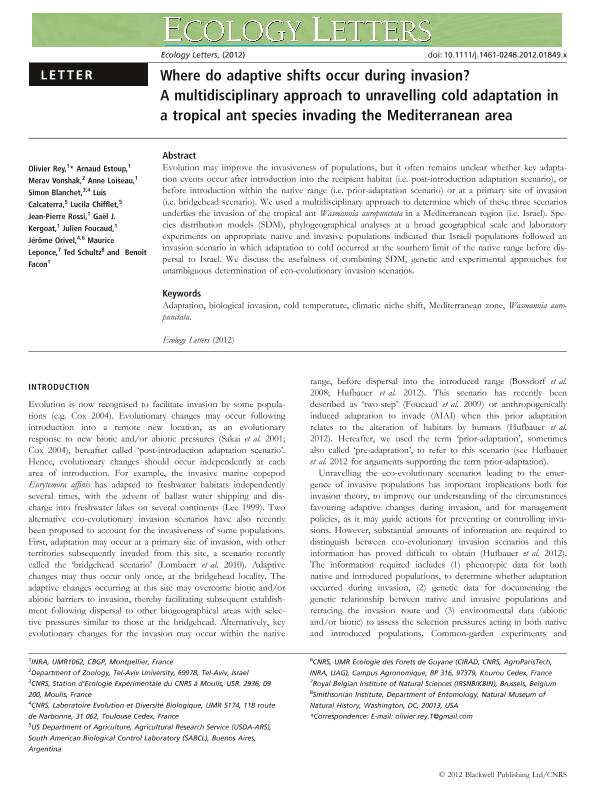
Evolution may improve the invasiveness of populations, but it often remains unclear whether key adaptation events occur after introduction into the recipient habitat (i.e. post-introduction adaptation scenario), or before introduction within the native range (i.e. prior-adaptation scenario) or at a primary site of invasion (i.e. bridgehead scenario). We used a multidisciplinary approach to determine which of these three scenarios underlies the invasion of the tropical ant Wasmannia auropunctata in a Mediterranean region (i.e. Israel). Species distribution models (SDM), phylogeographical analyses at a broad geographical scale and laboratory experiments on appropriate native and invasive populations indicated that Israeli populations followed an invasion scenario in which adaptation to cold occurred at the southern limit of the native range before dispersal to Israel. We discuss the usefulness of combining SDM, genetic and experimental approaches for unambiguous determination of eco-evolutionary invasion scenarios.
Archivos asociados

Tamaño:
678.8Kb
Formato:
PDF
Licencia
 Excepto donde se diga explícitamente, este item se publica bajo la siguiente descripción:
Creative Commons Attribution-NonCommercial-ShareAlike 2.5 Unported (CC BY-NC-SA 2.5)
Excepto donde se diga explícitamente, este item se publica bajo la siguiente descripción:
Creative Commons Attribution-NonCommercial-ShareAlike 2.5 Unported (CC BY-NC-SA 2.5)
Identificadores
Colecciones
Articulos(OCA CIUDAD UNIVERSITARIA)
Articulos de OFICINA DE COORDINACION ADMINISTRATIVA CIUDAD UNIVERSITARIA
Articulos de OFICINA DE COORDINACION ADMINISTRATIVA CIUDAD UNIVERSITARIA
Citación
Rey, Olivier; Estoup, Arnaud; Vonshak, Merav; Loiseau, Anne; Blanchet, Simon; et al.; Where do adaptive shifts occur during invasion? A multidisciplinary approach to unravelling cold adaptation in a tropical ant species invading the Mediterranean area; Wiley Blackwell Publishing, Inc; Ecology Letters; 15; 11; 11-2012; 1266-1275
Compartir


Altmétricas