Artículo
Interruption of classic CD40L-CD40 signalling but not of the novel CD40L-Mac-1 interaction limits arterial neointima formation in mice
Willecke, Florian; Tiwari, Shilpa; Rupprecht, Benjamin; Wolf, Dennis; Hergeth, Sonja; Hoppe, Natalie; Dufner, Bianca; Schulte, Lisa; Anto Michel, Nathaly; Bukosza, Nora; Marchini, Timoteo Oscar ; Jäekel, Markus; Stachon, Peter; Hilgendorf, Ingo; Zeschky, Katharina; Schleicher, Rebecca; Langer, Harald; von zur Muhlen, Constantin; Bode, Christoph; Karlheinz, Peter; Zirlik, Andreas
; Jäekel, Markus; Stachon, Peter; Hilgendorf, Ingo; Zeschky, Katharina; Schleicher, Rebecca; Langer, Harald; von zur Muhlen, Constantin; Bode, Christoph; Karlheinz, Peter; Zirlik, Andreas
Fecha de publicación:
08/2014
Editorial:
Schattauer Gmbh-Verlag Medizin Naturwissenschaften
Revista:
Thrombosis and Haemostasis
ISSN:
0340-6245
Idioma:
Inglés
Tipo de recurso:
Artículo publicado
Clasificación temática:
Resumen
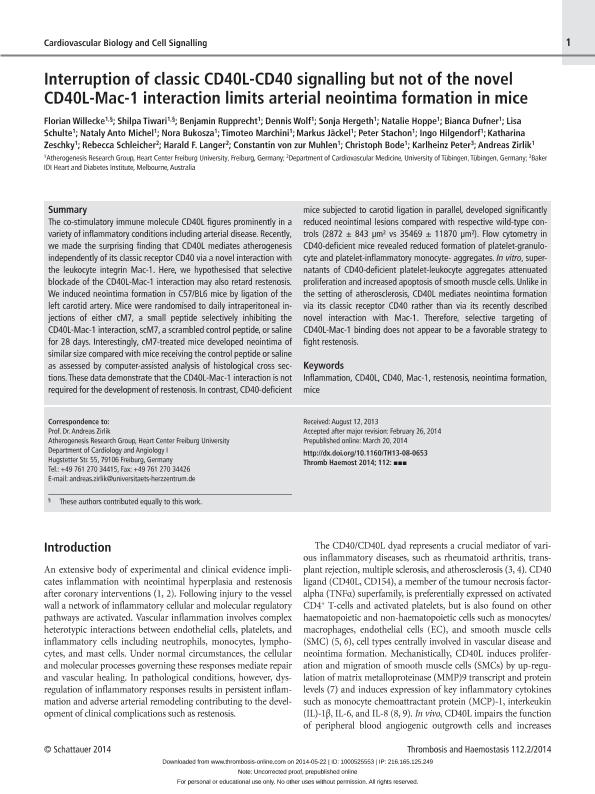
The co-stimulatory immune molecule CD40L figures prominently in a variety of inflammatory conditions including arterial disease. Recently, we made the surprising finding that CD40L mediates atherogenesis independently of its classic receptor CD40 via a novel interaction with the leukocyte integrin Mac-1. Here, we hypothesised that selective blockade of the CD40L-Mac-1 interaction may also retard restenosis. We induced neointima formation in C57/BL6 mice by ligation of the left carotid artery. Mice were randomised to daily intraperitoneal injections of either cM7, a small peptide selectively inhibiting the CD40L-Mac-1 interaction, scM7, a scrambled control peptide, or saline for 28 days. Interestingly, cM7-treated mice developed neointima of similar size compared with mice receiving the control peptide or saline as assessed by computer-assisted analysis of histological cross sections. These data demonstrate that the CD40L-Mac-1 interaction is not required for the development of restenosis. In contrast, CD40-deficient mice subjected to carotid ligation in parallel, developed significantly reduced neointimal lesions compared with respective wild-type controls (2872 ± 843 μm2 vs 35469 ± 11870 μm2). Flow cytometry in CD40-deficient mice revealed reduced formation of platelet-granulocyte and platelet-inflammatory monocyte- aggregates. In vitro, supernatants of CD40-deficient platelet-leukocyte aggregates attenuated proliferation and increased apoptosis of smooth muscle cells. Unlike in the setting of atherosclerosis, CD40L mediates neointima formation via its classic receptor CD40 rather than via its recently described novel interaction with Mac-1. Therefore, selective targeting of CD40L-Mac-1 binding does not appear to be a favorable strategy to fight restenosis. © Schattauer 2014.
Palabras clave:
Cd40
,
Cd40l
,
Inflammation
,
Mac-1
,
Mice
,
Neointima Formation
,
Restenosis
Archivos asociados

Tamaño:
8.708Mb
Formato:
PDF
Licencia
 Excepto donde se diga explícitamente, este item se publica bajo la siguiente descripción:
Creative Commons Attribution-NonCommercial-ShareAlike 2.5 Unported (CC BY-NC-SA 2.5)
Excepto donde se diga explícitamente, este item se publica bajo la siguiente descripción:
Creative Commons Attribution-NonCommercial-ShareAlike 2.5 Unported (CC BY-NC-SA 2.5)
Identificadores
Colecciones
Articulos(IBIMOL)
Articulos de INSTITUTO DE BIOQUIMICA Y MEDICINA MOLECULAR
Articulos de INSTITUTO DE BIOQUIMICA Y MEDICINA MOLECULAR
Citación
Willecke, Florian; Tiwari, Shilpa; Rupprecht, Benjamin ; Wolf, Dennis; Hergeth, Sonja; et al.; Interruption of classic CD40L-CD40 signalling but not of the novel CD40L-Mac-1 interaction limits arterial neointima formation in mice; Schattauer Gmbh-Verlag Medizin Naturwissenschaften; Thrombosis and Haemostasis; 112; 2; 8-2014; 379-389
Compartir


Altmétricas