Artículo
Long-term effects of warming and nutrients on microbes and other plankton in mesocosms
Özen, Arda; Sorf, Michal; Trochine, Carolina ; Liboriussen, Lone; Beklioglu, Meryem; Søndergaard, Martin; Lauridsen, Torben L.; Johansson, Liselotte S.; Jeppesen, Erik
; Liboriussen, Lone; Beklioglu, Meryem; Søndergaard, Martin; Lauridsen, Torben L.; Johansson, Liselotte S.; Jeppesen, Erik
Fecha de publicación:
05/2013
Editorial:
Wiley
Revista:
Freshwater Biology (print)
ISSN:
0046-5070
Idioma:
Inglés
Tipo de recurso:
Artículo publicado
Clasificación temática:
Resumen
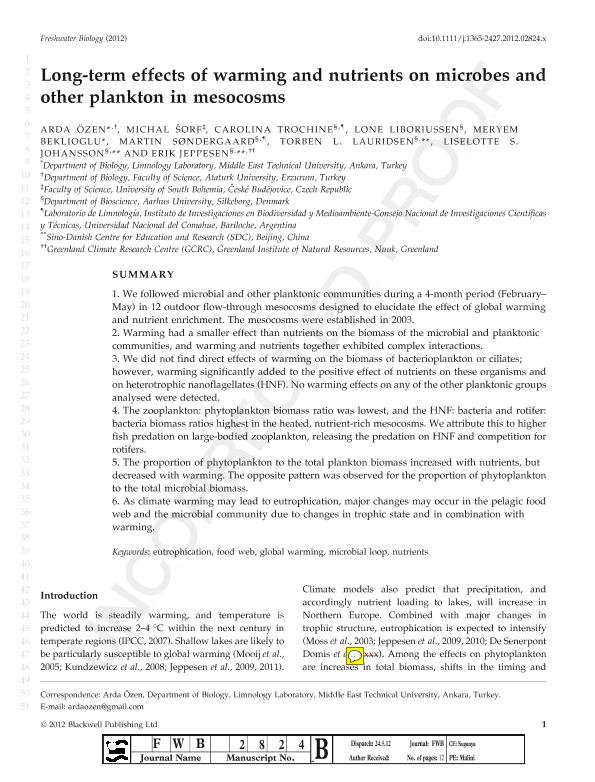
1. We followed microbial and other planktonic communities during a 4-month period (February–May) in 12 outdoor flow-through mesocosms designed to elucidate the effect of global warming and nutrient enrichment. The mesocosms were established in 2003.
2. Warming had a smaller effect than nutrients on the biomass of the microbial and planktonic communities, and warming and nutrients together exhibited complex interactions.
3. We did not find direct effects of warming on the biomass of bacterioplankton or ciliates; however, warming significantly added to the positive effect of nutrients on these organisms and on heterotrophic nanoflagellates (HNF). No warming effects on any of the other planktonic groups analysed were detected.
4. The zooplankton: phytoplankton biomass ratio was lowest, and the HNF: bacteria and rotifer: bacteria biomass ratios highest in the heated, nutrient-rich mesocosms. We attribute this to higher fish predation on large-bodied zooplankton, releasing the predation on HNF and competition for rotifers.
5. The proportion of phytoplankton to the total plankton biomass increased with nutrients, but decreased with warming. The opposite pattern was observed for the proportion of phytoplankton to the total microbial biomass.
6. As climate warming may lead to eutrophication, major changes may occur in the pelagic food web and the microbial community due to changes in trophic state and in combination with warming.
Palabras clave:
Eutrophication
,
Food Web
,
Global Warming
,
Microbial Loop-Nutrients
Archivos asociados

Tamaño:
1.134Mb
Formato:
PDF
Licencia
 Excepto donde se diga explícitamente, este item se publica bajo la siguiente descripción:
Creative Commons Attribution-NonCommercial-ShareAlike 2.5 Unported (CC BY-NC-SA 2.5)
Excepto donde se diga explícitamente, este item se publica bajo la siguiente descripción:
Creative Commons Attribution-NonCommercial-ShareAlike 2.5 Unported (CC BY-NC-SA 2.5)
Identificadores
Colecciones
Articulos(INIBIOMA)
Articulos de INST. DE INVEST.EN BIODIVERSIDAD Y MEDIOAMBIENTE
Articulos de INST. DE INVEST.EN BIODIVERSIDAD Y MEDIOAMBIENTE
Citación
Özen, Arda; Sorf, Michal; Trochine, Carolina; Liboriussen, Lone; Beklioglu, Meryem; et al.; Long-term effects of warming and nutrients on microbes and other plankton in mesocosms; Wiley; Freshwater Biology (print); 58; 3; 5-2013; 483-493
Compartir


Altmétricas