Artículo
STING-dependent cytosolic DNA sensing mediates innate immune recognition of immunogenic tumors
Woo, Seng Ryong ; Fuertes, Mercedes Beatriz ; Corrales, Leticia ; Spranger, Stefani ; Furdyna, Michael J. ; Leung, Michael Y. K.; Duggan, Ryan ; Wang, Ying ; Barber, Glen N. ; Fitzgerald, Katherine A.; Alegre, Maria luisa; Gajewski, Thomas F.
; Corrales, Leticia ; Spranger, Stefani ; Furdyna, Michael J. ; Leung, Michael Y. K.; Duggan, Ryan ; Wang, Ying ; Barber, Glen N. ; Fitzgerald, Katherine A.; Alegre, Maria luisa; Gajewski, Thomas F.
Fecha de publicación:
20/11/2014
Editorial:
Cell Press
Revista:
Immunity
ISSN:
1074-7613
e-ISSN:
1097-4180
Idioma:
Inglés
Tipo de recurso:
Artículo publicado
Clasificación temática:
Resumen
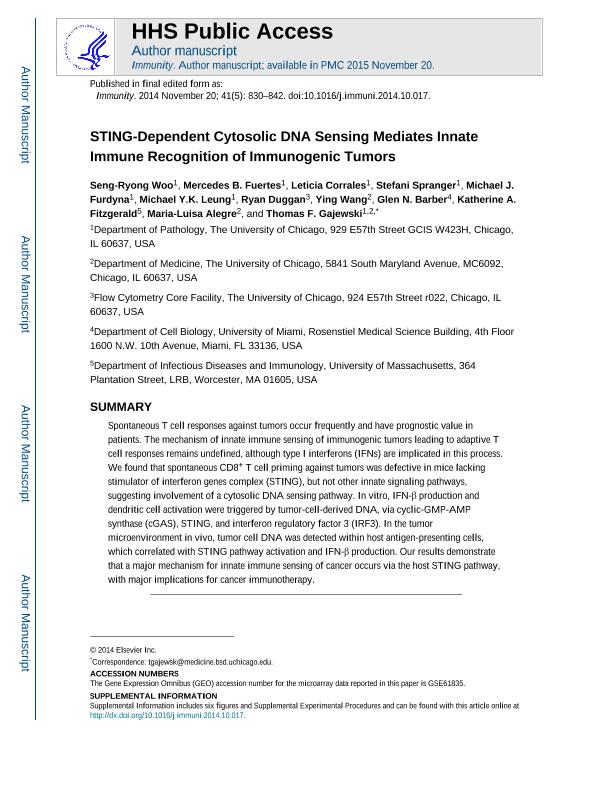
Spontaneous T cell responses against tumors occur frequently and have prognostic value in patients. The mechanism of innate immune sensing of immunogenic tumors leading to adaptive T cell responses remains undefined, although type I interferons (IFNs) are implicated in this process. We found that spontaneous CD8+ T cell priming against tumors was defective in mice lacking stimulator of interferon genes complex (STING), but not other innate signaling pathways, suggesting involvement of a cytosolic DNA sensing pathway. In vitro, IFN-β production and dendritic cell activation were triggered by tumor-cell-derived DNA, via cyclic-GMP-AMP synthase (cGAS), STING, and interferon regulatory factor 3 (IRF3). In the tumor microenvironment in vivo, tumor cell DNA was detected within host antigen-presenting cells, which correlated with STING pathway activation and IFN-β production. Our results demonstrate that a major mechanism for innate immune sensing of cancer occurs via the host STING pathway, with major implications for cancer immunotherapy.
Archivos asociados

Tamaño:
1.929Mb
Formato:
PDF
Licencia
 Excepto donde se diga explícitamente, este item se publica bajo la siguiente descripción:
Atribución-NoComercial-SinDerivadas 2.5 Argentina (CC BY-NC-ND 2.5 AR)
Excepto donde se diga explícitamente, este item se publica bajo la siguiente descripción:
Atribución-NoComercial-SinDerivadas 2.5 Argentina (CC BY-NC-ND 2.5 AR)
Identificadores
Colecciones
Articulos(IBYME)
Articulos de INST.DE BIOLOGIA Y MEDICINA EXPERIMENTAL (I)
Articulos de INST.DE BIOLOGIA Y MEDICINA EXPERIMENTAL (I)
Articulos(SEDE CENTRAL)
Articulos de SEDE CENTRAL
Articulos de SEDE CENTRAL
Citación
Woo, Seng Ryong ; Fuertes, Mercedes Beatriz; Corrales, Leticia ; Spranger, Stefani ; Furdyna, Michael J. ; et al.; STING-dependent cytosolic DNA sensing mediates innate immune recognition of immunogenic tumors; Cell Press; Immunity; 41; 5; 20-11-2014; 830-842
Compartir


Altmétricas