Artículo
The microRNA390/TAS3 pathway mediates symbiotic nodulation and lateral root growth
Hobecker, Karen Vanesa ; Reynoso, Mauricio Alberto
; Bustos Sanmamed, Pilar; Wen, Jiangqi; Mysore, Kirankumar S.; Crespi, Martín; Blanco, Flavio Antonio
; Zanetti, María Eugenia
; Reynoso, Mauricio Alberto
; Bustos Sanmamed, Pilar; Wen, Jiangqi; Mysore, Kirankumar S.; Crespi, Martín; Blanco, Flavio Antonio
; Zanetti, María Eugenia
; Reynoso, Mauricio Alberto
; Bustos Sanmamed, Pilar; Wen, Jiangqi; Mysore, Kirankumar S.; Crespi, Martín; Blanco, Flavio Antonio
; Zanetti, María Eugenia
Fecha de publicación:
08/2017
Editorial:
American Society of Plant Biologist
Revista:
Plant Physiology
ISSN:
0032-0889
Idioma:
Inglés
Tipo de recurso:
Artículo publicado
Clasificación temática:
Resumen
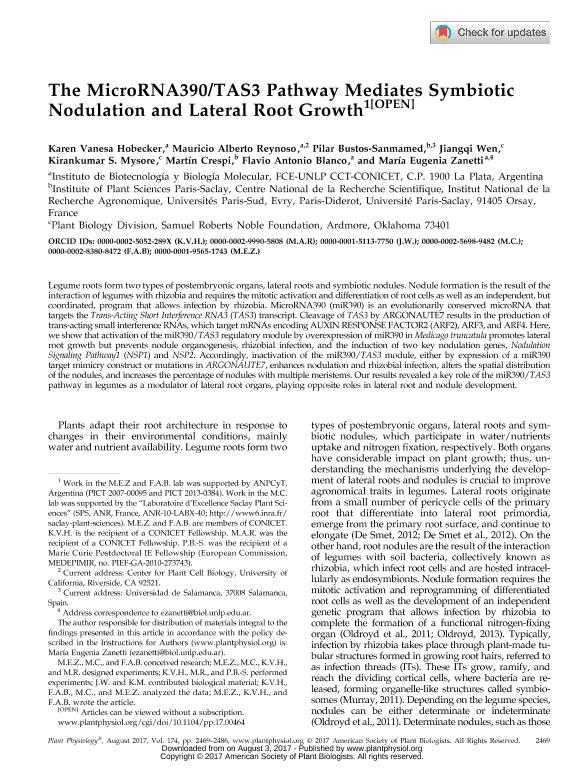
Legume roots form two types of postembryonic organs, lateral roots and symbiotic nodules. Nodule formation is the result of the interaction of legumes with rhizobia and requires the mitotic activation and differentiation of root cells as well as an independent, but coordinated, program that allows infection by rhizobia. MicroRNA390 (miR390) is an evolutionarily conserved microRNA that targets the Trans-Acting Short Interference RNA3 (TAS3) transcript. Cleavage of TAS3 by ARGONAUTE7 results in the production of trans-acting small interference RNAs, which target mRNAs encoding AUXIN RESPONSE FACTOR2 (ARF2), ARF3, and ARF4. Here, we show that activation of the miR390/TAS3 regulatory module by overexpression of miR390 in Medicago truncatula promotes lateral root growth but prevents nodule organogenesis, rhizobial infection, and the induction of two key nodulation genes, Nodulation Signaling Pathway1 (NSP1) and NSP2. Accordingly, inactivation of the miR390/TAS3 module, either by expression of a miR390 target mimicry construct or mutations in ARGONAUTE7, enhances nodulation and rhizobial infection, alters the spatial distribution of the nodules, and increases the percentage of nodules with multiple meristems. Our results revealed a key role of the miR390/TAS3 pathway in legumes as a modulator of lateral root organs, playing opposite roles in lateral root and nodule development.
Palabras clave:
Argonaute 7
,
Nitrogen Fixation
,
Root Architecture
,
Symbiosis
Archivos asociados

Tamaño:
2.066Mb
Formato:
PDF
Licencia
 Excepto donde se diga explícitamente, este item se publica bajo la siguiente descripción:
Creative Commons Attribution-NonCommercial-ShareAlike 2.5 Unported (CC BY-NC-SA 2.5)
Excepto donde se diga explícitamente, este item se publica bajo la siguiente descripción:
Creative Commons Attribution-NonCommercial-ShareAlike 2.5 Unported (CC BY-NC-SA 2.5)
Identificadores
Colecciones
Articulos(IBBM)
Articulos de INST.DE BIOTECNOLOGIA Y BIOLOGIA MOLECULAR
Articulos de INST.DE BIOTECNOLOGIA Y BIOLOGIA MOLECULAR
Citación
Hobecker, Karen Vanesa; Reynoso, Mauricio Alberto; Bustos Sanmamed, Pilar; Wen, Jiangqi; Mysore, Kirankumar S.; et al.; The microRNA390/TAS3 pathway mediates symbiotic nodulation and lateral root growth; American Society of Plant Biologist; Plant Physiology; 174; 4; 8-2017; 2469-2486
Compartir


Altmétricas