Artículo
Predator-prey body size relationship in temporary wetlands: Effect of predatory insects on prey size spectra and survival

Fecha de publicación:
03/2016
Editorial:
EDP Sciences
Revista:
Annales de Limnologie-International Journal of Limnology
ISSN:
0003-4088
e-ISSN:
2100-000X
Idioma:
Inglés
Tipo de recurso:
Artículo publicado
Clasificación temática:
Resumen
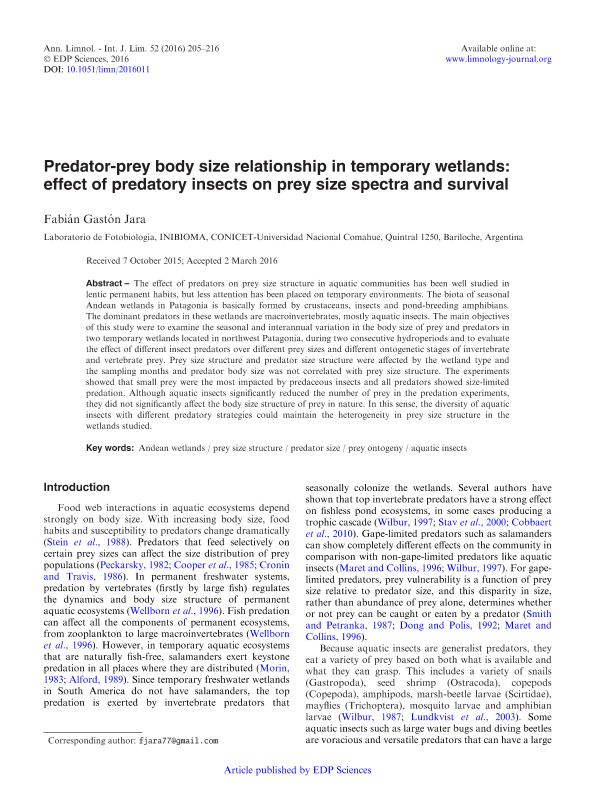
The effect of predators on prey size structure in aquatic communities has been well studied in lentic permanent habits, but less attention has been placed on temporary environments. The biota of seasonal Andean wetlands in Patagonia is basically formed by crustaceans, insects and pond-breeding amphibians. The dominant predators in these wetlands are macroinvertebrates, mostly aquatic insects. The main objectives of this study were to examine the seasonal and interannual variation in the body size of prey and predators in two temporary wetlands located in northwest Patagonia, during two consecutive hydroperiods and to evaluate the effect of different insect predators over different prey sizes and different ontogenetic stages of invertebrate and vertebrate prey. Prey size structure and predator size structure were affected by the wetland type and the sampling months and predator body size was not correlated with prey size structure. The experiments showed that small prey were the most impacted by predaceous insects and all predators showed size-limited predation. Although aquatic insects significantly reduced the number of prey in the predation experiments, they did not significantly affect the body size structure of prey in nature. In this sense, the diversity of aquatic insects with different predatory strategies could maintain the heterogeneity in prey size structure in the wetlands studied.
Archivos asociados

Tamaño:
630.1Kb
Formato:
PDF
Licencia
 Excepto donde se diga explícitamente, este item se publica bajo la siguiente descripción:
Creative Commons Attribution-NonCommercial-ShareAlike 2.5 Unported (CC BY-NC-SA 2.5)
Excepto donde se diga explícitamente, este item se publica bajo la siguiente descripción:
Creative Commons Attribution-NonCommercial-ShareAlike 2.5 Unported (CC BY-NC-SA 2.5)
Identificadores
Colecciones
Articulos(INIBIOMA)
Articulos de INST. DE INVEST.EN BIODIVERSIDAD Y MEDIOAMBIENTE
Articulos de INST. DE INVEST.EN BIODIVERSIDAD Y MEDIOAMBIENTE
Citación
Jara, Fabian Gaston; Predator-prey body size relationship in temporary wetlands: Effect of predatory insects on prey size spectra and survival; EDP Sciences; Annales de Limnologie-International Journal of Limnology; 52; 10; 3-2016; 205-216
Compartir


Altmétricas