Mostrar el registro sencillo del ítem
dc.contributor.author
Ibarrola, Francisco Javier
dc.contributor.author
Spies, Ruben Daniel
dc.date.available
2018-11-09T22:00:42Z
dc.date.issued
2017-04
dc.identifier.citation
Ibarrola, Francisco Javier; Spies, Ruben Daniel; A two-step mixed inpainting method with curvature-based anisotropy and spatial adaptivity; American Institute of Mathematical Sciences; Inverse Problems And Imaging; 11; 2; 4-2017; 247-262
dc.identifier.issn
1930-8337
dc.identifier.uri
http://hdl.handle.net/11336/64175
dc.description.abstract
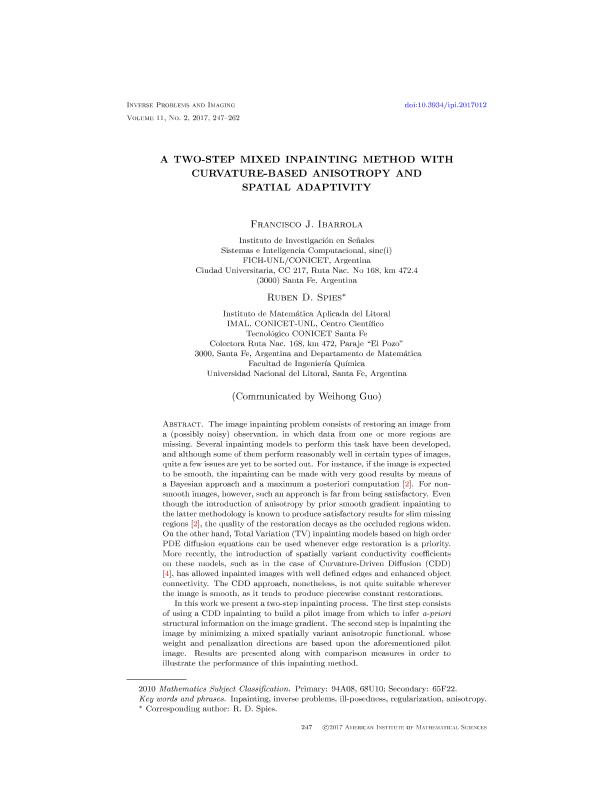
The image inpainting problem consists of restoring an image from a (possibly noisy) observation, in which data from one or more regions are missing. Several inpainting models to perform this task have been developed, and although some of them perform reasonably well in certain types of images, quite a few issues are yet to be sorted out. For instance, if the image is expected to be smooth, the inpainting can be made with very good results by means of a Bayesian approach and a maximum a posteriori computation [2]. For non-smooth images, however, such an approach is far from being satisfactory. Even though the introduction of anisotropy by prior smooth gradient inpainting to the latter methodology is known to produce satisfactory results for slim missing regions [2], the quality of the restoration decays as the occluded regions widen. On the other hand, Total Variation (TV) inpainting models based on high order PDE diffusion equations can be used whenever edge restoration is a priority. More recently, the introduction of spatially variant conductivity coefficients on these models, such as in the case of Curvature-Driven Diffusion (CDD) [4], has allowed inpainted images with well defined edges and enhanced object connectivity. The CDD approach, nonetheless, is not quite suitable wherever the image is smooth, as it tends to produce piecewise constant restorations. In this work we present a two-step inpainting process. The first step consists of using a CDD inpainting to build a pilot image from which to infer a-priori structural information on the image gradient. The second step is inpainting the image by minimizing a mixed spatially variant anisotropic functional, whose weight and penalization directions are based upon the aforementioned pilot image. Results are presented along with comparison measures in order to illustrate the performance of this inpainting method.
dc.format
application/pdf
dc.language.iso
eng
dc.publisher
American Institute of Mathematical Sciences
dc.rights
info:eu-repo/semantics/openAccess
dc.rights.uri
https://creativecommons.org/licenses/by-nc-sa/2.5/ar/
dc.subject
ANISOTROPY
dc.subject
ILL-POSEDNESS
dc.subject
INPAINTING
dc.subject
INVERSE PROBLEMS
dc.subject
REGULARIZATION
dc.subject.classification
Matemática Pura
dc.subject.classification
Matemáticas
dc.subject.classification
CIENCIAS NATURALES Y EXACTAS
dc.title
A two-step mixed inpainting method with curvature-based anisotropy and spatial adaptivity
dc.type
info:eu-repo/semantics/article
dc.type
info:ar-repo/semantics/artículo
dc.type
info:eu-repo/semantics/publishedVersion
dc.date.updated
2018-10-23T20:41:29Z
dc.journal.volume
11
dc.journal.number
2
dc.journal.pagination
247-262
dc.journal.pais
Estados Unidos
dc.journal.ciudad
Springfield
dc.description.fil
Fil: Ibarrola, Francisco Javier. Consejo Nacional de Investigaciones Científicas y Técnicas. Centro Científico Tecnológico Conicet - Santa Fe. Instituto de Investigación en Señales, Sistemas e Inteligencia Computacional. Universidad Nacional del Litoral. Facultad de Ingeniería y Ciencias Hídricas. Instituto de Investigación en Señales, Sistemas e Inteligencia Computacional; Argentina
dc.description.fil
Fil: Spies, Ruben Daniel. Consejo Nacional de Investigaciones Científicas y Técnicas. Centro Científico Tecnológico Conicet - Santa Fe. Instituto de Matemática Aplicada del Litoral. Universidad Nacional del Litoral. Instituto de Matemática Aplicada del Litoral; Argentina
dc.journal.title
Inverse Problems And Imaging
dc.relation.alternativeid
info:eu-repo/semantics/altIdentifier/url/http://www.aimsciences.org/journals/displayArticlesnew.jsp?paperID=13831
dc.relation.alternativeid
info:eu-repo/semantics/altIdentifier/doi/http://dx.doi.org/10.3934/ipi.2017012
Archivos asociados

Tamaño:
940.5Kb
Formato:
PDF