Artículo
Ethnobiology and research on Global Environmental Change: what distinctive contribution can we make?

Fecha de publicación:
06/07/2017
Editorial:
Ethnobiology and Conservation
Revista:
Ethnobiology and Conservation
ISSN:
2238-4782
Idioma:
Inglés
Tipo de recurso:
Artículo publicado
Clasificación temática:
Resumen
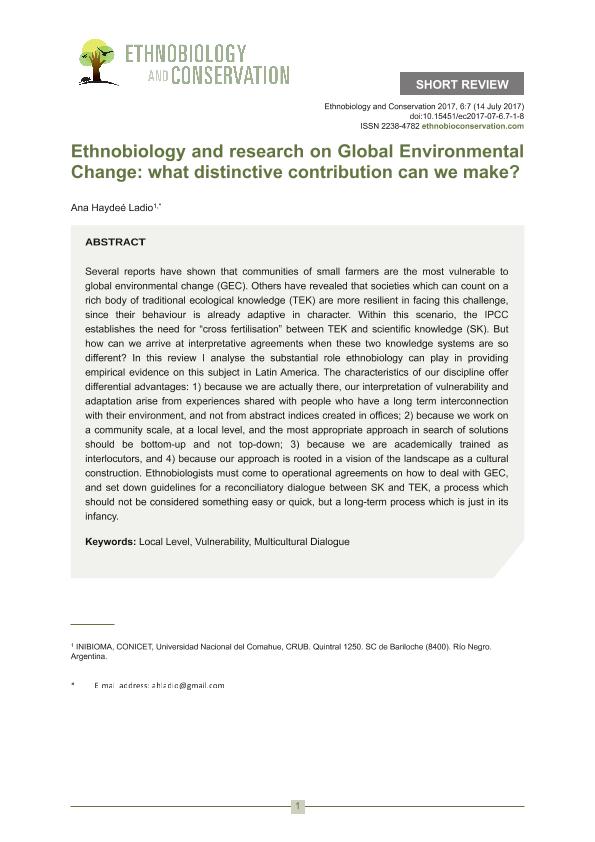
Several reports have shown that communities of small farmers are the most vulnerable to global environmental change (GEC). Others have revealed that societies which can count on a rich body of traditional ecological knowledge (TEK) are more resilient in facing this challenge, since their behaviour is already adaptive in character. Within this scenario, the IPCC establishes the need for “cross fertilisation” between TEK and scientific knowledge (SK). But how can we arrive at interpretative agreements when these two knowledge systems are so different? In this review I analyse the substantial role ethnobiology can play in providing empirical evidence on this subject in Latin America. The characteristics of our discipline offer differential advantages: 1) because we are actually there, our interpretation of vulnerability and adaptation arise from experiences shared with people who have a long term interconnection with their environment, and not from abstract indices created in offices; 2) because we work on a community scale, at a local level, and the most appropriate approach in search of solutions should be bottom-up and not top-down; 3) because we are academically trained as interlocutors, and 4) because our approach is rooted in a vision of the landscape as a cultural construction. Ethnobiologists must come to operational agreements on how to deal with GEC, and set down guidelines for a reconciliatory dialogue between SK and TEK, a process which should not be considered something easy or quick, but a long-term process which is just in its infancy.
Palabras clave:
Local Level
,
Vulnerability
,
Intercultural Dialogue
Archivos asociados

Tamaño:
1.593Mb
Formato:
PDF
Licencia
 Excepto donde se diga explícitamente, este item se publica bajo la siguiente descripción:
Creative Commons Attribution-NonCommercial-ShareAlike 2.5 Unported (CC BY-NC-SA 2.5)
Excepto donde se diga explícitamente, este item se publica bajo la siguiente descripción:
Creative Commons Attribution-NonCommercial-ShareAlike 2.5 Unported (CC BY-NC-SA 2.5)
Identificadores
Colecciones
Articulos(INIBIOMA)
Articulos de INST. DE INVEST.EN BIODIVERSIDAD Y MEDIOAMBIENTE
Articulos de INST. DE INVEST.EN BIODIVERSIDAD Y MEDIOAMBIENTE
Citación
Ladio, Ana Haydee; Ethnobiology and research on Global Environmental Change: what distinctive contribution can we make?; Ethnobiology and Conservation; Ethnobiology and Conservation; 6; 6-7-2017; 1-8
Compartir


Altmétricas