Artículo
Could artificial plant beds favour microcrustaceans during biomanipulation of eutrophic shallow lakes?

Fecha de publicación:
11/2017
Editorial:
Springer
Revista:
Hydrobiologia
ISSN:
0018-8158
Idioma:
Inglés
Tipo de recurso:
Artículo publicado
Clasificación temática:
Resumen
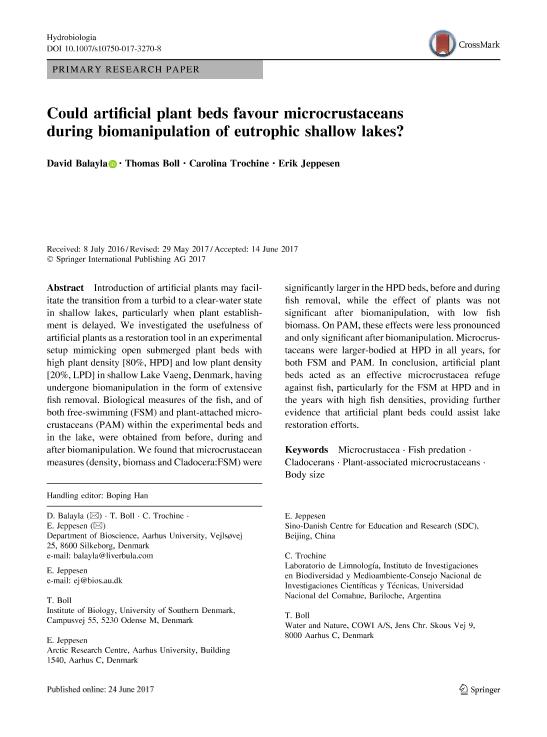
Introduction of artificial plants may facilitate the transition from a turbid to a clear-water state in shallow lakes, particularly when plant establishment is delayed. We investigated the usefulness of artificial plants as a restoration tool in an experimental setup mimicking open submerged plant beds with high plant density [80%, HPD] and low plant density [20%, LPD] in shallow Lake Vaeng, Denmark, having undergone biomanipulation in the form of extensive fish removal. Biological measures of the fish, and of both free-swimming (FSM) and plant-attached microcrustaceans (PAM) within the experimental beds and in the lake, were obtained from before, during and after biomanipulation. We found that microcrustacean measures (density, biomass and Cladocera:FSM) were significantly larger in the HPD beds, before and during fish removal, while the effect of plants was not significant after biomanipulation, with low fish biomass. On PAM, these effects were less pronounced and only significant after biomanipulation. Microcrustaceans were larger-bodied at HPD in all years, for both FSM and PAM. In conclusion, artificial plant beds acted as an effective microcrustacea refuge against fish, particularly for the FSM at HPD and in the years with high fish densities, providing further evidence that artificial plant beds could assist lake restoration efforts.
Archivos asociados

Tamaño:
837.5Kb
Formato:
PDF
Licencia
 Excepto donde se diga explícitamente, este item se publica bajo la siguiente descripción:
Creative Commons Attribution-NonCommercial-ShareAlike 2.5 Unported (CC BY-NC-SA 2.5)
Excepto donde se diga explícitamente, este item se publica bajo la siguiente descripción:
Creative Commons Attribution-NonCommercial-ShareAlike 2.5 Unported (CC BY-NC-SA 2.5)
Identificadores
Colecciones
Articulos(INIBIOMA)
Articulos de INST. DE INVEST.EN BIODIVERSIDAD Y MEDIOAMBIENTE
Articulos de INST. DE INVEST.EN BIODIVERSIDAD Y MEDIOAMBIENTE
Citación
Balayla, David; Boll, Thomas; Trochine, Carolina; Jeppesen, Erik; Could artificial plant beds favour microcrustaceans during biomanipulation of eutrophic shallow lakes?; Springer; Hydrobiologia; 802; 1; 11-2017; 221-233
Compartir


Altmétricas