Artículo
Use of different kinds of persulfate activation with iron for the remediation of a PAH-contaminated soil

Fecha de publicación:
09/2016
Editorial:
Elsevier Science
Revista:
Science of the Total Environment
ISSN:
0048-9697
Idioma:
Inglés
Tipo de recurso:
Artículo publicado
Clasificación temática:
Resumen
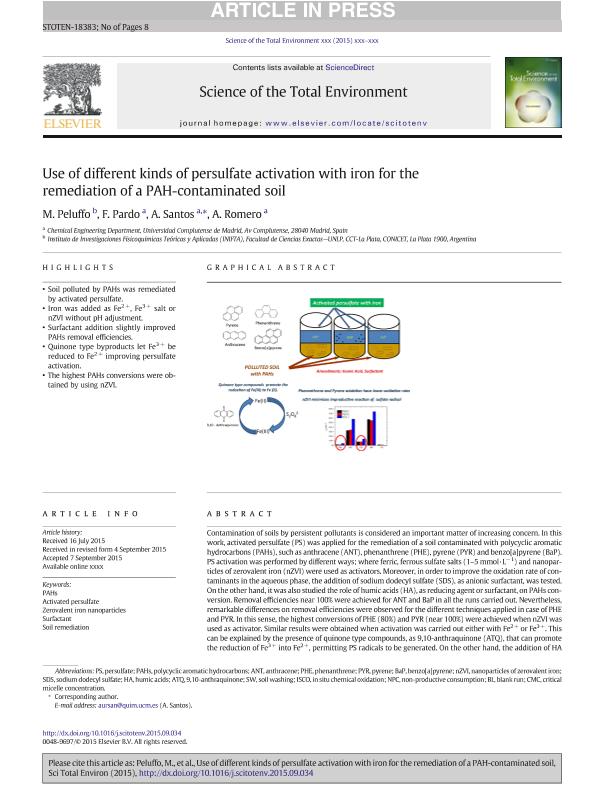
Contamination of soils by persistent pollutants is considered an important matter of increasing concern. In this work, activated persulfate (PS) was applied for the remediation of a soil contaminated with polycyclic aromatic hydrocarbons (PAHs), such as anthracene (ANT), phenanthrene (PHE), pyrene (PYR) and benzo[a]pyrene (BaP). PS activation was performed by different ways; where ferric, ferrous sulfate salts (1–5 mmol·L− 1) and nanoparticles of zerovalent iron (nZVI) were used as activators. Moreover, in order to improve the oxidation rate of contaminants in the aqueous phase, the addition of sodium dodecyl sulfate (SDS), as anionic surfactant, was tested. On the other hand, it was also studied the role of humic acids (HA), as reducing agent or surfactant, on PAHs conversion. Removal efficiencies near 100% were achieved for ANT and BaP in all the runs carried out. Nevertheless, remarkable differences on removal efficiencies were observed for the different techniques applied in case of PHE and PYR. In this sense, the highest conversions of PHE (80%) and PYR (near 100%) were achieved when nZVI was used as activator. Similar results were obtained when activation was carried out either with Fe2 + or Fe3 +. This can be explained by the presence of quinone type compounds, as 9,10-anthraquinone (ATQ), that can promote the reduction of Fe3 + into Fe2 +, permitting PS radicals to be generated. On the other hand, the addition of HA did not produce an improvement of the process while surfactant addition slightly increases the PAHs removal. Furthermore, a kinetic model was developed, describing the behavior of persulfate consumption, and contaminants removal under first order kinetics.
Archivos asociados

Tamaño:
1.016Mb
Formato:
PDF
Licencia
 Excepto donde se diga explícitamente, este item se publica bajo la siguiente descripción:
Creative Commons Attribution-NonCommercial-ShareAlike 2.5 Unported (CC BY-NC-SA 2.5)
Excepto donde se diga explícitamente, este item se publica bajo la siguiente descripción:
Creative Commons Attribution-NonCommercial-ShareAlike 2.5 Unported (CC BY-NC-SA 2.5)
Identificadores
Colecciones
Articulos(INIFTA)
Articulos de INST.DE INV.FISICOQUIMICAS TEORICAS Y APLIC.
Articulos de INST.DE INV.FISICOQUIMICAS TEORICAS Y APLIC.
Citación
Peluffo, Marina; Pardo, F.; Santos, A.; Romero, A.; Use of different kinds of persulfate activation with iron for the remediation of a PAH-contaminated soil; Elsevier Science; Science of the Total Environment; 563-564; 9-2016; 649-656
Compartir


Altmétricas