Mostrar el registro sencillo del ítem
dc.contributor.author
Alcoba, Diego Ricardo
dc.contributor.author
Valdemoro, C.
dc.contributor.author
Tel, L. M.
dc.contributor.author
Pérez-Romero, E.
dc.date.available
2018-10-04T14:51:59Z
dc.date.issued
2009-03
dc.identifier.citation
Alcoba, Diego Ricardo; Valdemoro, C.; Tel, L. M.; Pérez-Romero, E.; The correlation contracted schrodinger equation: An accurate solution of the G-particle-hole hypervirial; John Wiley & Sons Inc; International Journal of Quantum Chemistry; 109; 14; 3-2009; 3178-3190
dc.identifier.issn
0020-7608
dc.identifier.uri
http://hdl.handle.net/11336/61667
dc.description.abstract
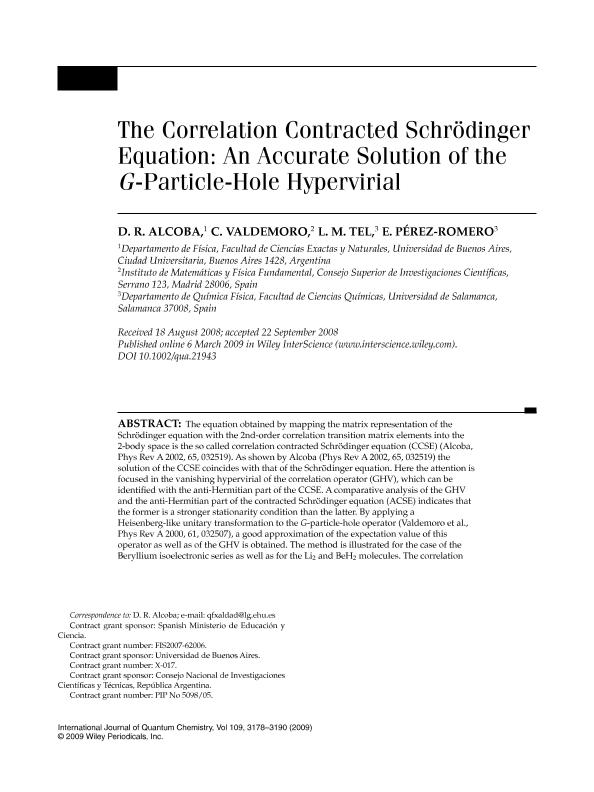
The equation obtained by mapping the matrix representation of the Schrödinger equation with the 2nd-order correlation transition matrix elements into the 2-body space is the so called correlation contracted Schrödinger equation (CCSE) (Alcoba, Phys Rev A 2002, 65, 032519). As shown by Alcoba (Phys Rev A 2002, 65, 032519) the solution of the CCSE coincides with that of the Schrödinger equation. Here the attention is focused in the vanishing hypervirial of the correlation operator (GHV), which can be identified with the anti-Hermitian part of the CCSE. A comparative analysis of the GHV and the anti-Hermitian part of the contracted Schrödinger equation (ACSE) indicates that the former is a stronger stationarity condition than the latter. By applying a Heisenberg-like unitary transformation to the G-particle-hole operator (Valdemoro et al., Phys Rev A 2000, 61, 032507), a good approximation of the expectation value of this operator as well as of the GHV is obtained. The method is illustrated for the case of the Beryllium isoelectronic series as well as for the Li2 and BeH2 molecules. The correlation energies obtained are within 98.80-100.09% of the full-configuration interaction ones. The convergence of these calculations was faster when using the GHV than with the ACSE. © 2009 Wiley Periodicals, Inc.
dc.format
application/pdf
dc.language.iso
eng
dc.publisher
John Wiley & Sons Inc
dc.rights
info:eu-repo/semantics/openAccess
dc.rights.uri
https://creativecommons.org/licenses/by-nc-sa/2.5/ar/
dc.subject
Anti-Hermitian Contracted SchrÖDinger Equation
dc.subject
Contracted Schrodinger Equation
dc.subject
Correlation Matrix
dc.subject
Electronic Correlation Effects
dc.subject
G-Matrix
dc.subject
Reduced Density Matrix
dc.subject.classification
Astronomía
dc.subject.classification
Ciencias Físicas
dc.subject.classification
CIENCIAS NATURALES Y EXACTAS
dc.title
The correlation contracted schrodinger equation: An accurate solution of the G-particle-hole hypervirial
dc.type
info:eu-repo/semantics/article
dc.type
info:ar-repo/semantics/artículo
dc.type
info:eu-repo/semantics/publishedVersion
dc.date.updated
2018-10-03T17:29:16Z
dc.journal.volume
109
dc.journal.number
14
dc.journal.pagination
3178-3190
dc.journal.pais
Estados Unidos
dc.journal.ciudad
New Jersey
dc.description.fil
Fil: Alcoba, Diego Ricardo. Universidad de Buenos Aires; Argentina. Consejo Nacional de Investigaciones Científicas y Técnicas. Oficina de Coordinación Administrativa Ciudad Universitaria. Instituto de Física de Buenos Aires. Universidad de Buenos Aires. Facultad de Ciencias Exactas y Naturales. Instituto de Física de Buenos Aires; Argentina
dc.description.fil
Fil: Valdemoro, C.. Csic - Instituto de Matematicas y Fisica Fundamental; España
dc.description.fil
Fil: Tel, L. M.. Universidad de Salamanca; España
dc.description.fil
Fil: Pérez-Romero, E.. Universidad de Salamanca; España
dc.journal.title
International Journal of Quantum Chemistry
dc.relation.alternativeid
info:eu-repo/semantics/altIdentifier/doi/http://dx.doi.org/10.1002/qua.21943
Archivos asociados

Tamaño:
181.5Kb
Formato:
PDF