Artículo
Real-time measurement of glucose using chrono-impedance technique on a second generation biosensor
Mayorga Martinez, Carmen Clotilde ; Treo, Ernesto Federico
; Madrid, Rossana Elena
; Felice, Carmelo Jose
; Treo, Ernesto Federico
; Madrid, Rossana Elena
; Felice, Carmelo Jose
; Treo, Ernesto Federico
; Madrid, Rossana Elena
; Felice, Carmelo Jose
Fecha de publicación:
11/2011
Editorial:
Elsevier Advanced Technology
Revista:
Biosensors & Bioelectronics
ISSN:
0956-5663
Idioma:
Inglés
Tipo de recurso:
Artículo publicado
Clasificación temática:
Resumen
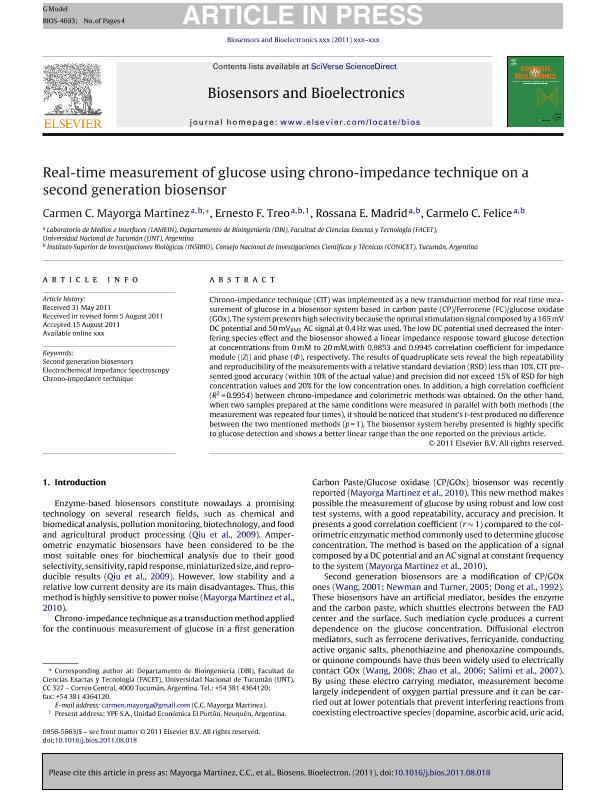
Chrono-impedance technique (CIT) was implemented as a new transduction method for real time measurement of glucose in a biosensor system based in carbon paste (CP)/Ferrocene (FC)/glucose oxidase (GOx). The system presents high selectivity because the optimal stimulation signal composed by a 165mV DC potential and 50mV RMS AC signal at 0.4Hz was used. The low DC potential used decreased the interfering species effect and the biosensor showed a linear impedance response toward glucose detection at concentrations from 0mM to 20mM,with 0.9853 and 0.9945 correlation coefficient for impedance module (|Z|) and phase (Φ), respectively. The results of quadruplicate sets reveal the high repeatability and reproducibility of the measurements with a relative standard deviation (RSD) less than 10%. CIT presented good accuracy (within 10% of the actual value) and precision did not exceed 15% of RSD for high concentration values and 20% for the low concentration ones. In addition, a high correlation coefficient (R 2=0.9954) between chrono-impedance and colorimetric methods was obtained. On the other hand, when two samples prepared at the same conditions were measured in parallel with both methods (the measurement was repeated four times), it should be noticed that student's t-test produced no difference between the two mentioned methods (p=1). The biosensor system hereby presented is highly specific to glucose detection and shows a better linear range than the one reported on the previous article.
Archivos asociados

Tamaño:
291.7Kb
Formato:
PDF
Licencia
 Excepto donde se diga explícitamente, este item se publica bajo la siguiente descripción:
Creative Commons Attribution-NonCommercial-ShareAlike 2.5 Unported (CC BY-NC-SA 2.5)
Excepto donde se diga explícitamente, este item se publica bajo la siguiente descripción:
Creative Commons Attribution-NonCommercial-ShareAlike 2.5 Unported (CC BY-NC-SA 2.5)
Identificadores
Colecciones
Articulos(INSIBIO)
Articulos de INST.SUP.DE INVEST.BIOLOGICAS
Articulos de INST.SUP.DE INVEST.BIOLOGICAS
Citación
Mayorga Martinez, Carmen Clotilde; Treo, Ernesto Federico; Madrid, Rossana Elena; Felice, Carmelo Jose; Real-time measurement of glucose using chrono-impedance technique on a second generation biosensor; Elsevier Advanced Technology; Biosensors & Bioelectronics; 29; 1; 11-2011; 200-203
Compartir


Altmétricas