Artículo
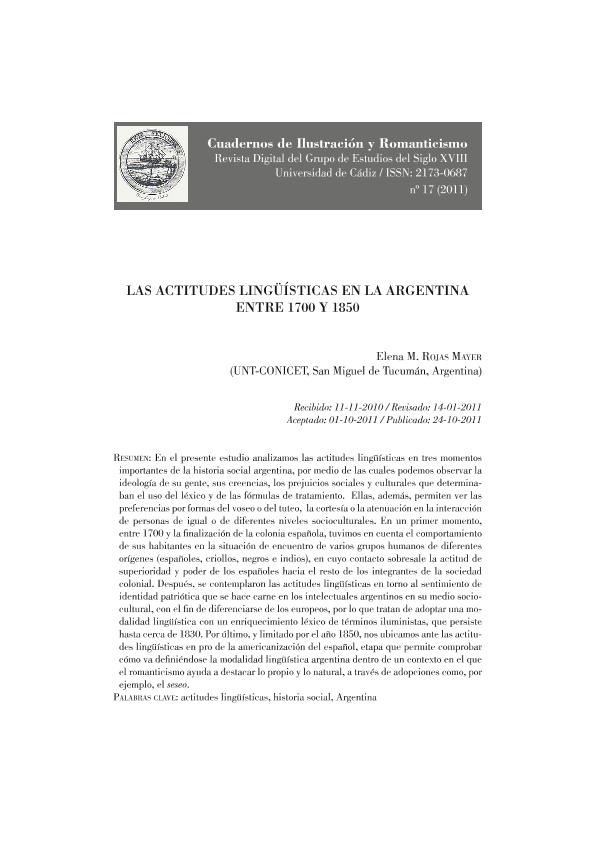
En el presente estudio analizamos las actitudes lingüísticas en tres momentos importantes de la historia social argentina, por medio de las cuales podemos observar la ideología de su gente, sus creencias, los prejuicios sociales y culturales que determinaban el uso del léxico y de las fórmulas de tratamiento. Ellas, además, permiten ver las preferencias por formas del voseo o del tuteo, la cortesía o la atenuación en la interacción de personas de igual o de diferentes niveles socioculturales. En un primer momento, entre 1700 y la finalización de la colonia española, tuvimos en cuenta el comportamiento de sus habitantes en la situación de encuentro de varios grupos humanos de diferentes orígenes (españoles, criollos, negros e indios), en cuyo contacto sobresale la actitud de superioridad y poder de los españoles hacia el resto de los integrantes de la sociedad colonial. Después, se contemplaron las actitudes lingüísticas en torno al sentimiento de identidad patriótica que se hace carne en los intelectuales argentinos en su medio sociocultural, con el fin de diferenciarse de los europeos, por lo que tratan de adoptar una modalidad lingüística con un enriquecimiento léxico de términos iluministas, que persiste hasta cerca de 1830. Por último, y limitado por el año 1850, nos ubicamos ante las actitudes lingüísticas en pro de la americanización del español, etapa que permite comprobar cómo va definiéndose la modalidad lingüística argentina dentro de un contexto en el que el romanticismo ayuda a destacar lo propio y lo natural, a través de adopciones como, por ejemplo, el seseo. This paper analizes linguistic attitudes in three meaningful moments of Argentine social history, which allows us to appreciate people’s ideologies, beliefs, social and cultural prejudices which would determine their use of vocabulary and forms of address, thus enabling us to notice their preferences concerning forms of «voseo» or of «tuteo», courtesy or atenuation in their interaction. Considering the first moment —between 1700 and the end of Spanish domination—, we took into consideration the behavior of the colonials when interacting within a variety of human groups coming from different extraction (Spaniards, Creoles, Blacks and Indians). Whenever these contacts take place, what is most noticeable is the attitude of superiority and power of the Spaniards towards the other members of the colonial society. In the second period we can appreciate linguistic attitudes connected with a feeling of patriotic identity which becomes the trademark in the Argentine intelligentsia within their socio-cultural atmosphere in order to mark a difference from Europeans, trying to adopt linguistic practices which show lexical acquisition of Illuministic terms, approximately until 1830. Finally, the third moment, which ends in 1850, we are faced with linguistic attitudes which favor the «americanization» of Spanish. This stage allows us to register how the Argentinian lingüistic traits reach a definition within a context in which Romanticism helps to emphasize what belongs to us, what is natural for us, as it happens with the acceptance of the seseo.
Las Actitudes Lingüísticas en la Argentina entre 1700 y 1850
Título:
Linguistic attitudes in argentina between 1700 and 1850

Fecha de publicación:
10/2011
Editorial:
Universidad de Cádiz. Grupo de Estudios del Siglo XVIII
Revista:
Cuadernos de Ilustración y Romanticismo
ISSN:
2173-0687
Idioma:
Español
Tipo de recurso:
Artículo publicado
Clasificación temática:
Resumen
Palabras clave:
Actitudes
,
Lingüística
,
Argentina
,
Colonia
Archivos asociados

Tamaño:
276.8Kb
Formato:
PDF
Licencia
 Excepto donde se diga explícitamente, este item se publica bajo la siguiente descripción:
Creative Commons Attribution-NonCommercial-ShareAlike 2.5 Unported (CC BY-NC-SA 2.5)
Excepto donde se diga explícitamente, este item se publica bajo la siguiente descripción:
Creative Commons Attribution-NonCommercial-ShareAlike 2.5 Unported (CC BY-NC-SA 2.5)
Identificadores
Colecciones
Articulos(INVELEC)
Articulos de INSTITUTO DE INVESTIGACIONES SOBRE EL LENGUAJE Y LA CULTURA
Articulos de INSTITUTO DE INVESTIGACIONES SOBRE EL LENGUAJE Y LA CULTURA
Citación
Rojas Mayer, Elena Malvina del V.; Las Actitudes Lingüísticas en la Argentina entre 1700 y 1850; Universidad de Cádiz. Grupo de Estudios del Siglo XVIII; Cuadernos de Ilustración y Romanticismo; 17; 10-2011; 1-14
Compartir

