Artículo
Local extinction risk of three species of lizard from Patagonia as a result of global warming
Kubisch, Erika Leticia ; Corbalán, Valeria Elizabeth
; Ibarguengoytía, Nora
; Sinervo, Barry Raymond
; Corbalán, Valeria Elizabeth
; Ibarguengoytía, Nora
; Sinervo, Barry Raymond
; Corbalán, Valeria Elizabeth
; Ibarguengoytía, Nora
; Sinervo, Barry Raymond
Fecha de publicación:
10/2015
Editorial:
National Research Council Canada-NRC Research Press
Revista:
Canadian Journal of Zoology
ISSN:
0008-4301
Idioma:
Inglés
Tipo de recurso:
Artículo publicado
Clasificación temática:
Resumen
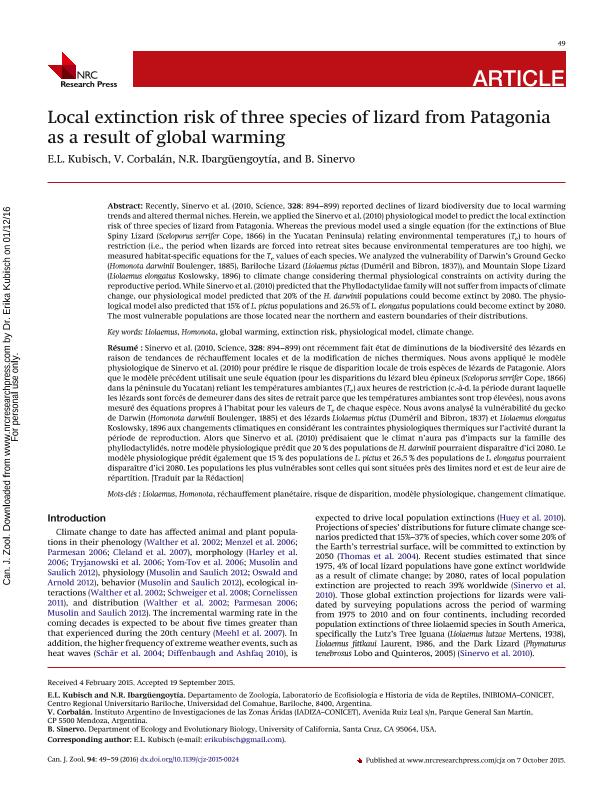
Recently, Sinervo et al. (2010, Science, 328: 894–899) reported declines of lizard biodiversity due to local warming trends and altered thermal niches. Herein, we applied the Sinervo et al. (2010) physiological model to predict the local extinction risk of three species of lizard from Patagonia. Whereas the previous model used a single equation (for the extinctions of Blue Spiny Lizard (Sceloporus serrifer Cope, 1866) in the Yucatan Peninsula) relating environmental temperatures (Te) to hours of restriction (i.e., the period when lizards are forced into retreat sites because environmental temperatures are too high), we measured habitat-specific equations for the Te values of each species. We analyzed the vulnerability of Darwin’s Ground Gecko (Homonota darwinii Boulenger, 1885), Bariloche Lizard (Liolaemus pictus (Duméril and Bibron, 1837)), and Mountain Slope Lizard (Liolaemus elongatus Koslowsky, 1896) to climate change considering thermal physiological constraints on activity during the reproductive period. While Sinervo et al. (2010) predicted that the Phyllodactylidae family will not suffer from impacts of climate change, our physiological model predicted that 20% of the H. darwinii populations could become extinct by 2080. The physiological model also predicted that 15% of L. pictus populations and 26.5% of L. elongatus populations could become extinct by 2080. The most vulnerable populations are those located near the northern and eastern boundaries of their distributions.
Archivos asociados

Tamaño:
884.1Kb
Formato:
PDF
Licencia
 Excepto donde se diga explícitamente, este item se publica bajo la siguiente descripción:
Creative Commons Attribution-NonCommercial-ShareAlike 2.5 Unported (CC BY-NC-SA 2.5)
Excepto donde se diga explícitamente, este item se publica bajo la siguiente descripción:
Creative Commons Attribution-NonCommercial-ShareAlike 2.5 Unported (CC BY-NC-SA 2.5)
Identificadores
Colecciones
Articulos(INIBIOMA)
Articulos de INST. DE INVEST.EN BIODIVERSIDAD Y MEDIOAMBIENTE
Articulos de INST. DE INVEST.EN BIODIVERSIDAD Y MEDIOAMBIENTE
Citación
Kubisch, Erika Leticia; Corbalán, Valeria Elizabeth; Ibarguengoytía, Nora; Sinervo, Barry Raymond; Local extinction risk of three species of lizard from Patagonia as a result of global warming; National Research Council Canada-NRC Research Press; Canadian Journal of Zoology; 94; 1; 10-2015; 49-59
Compartir


Altmétricas