Artículo
Order in Implication Zroupoids

Fecha de publicación:
06/2016
Editorial:
Springer
Revista:
Studia Logica
ISSN:
0039-3215
e-ISSN:
1572-8730
Idioma:
Inglés
Tipo de recurso:
Artículo publicado
Clasificación temática:
Resumen
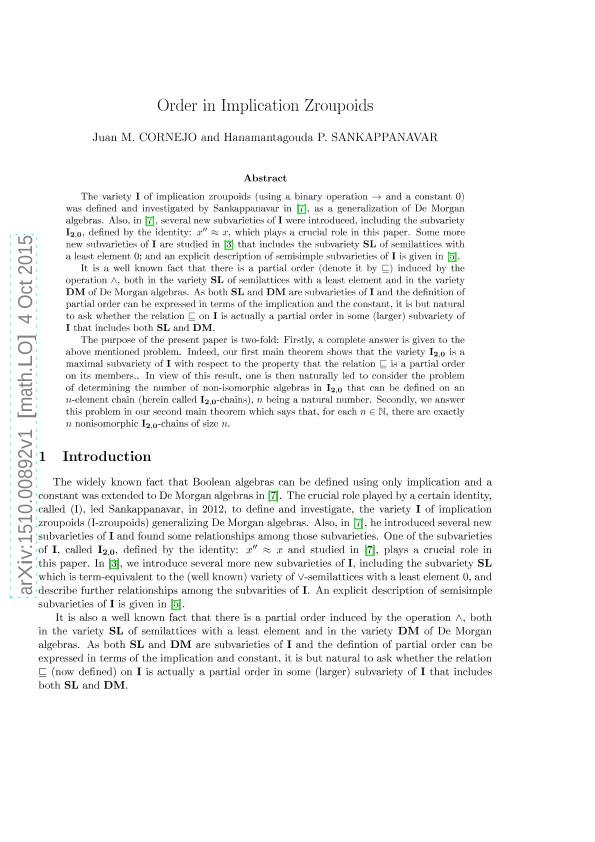
The variety I of implication zroupoids (using a binary operation → and a constant 0) was defined and investigated by Sankappanavar (Scientia Mathematica Japonica 75(1):21–50, 2012), as a generalization of De Morgan algebras. Also, in Sankappanavar (Scientia Mathematica Japonica 75(1):21–50, 2012), several subvarieties of I were introduced, including the subvariety I2 ,0, defined by the identity: x″≈ x, which plays a crucial role in this paper. Some more new subvarieties of I are studied in Cornejo and Sankappanavar (Algebra Univ, 2015) that includes the subvariety SL of semilattices with a least element 0. An explicit description of semisimple subvarieties of I is given in Cornejo and Sankappanavar (Soft Computing, 2015). It is a well known fact that there is a partial order (denote it by ⊑) induced by the operation ∧, both in the variety SL of semilattices with a least element and in the variety DM of De Morgan algebras. As both SL and DM are subvarieties of I and the definition of partial order can be expressed in terms of the implication and the constant, it is but natural to ask whether the relation ⊑ on I is actually a partial order in some (larger) subvariety of I that includes both SL and DM. The purpose of the present paper is two-fold: Firstly, a complete answer is given to the above mentioned problem. Indeed, our first main theorem shows that the variety I2,0 is a maximal subvariety of I with respect to the property that the relation ⊑ is a partial order on its members. In view of this result, one is then naturally led to consider the problem of determining the number of non-isomorphic algebras in I2,0 that can be defined on an n-element chain (herein called I2,0-chains), n being a natural number. Secondly, we answer this problem in our second main theorem which says that, for each n∈ N, there are exactly n nonisomorphic I2, 0-chains of size n.
Archivos asociados

Tamaño:
335.1Kb
Formato:
PDF
Licencia
 Excepto donde se diga explícitamente, este item se publica bajo la siguiente descripción:
Atribución-NoComercial-SinDerivadas 2.5 Argentina (CC BY-NC-ND 2.5 AR)
Excepto donde se diga explícitamente, este item se publica bajo la siguiente descripción:
Atribución-NoComercial-SinDerivadas 2.5 Argentina (CC BY-NC-ND 2.5 AR)
Identificadores
Colecciones
Articulos(INMABB)
Articulos de INST.DE MATEMATICA BAHIA BLANCA (I)
Articulos de INST.DE MATEMATICA BAHIA BLANCA (I)
Citación
Cornejo, Juan Manuel; Sankappanavar, Hanamantagouda P.; Order in Implication Zroupoids; Springer; Studia Logica; 104; 3; 6-2016; 417-453
Compartir


Altmétricas