Artículo
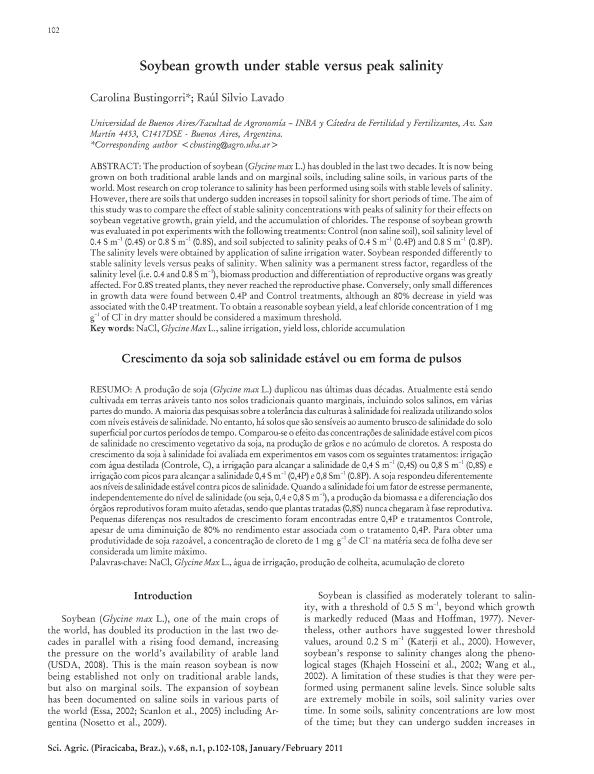
The production of soybean (Glycine max L.) has doubled in the last two decades. It is now being grown on both traditional arable lands and on marginal soils, including saline soils, in various parts of the world. Most research on crop tolerance to salinity has been performed using soils with stable levels of salinity. However, there are soils that undergo sudden increases in topsoil salinity for short periods of time. The aim of this study was to compare the effect of stable salinity concentrations with peaks of salinity for their effects on soybean vegetative growth, grain yield, and the accumulation of chlorides. The response of soybean growth was evaluated in pot experiments with the following treatments: Control (non saline soil), soil salinity level of 0.4 S m-1 (0.4S) or 0.8 S m-1 (0.8S), and soil subjected to salinity peaks of 0.4 S m-1 (0.4P) and 0.8 S m-1 (0.8P). The salinity levels were obtained by application of saline irrigation water. Soybean responded differently to stable salinity levels versus peaks of salinity. When salinity was a permanent stress factor, regardless of the salinity level (i.e. 0.4 and 0.8 S m-1), biomass production and differentiation of reproductive organs was greatly affected. For 0.8S treated plants, they never reached the reproductive phase. Conversely, only small differences in growth data were found between 0.4P and Control treatments, although an 80% decrease in yield was associated with the 0.4P treatment. To obtain a reasonable soybean yield, a leaf chloride concentration of 1 mg g-1 of Cl- in dry matter should be considered a maximum threshold. A produção de soja (Glycine max L.) duplicou nas últimas duas décadas. Atualmente está sendo cultivada em terras aráveis tanto nos solos tradicionais quanto marginais, incluindo solos salinos, em várias partes do mundo. A maioria das pesquisas sobre a tolerância das culturas à salinidade foi realizada utilizando solos com níveis estáveis de salinidade. No entanto, há solos que são sensíveis ao aumento brusco de salinidade do solo superficial por curtos períodos de tempo. Comparou-se o efeito das concentrações de salinidade estável com picos de salinidade no crescimento vegetativo da soja, na produção de grãos e no acúmulo de cloretos. A resposta do crescimento da soja à salinidade foi avaliada em experimentos em vasos com os seguintes tratamentos: irrigação com água destilada (Controle, C), a irrigação para alcançar a salinidade de 0,4 S m-1 (0,4S) ou 0,8 S m-1 (0,8S) e irrigação com picos para alcançar a salinidade 0,4 S m-1 (0,4P) e 0,8 Sm-1 (0.8P). A soja respondeu diferentemente aos níveis de salinidade estável contra picos de salinidade. Quando a salinidade foi um fator de estresse permanente, independentemente do nível de salinidade (ou seja, 0,4 e 0,8 S m-1), a produção da biomassa e a diferenciação dos órgãos reprodutivos foram muito afetadas, sendo que plantas tratadas (0,8S) nunca chegaram à fase reprodutiva. Pequenas diferenças nos resultados de crescimento foram encontradas entre 0,4P e tratamentos Controle, apesar de uma diminuição de 80% no rendimento estar associada com o tratamento 0,4P. Para obter uma produtividade de soja razoável, a concentração de cloreto de 1 mg g-1 de Cl- na matéria seca de folha deve ser considerada um limite máximo.
Soybean growth under stable versus peak salinity
Título:
Crescimento da soja sob salinidade estável ou em forma de pulsos

Fecha de publicación:
02/2011
Editorial:
Univ Sao Paolo
Revista:
Scientia Agricola
ISSN:
0103-9016
e-ISSN:
1678-992X
Idioma:
Inglés
Tipo de recurso:
Artículo publicado
Clasificación temática:
Resumen
Palabras clave:
Soja
,
Salinidad
,
Irrigación
,
Nacl
,
Yield Loss
Archivos asociados

Tamaño:
192.1Kb
Formato:
PDF
Licencia
 Excepto donde se diga explícitamente, este item se publica bajo la siguiente descripción:
Creative Commons Attribution-NonCommercial-ShareAlike 2.5 Unported (CC BY-NC-SA 2.5)
Excepto donde se diga explícitamente, este item se publica bajo la siguiente descripción:
Creative Commons Attribution-NonCommercial-ShareAlike 2.5 Unported (CC BY-NC-SA 2.5)
Identificadores
Colecciones
Articulos(INBA)
Articulos de INST.DE INVEST. EN BIOCIENCIAS AGRICOLAS Y AMBIENTALES
Articulos de INST.DE INVEST. EN BIOCIENCIAS AGRICOLAS Y AMBIENTALES
Citación
Bustingorri, Carolina; Lavado, Raul Silvio; Soybean growth under stable versus peak salinity; Univ Sao Paolo; Scientia Agricola; 68; 1; 2-2011; 102-108
Compartir


Altmétricas