Artículo
Reproductive and parental care physiology of Cichlasoma dimerus males
Birba, Agustina ; Ramallo, Martín Roberto
; Lo Nostro, Fabiana Laura
; Guimarães Moreira, Renata; Pandolfi, Matias
; Ramallo, Martín Roberto
; Lo Nostro, Fabiana Laura
; Guimarães Moreira, Renata; Pandolfi, Matias
; Ramallo, Martín Roberto
; Lo Nostro, Fabiana Laura
; Guimarães Moreira, Renata; Pandolfi, Matias
Fecha de publicación:
09/2015
Editorial:
Academic Press Inc Elsevier Science
Revista:
General and Comparative Endocrinology
ISSN:
0016-6480
Idioma:
Inglés
Tipo de recurso:
Artículo publicado
Clasificación temática:
Resumen
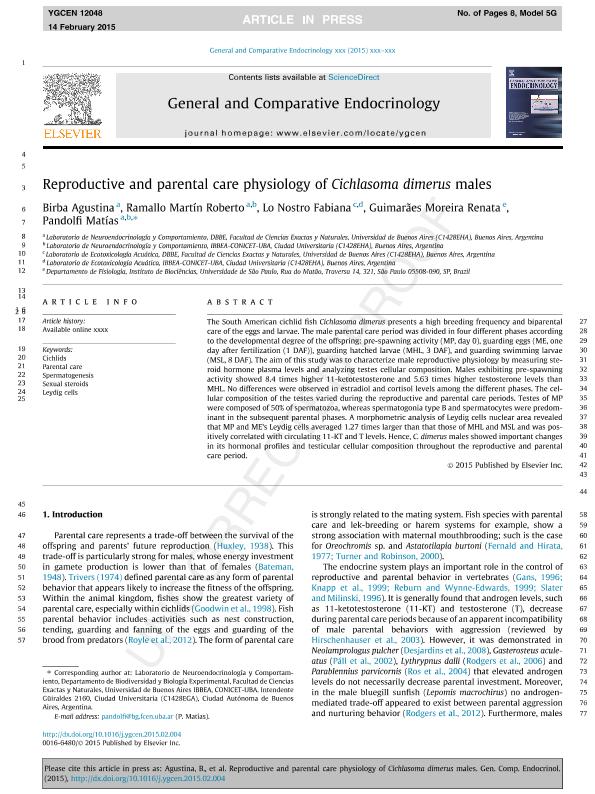
The South American cichlid fish Cichlasoma dimerus presents a high breeding frequency and biparental care of the eggs and larvae. The male parental care period was divided in four different phases according to the developmental degree of the offspring: pre-spawning activity (MP, day 0), guarding eggs (ME, one day after fertilization (1 DAF)), guarding hatched larvae (MHL, 3 DAF), and guarding swimming larvae (MSL, 8 DAF). The aim of this study was to characterize male reproductive physiology by measuring steroid hormone plasma levels and analyzing testes cellular composition. Males exhibiting pre-spawning activity showed 8.4 times higher 11-ketotestosterone and 5.63 times higher testosterone levels than MHL. No differences were observed in estradiol and cortisol levels among the different phases. The cellular composition of the testes varied during the reproductive and parental care periods. Testes of MP were composed of 50% of spermatozoa, whereas spermatogonia type B and spermatocytes were predominant in the subsequent parental phases. A morphometric analysis of Leydig cells nuclear area revealed that MP and ME's Leydig cells averaged 1.27 times larger than that those of MHL and MSL and was positively correlated with circulating 11-KT and T levels. Hence, C. dimerus males showed important changes in its hormonal profiles and testicular cellular composition throughout the reproductive and parental care period.
Palabras clave:
Cichlids
,
Leydig Cells
,
Parental Care
,
Sexual Steroids
,
Spermatogenesis
Archivos asociados

Tamaño:
2.022Mb
Formato:
PDF
Licencia
 Excepto donde se diga explícitamente, este item se publica bajo la siguiente descripción:
Creative Commons Attribution-NonCommercial-ShareAlike 2.5 Unported (CC BY-NC-SA 2.5)
Excepto donde se diga explícitamente, este item se publica bajo la siguiente descripción:
Creative Commons Attribution-NonCommercial-ShareAlike 2.5 Unported (CC BY-NC-SA 2.5)
Identificadores
Colecciones
Articulos(IBBEA)
Articulos de INSTITUTO DE BIODIVERSIDAD Y BIOLOGIA EXPERIMENTAL Y APLICADA
Articulos de INSTITUTO DE BIODIVERSIDAD Y BIOLOGIA EXPERIMENTAL Y APLICADA
Citación
Birba, Agustina; Ramallo, Martín Roberto; Lo Nostro, Fabiana Laura; Guimarães Moreira, Renata; Pandolfi, Matias; Reproductive and parental care physiology of Cichlasoma dimerus males; Academic Press Inc Elsevier Science; General and Comparative Endocrinology; 221; 9-2015; 193-200
Compartir


Altmétricas