Artículo
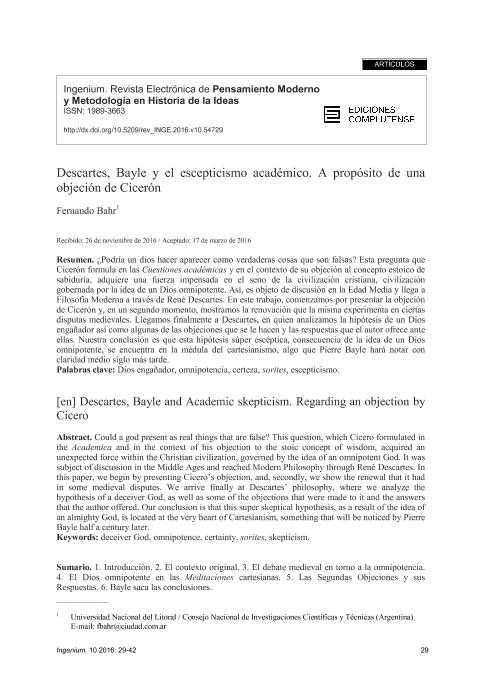
¿Podría un dios hacer aparecer como verdaderas cosas que son falsas? Esta pregunta que Cicerón formula en las Cuestiones académicas y en el contexto de su objeción al concepto estoico de sabiduría, adquiere una fuerza impensada en el seno de la civilización cristiana, civilización gobernada por la idea de un Dios omnipotente. Así, es objeto de discusión en la Edad Media y llega a Filosofía Moderna a través de René Descartes. En este trabajo, comenzamos por presentar la objeción de Cicerón y, en un segundo momento, mostramos la renovación que la misma experimenta en ciertas disputas medievales. Llegamos finalmente a Descartes, en quien analizamos la hipótesis de un Dios engañador así como algunas de las objeciones que se le hacen y las respuestas que el autor ofrece ante ellas. Nuestra conclusión es que esta hipótesis súper escéptica, consecuencia de la idea de un Dios omnipotente, se encuentra en la médula del cartesianismo, algo que Pierre Bayle hará notar con claridad medio siglo más tarde. Could a god present as real things that are false? This question, which Cicero formulated in the Academica and in the context of his objection to the stoic concept of wisdom, acquired an unexpected force within the Christian civilization, governed by the idea of an omnipotent God. It was subject of discussion in the Middle Ages and reached Modern Philosophy through René Descartes. In this paper, we begin by presenting Cicero’s objection, and, secondly, we show the renewal that it had in some medieval disputes. We arrive finally at Descartes’ philosophy, where we analyze the hypothesis of a deceiver God, as well as some of the objections that were made to it and the answers that the author offered. Our conclusion is that this super skeptical hypothesis, as a result of the idea of an almighty God, is located at the very heart of Cartesianism, something that will be noticed by Pierre Bayle half a century later.
Descartes, Bayle y el escepticismo académico : a propósito de una objeción de Cicerón

Fecha de publicación:
12/2016
Editorial:
Universidad Complutense de Madrid
Revista:
Ingenium
ISSN:
1989-3663
Idioma:
Español
Tipo de recurso:
Artículo publicado
Clasificación temática:
Resumen
Palabras clave:
Dios Engañador
,
Omnipotencia
,
Certeza
,
Sorites
,
Escepticismo
Archivos asociados

Tamaño:
307.6Kb
Formato:
PDF
Licencia
 Excepto donde se diga explícitamente, este item se publica bajo la siguiente descripción:
Creative Commons Attribution-NonCommercial-ShareAlike 2.5 Unported (CC BY-NC-SA 2.5)
Excepto donde se diga explícitamente, este item se publica bajo la siguiente descripción:
Creative Commons Attribution-NonCommercial-ShareAlike 2.5 Unported (CC BY-NC-SA 2.5)
Identificadores
Colecciones
Articulos(IHUCSO LITORAL)
Articulos de INSTITUTO DE HUMANIDADES Y CIENCIAS SOCIALES DEL LITORAL
Articulos de INSTITUTO DE HUMANIDADES Y CIENCIAS SOCIALES DEL LITORAL
Citación
Bahr, Fernando Anibal; Descartes, Bayle y el escepticismo académico : a propósito de una objeción de Cicerón; Universidad Complutense de Madrid; Ingenium; 10; 10; 12-2016; 29-42
Compartir


Altmétricas