Artículo
Over-exposed classes in Java: An empirical study

Fecha de publicación:
11/2016
Editorial:
Pergamon-Elsevier Science Ltd
Revista:
Computer Languages Systems & Structures
ISSN:
1477-8424
Idioma:
Inglés
Tipo de recurso:
Artículo publicado
Clasificación temática:
Resumen
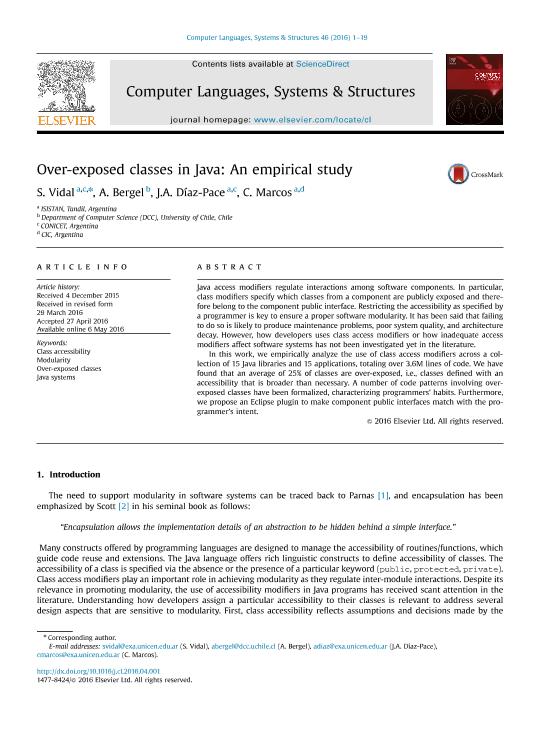
Java access modifiers regulate interactions among software components. In particular, class modifiers specify which classes from a component are publicly exposed and therefore belong to the component public interface. Restricting the accessibility as specified by a programmer is key to ensure a proper software modularity. It has been said that failing to do so is likely to produce maintenance problems, poor system quality, and architecture decay. However, how developers uses class access modifiers or how inadequate access modifiers affect software systems has not been investigated yet in the literature. In this work, we empirically analyze the use of class access modifiers across a collection of 15 Java libraries and 15 applications, totaling over 3.6M lines of code. We have found that an average of 25% of classes are over-exposed, i.e., classes defined with an accessibility that is broader than necessary. A number of code patterns involving over-exposed classes have been formalized, characterizing programmers' habits. Furthermore, we propose an Eclipse plugin to make component public interfaces match with the programmer's intent.
Palabras clave:
Class Accessibility
,
Java Systems
,
Modularity
,
Over-Exposed Classes
Archivos asociados

Tamaño:
1.086Mb
Formato:
PDF
Licencia
 Excepto donde se diga explícitamente, este item se publica bajo la siguiente descripción:
Creative Commons Attribution-NonCommercial-ShareAlike 2.5 Unported (CC BY-NC-SA 2.5)
Excepto donde se diga explícitamente, este item se publica bajo la siguiente descripción:
Creative Commons Attribution-NonCommercial-ShareAlike 2.5 Unported (CC BY-NC-SA 2.5)
Identificadores
Colecciones
Articulos(ISISTAN)
Articulos de INSTITUTO SUPERIOR DE INGENIERIA DEL SOFTWARE
Articulos de INSTITUTO SUPERIOR DE INGENIERIA DEL SOFTWARE
Citación
Vidal, Santiago Agustín; Bergel, Alexandre; Diaz Pace, Jorge Andres; Marcos, Claudia Andrea; Over-exposed classes in Java: An empirical study; Pergamon-Elsevier Science Ltd; Computer Languages Systems & Structures; 46; 11-2016; 1-19
Compartir


Altmétricas