Artículo
Geometry distortion of the benzene molecule in a strong magnetic field

Fecha de publicación:
10/2010
Editorial:
John Wiley & Sons Inc
Revista:
International Journal of Quantum Chemistry
ISSN:
0020-7608
Idioma:
Inglés
Tipo de recurso:
Artículo publicado
Clasificación temática:
Resumen
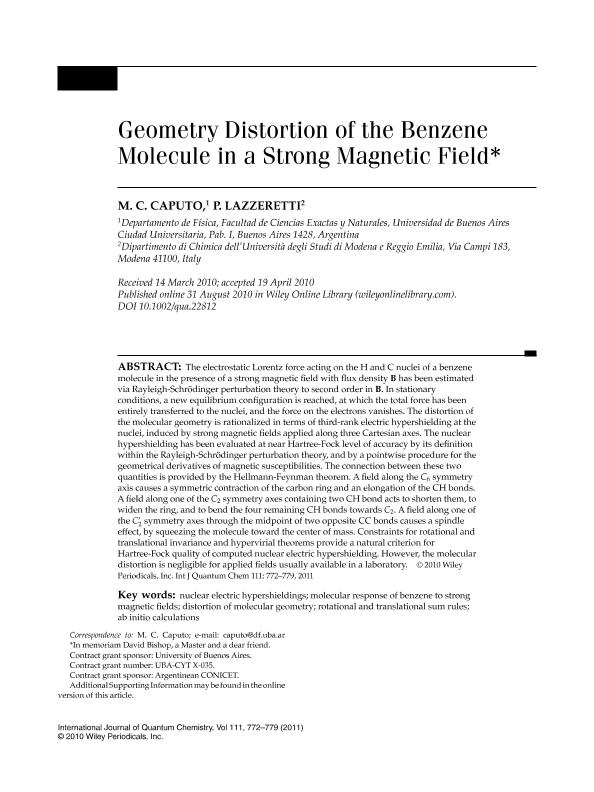
The electrostatic Lorentz force acting on the H and C nuclei of a benzene molecule in the presence of a strong magnetic field with flux density B has been estimated via Rayleigh-Schrödinger perturbation theory to second order in B. In stationary conditions, a new equilibrium configuration is reached, at which the total force has been entirely transferred to the nuclei, and the force on the electrons vanishes. The distortion of the molecular geometry is rationalized in terms of third-rank electric hypershielding at the nuclei, induced by strong magnetic fields applied along three Cartesian axes. The nuclear hypershielding has been evaluated at near Hartree-Fock level of accuracy by its definition within the Rayleigh-Schrödinger perturbation theory, and by a pointwise procedure for the geometrical derivatives of magnetic susceptibilities. The connection between these two quantities is provided by the Hellmann-Feynman theorem. A field along the C6 symmetry axis causes a symmetric contraction of the carbon ring and an elongation of the CH bonds. A field along one of the C2 symmetry axes containing two CH bond acts to shorten them, to widen the ring, and to bend the four remaining CH bonds towards C2. A field along one of the C 2′ symmetry axes through the midpoint of two opposite CC bonds causes a spindle effect, by squeezing the molecule toward the center of mass. Constraints for rotational and translational invariance and hypervirial theorems provide a natural criterion for Hartree-Fock quality of computed nuclear electric hypershielding. However, the molecular distortion is negligible for applied fields usually available in a laboratory. Copyright © 2010 Wiley Periodicals, Inc.
Archivos asociados

Tamaño:
214.2Kb
Formato:
PDF
Licencia
 Excepto donde se diga explícitamente, este item se publica bajo la siguiente descripción:
Creative Commons Attribution-NonCommercial-ShareAlike 2.5 Unported (CC BY-NC-SA 2.5)
Excepto donde se diga explícitamente, este item se publica bajo la siguiente descripción:
Creative Commons Attribution-NonCommercial-ShareAlike 2.5 Unported (CC BY-NC-SA 2.5)
Identificadores
Colecciones
Articulos(IFIBA)
Articulos de INST.DE FISICA DE BUENOS AIRES
Articulos de INST.DE FISICA DE BUENOS AIRES
Citación
Caputo, Maria Cristina; Lazzeretti, P.; Geometry distortion of the benzene molecule in a strong magnetic field; John Wiley & Sons Inc; International Journal of Quantum Chemistry; 111; 4; 10-2010; 772-779
Compartir


Altmétricas