Artículo
Geographical variation in sexual behavior and body traits in a sex role reversed wolf spider
Bollatti, Fedra Ariana ; Garcia Diaz, Virginia; Peretti, Alfredo Vicente
; Aisenberg Olivera, Anita Diana
; Garcia Diaz, Virginia; Peretti, Alfredo Vicente
; Aisenberg Olivera, Anita Diana
; Garcia Diaz, Virginia; Peretti, Alfredo Vicente
; Aisenberg Olivera, Anita Diana
Fecha de publicación:
06/2017
Editorial:
Springer Berlin Heidelberg
Revista:
Naturwissenschaften
ISSN:
0028-1042
e-ISSN:
1432-1904
Idioma:
Inglés
Tipo de recurso:
Artículo publicado
Clasificación temática:
Resumen
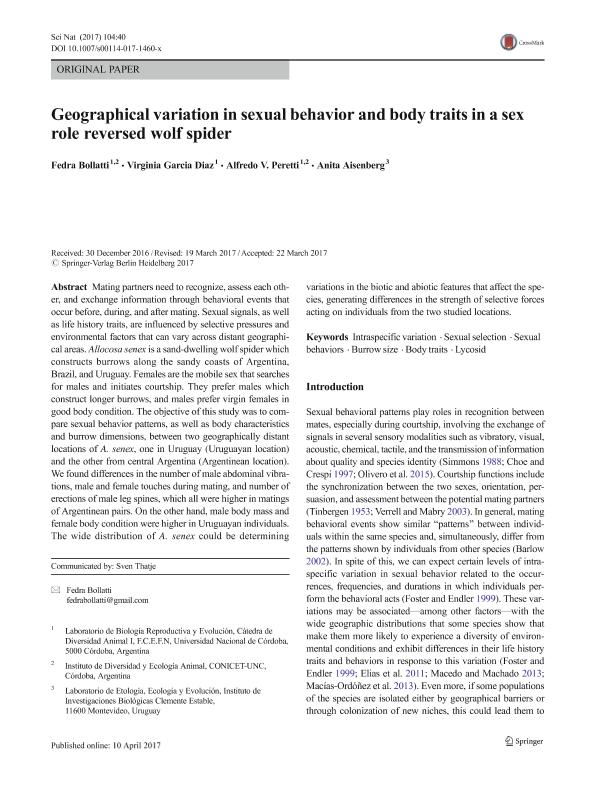
Mating partners need to recognize, assess each other, and exchange information through behavioral events that occur before, during, and after mating. Sexual signals, as well as life history traits, are influenced by selective pressures and environmental factors that can vary across distant geographical areas. Allocosa senex is a sand-dwelling wolf spider which constructs burrows along the sandy coasts of Argentina, Brazil, and Uruguay. Females are the mobile sex that searches for males and initiates courtship. They prefer males which construct longer burrows, and males prefer virgin females in good body condition. The objective of this study was to compare sexual behavior patterns, as well as body characteristics and burrow dimensions, between two geographically distant locations of A. senex, one in Uruguay (Uruguayan location) and the other from central Argentina (Argentinean location). We found differences in the number of male abdominal vibrations, male and female touches during mating, and number of erections of male leg spines, which all were higher in matings of Argentinean pairs. On the other hand, male body mass and female body condition were higher in Uruguayan individuals. The wide distribution of A. senex could be determining variations in the biotic and abiotic features that affect the species, generating differences in the strength of selective forces acting on individuals from the two studied locations.
Archivos asociados

Tamaño:
1.135Mb
Formato:
PDF
Licencia
 Excepto donde se diga explícitamente, este item se publica bajo la siguiente descripción:
Creative Commons Attribution-NonCommercial-ShareAlike 2.5 Unported (CC BY-NC-SA 2.5)
Excepto donde se diga explícitamente, este item se publica bajo la siguiente descripción:
Creative Commons Attribution-NonCommercial-ShareAlike 2.5 Unported (CC BY-NC-SA 2.5)
Identificadores
Colecciones
Articulos(IDEA)
Articulos de INSTITUTO DE DIVERSIDAD Y ECOLOGIA ANIMAL
Articulos de INSTITUTO DE DIVERSIDAD Y ECOLOGIA ANIMAL
Citación
Bollatti, Fedra Ariana; Garcia Diaz, Virginia; Peretti, Alfredo Vicente; Aisenberg Olivera, Anita Diana; Geographical variation in sexual behavior and body traits in a sex role reversed wolf spider; Springer Berlin Heidelberg; Naturwissenschaften; 104; 5-6; 6-2017
Compartir


Altmétricas