Artículo
Mass extinctions drove increased global faunal cosmopolitanism on the supercontinent Pangaea

Fecha de publicación:
12/2017
Editorial:
Nature Publishing Group
Revista:
Nature Communications
ISSN:
2041-1723
Idioma:
Inglés
Tipo de recurso:
Artículo publicado
Clasificación temática:
Resumen
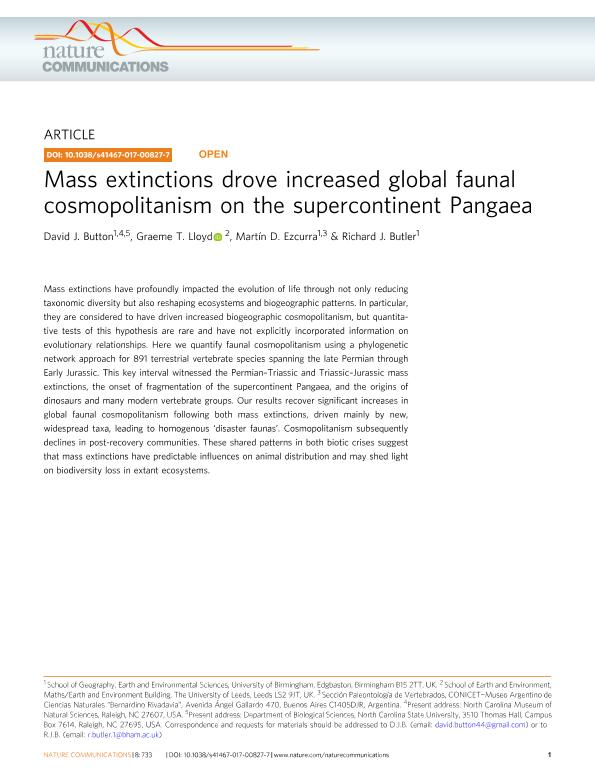
Mass extinctions have profoundly impacted the evolution of life through not only reducing taxonomic diversity but also reshaping ecosystems and biogeographic patterns. In particular, they are considered to have driven increased biogeographic cosmopolitanism, but quantitative tests of this hypothesis are rare and have not explicitly incorporated information on evolutionary relationships. Here we quantify faunal cosmopolitanism using a phylogenetic network approach for 891 terrestrial vertebrate species spanning the late Permian through Early Jurassic. This key interval witnessed the Permian-Triassic and Triassic-Jurassic mass extinctions, the onset of fragmentation of the supercontinent Pangaea, and the origins of dinosaurs and many modern vertebrate groups. Our results recover significant increases in global faunal cosmopolitanism following both mass extinctions, driven mainly by new, widespread taxa, leading to homogenous 'disaster faunas'. Cosmopolitanism subsequently declines in post-recovery communities. These shared patterns in both biotic crises suggest that mass extinctions have predictable influences on animal distribution and may shed light on biodiversity loss in extant ecosystems.
Palabras clave:
Amniota
,
Permian
,
Triassic
,
Biogeography
Archivos asociados

Tamaño:
1.017Mb
Formato:
PDF
Licencia
 Excepto donde se diga explícitamente, este item se publica bajo la siguiente descripción:
Creative Commons Attribution-NonCommercial-ShareAlike 2.5 Unported (CC BY-NC-SA 2.5)
Excepto donde se diga explícitamente, este item se publica bajo la siguiente descripción:
Creative Commons Attribution-NonCommercial-ShareAlike 2.5 Unported (CC BY-NC-SA 2.5)
Identificadores
Colecciones
Articulos(MACNBR)
Articulos de MUSEO ARG.DE CS.NAT "BERNARDINO RIVADAVIA"
Articulos de MUSEO ARG.DE CS.NAT "BERNARDINO RIVADAVIA"
Citación
Button, David J.; Lloyd, Graeme T.; Ezcurra, Martin Daniel; Butler, Richard J.; Mass extinctions drove increased global faunal cosmopolitanism on the supercontinent Pangaea; Nature Publishing Group; Nature Communications; 8; 1; 12-2017; 1-8
Compartir


Altmétricas