Artículo
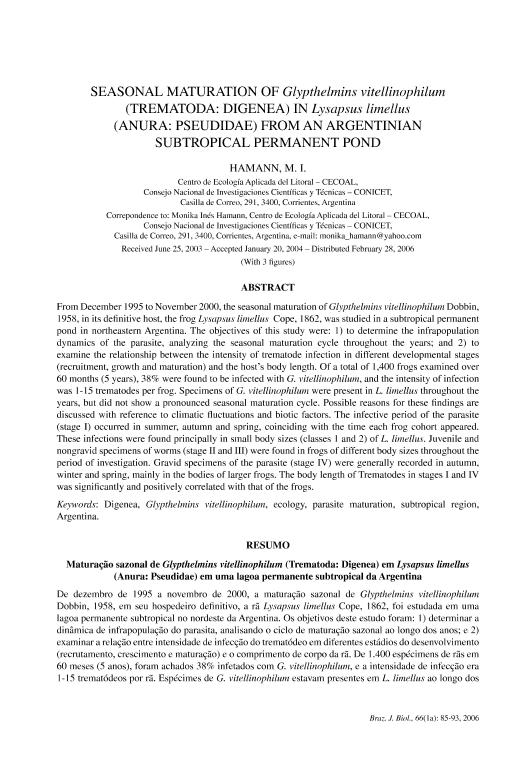
From December 1995 to November 2000, the seasonal maturation of Glypthelmins vitellinophilum Dobbin, 1958, in its definitive host, the frog Lysapsus limellus Cope, 1862, was studied in a subtropical permanent pond in northeastern Argentina. The objectives of this study were: 1) to determine the infrapopulation dynamics of the parasite, analyzing the seasonal maturation cycle throughout the years; and 2) to examine the relationship between the intensity of trematode infection in different developmental stages (recruitment, growth and maturation) and the host's body length. Of a total of 1,400 frogs examined over 60 months (5 years), 38% were found to be infected with G. vitellinophilum, and the intensity of infection was 1-15 trematodes per frog. Specimens of G. vitellinophilum were present in L. limellus throughout the years, but did not show a pronounced seasonal maturation cycle. Possible reasons for these findings are discussed with reference to climatic fluctuations and biotic factors. The infective period of the parasite (stage I) occurred in summer, autumn and spring, coinciding with the time each frog cohort appeared. These infections were found principally in small body sizes (classes 1 and 2) of L. limellus. Juvenile and nongravid specimens of worms (stage II and III) were found in frogs of different body sizes throughout the period of investigation. Gravid specimens of the parasite (stage IV) were generally recorded in autumn, winter and spring, mainly in the bodies of larger frogs. The body length of Trematodes in stages I and IV was significantly and positively correlated with that of the frogs. De dezembro de 1995 a novembro de 2000, a maturação sazonal de Glypthelmins vitellinophilum Dobbin, 1958, em seu hospedeiro definitivo, a rã Lysapsus limellus Cope, 1862, foi estudada em uma lagoa permanente subtropical no nordeste da Argentina. Os objetivos deste estudo foram: 1) determinar a dinâmica de infrapopulação do parasita, analisando o ciclo de maturação sazonal ao longo dos anos; e 2) examinar a relação entre intensidade de infecção do trematódeo em diferentes estádios do desenvolvimento (recrutamento, crescimento e maturação) e o comprimento de corpo da rã. De 1.400 espécimens de rãs em 60 meses (5 anos), foram achados 38% infetados com G. vitellinophilum, e a intensidade de infecção era 1-15 trematódeos por rã. Espécimes de G. vitellinophilum estavam presentes em L. limellus ao longo dos anos, mas não mostraram um ciclo sazonal pronunciado de maturação. São discutidas possíveis razões para estes resultados com referência a flutuações climáticas e fatores bióticos. O período infectante do parasita (estádio I) aconteceu no verão, outono e primavera, coincidentemente com o tempo de aparecimento de cada corte das rãs. Estas infecções eram principalmente registradas em tamanhos de corpo pequenos (classes 1 e 2) de L. limellus. Espécimes de parasitas juvenis e não grávidas (estádios II e III) eram encontradas em diferentes tamanhos de rãs ao longo do período de investigação. Espécimes de parasitas grávidas (estádio IV) eram geralmente registradas no outono, inverno e primavera, principalmente nos tamanhos de corpo maiores de rãs. O comprimento de corpo do trematódeo dos estádios I e IV eram significativa e positivamente correlatos com o comprimento de corpo da rã.
Seasonal maturation of Glypthelmins vitellinophilum (Trematoda: Digenea) in Lysapsus limellus (Anura: Pseudidae) from an argentinean subtropical permanent pond
Título:
Maturação sazonal de Glypthelmins vitellinophilum (Trematoda: Digenea) em Lysapsus limellus (Anura: Pseudidae) em uma lagoa permanente subtropical da Argentina

Fecha de publicación:
12/2006
Editorial:
Instituto Internacional de Ecología
Revista:
Brazilian Journal of Biology
ISSN:
1519-6984
e-ISSN:
1678-4375
Idioma:
Inglés
Tipo de recurso:
Artículo publicado
Clasificación temática:
Resumen
Archivos asociados

Tamaño:
726.0Kb
Formato:
PDF
Licencia
 Excepto donde se diga explícitamente, este item se publica bajo la siguiente descripción:
Creative Commons Attribution-NonCommercial-ShareAlike 2.5 Unported (CC BY-NC-SA 2.5)
Excepto donde se diga explícitamente, este item se publica bajo la siguiente descripción:
Creative Commons Attribution-NonCommercial-ShareAlike 2.5 Unported (CC BY-NC-SA 2.5)
Identificadores
Colecciones
Articulos(CECOAL)
Articulos de CENTRO DE ECOLOGIA APLICADA DEL LITORAL (I)
Articulos de CENTRO DE ECOLOGIA APLICADA DEL LITORAL (I)
Citación
Hamann, Mónika Inés; Seasonal maturation of Glypthelmins vitellinophilum (Trematoda: Digenea) in Lysapsus limellus (Anura: Pseudidae) from an argentinean subtropical permanent pond; Instituto Internacional de Ecología; Brazilian Journal of Biology; 66; 1a; 12-2006; 85-93
Compartir


Altmétricas