Artículo
Transcranial Direct Current Stimulation Modulates Neuronal Networks in Attention Deficit Hyperactivity Disorder

Fecha de publicación:
09/2017
Editorial:
Springer
Revista:
Brain Topography
ISSN:
0896-0267
Idioma:
Inglés
Tipo de recurso:
Artículo publicado
Clasificación temática:
Resumen
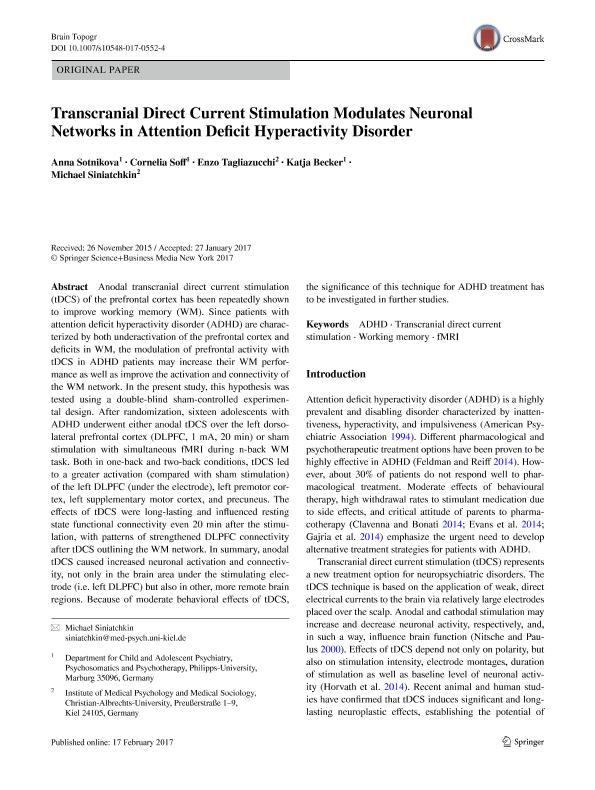
Anodal transcranial direct current stimulation (tDCS) of the prefrontal cortex has been repeatedly shown to improve working memory (WM). Since patients with attention deficit hyperactivity disorder (ADHD) are characterized by both underactivation of the prefrontal cortex and deficits in WM, the modulation of prefrontal activity with tDCS in ADHD patients may increase their WM performance as well as improve the activation and connectivity of the WM network. In the present study, this hypothesis was tested using a double-blind sham-controlled experimental design. After randomization, sixteen adolescents with ADHD underwent either anodal tDCS over the left dorsolateral prefrontal cortex (DLPFC, 1 mA, 20 min) or sham stimulation with simultaneous fMRI during n-back WM task. Both in one-back and two-back conditions, tDCS led to a greater activation (compared with sham stimulation) of the left DLPFC (under the electrode), left premotor cortex, left supplementary motor cortex, and precuneus. The effects of tDCS were long-lasting and influenced resting state functional connectivity even 20 min after the stimulation, with patterns of strengthened DLPFC connectivity after tDCS outlining the WM network. In summary, anodal tDCS caused increased neuronal activation and connectivity, not only in the brain area under the stimulating electrode (i.e. left DLPFC) but also in other, more remote brain regions. Because of moderate behavioral effects of tDCS, the significance of this technique for ADHD treatment has to be investigated in further studies.
Palabras clave:
Adhd
,
Fmri
,
Transcranial Direct Current Stimulation
,
Working Memory
Archivos asociados

Tamaño:
1.810Mb
Formato:
PDF
Licencia
 Excepto donde se diga explícitamente, este item se publica bajo la siguiente descripción:
Creative Commons Attribution-NonCommercial-ShareAlike 2.5 Unported (CC BY-NC-SA 2.5)
Excepto donde se diga explícitamente, este item se publica bajo la siguiente descripción:
Creative Commons Attribution-NonCommercial-ShareAlike 2.5 Unported (CC BY-NC-SA 2.5)
Identificadores
Colecciones
Articulos(IFIBA)
Articulos de INST.DE FISICA DE BUENOS AIRES
Articulos de INST.DE FISICA DE BUENOS AIRES
Citación
Sotnikova, Anna; Soff, Cornelia; Tagliazucchi, Enzo Rodolfo; Becker, Katja; Siniatchkin, Michael; Transcranial Direct Current Stimulation Modulates Neuronal Networks in Attention Deficit Hyperactivity Disorder; Springer; Brain Topography; 30; 5; 9-2017; 656-672
Compartir


Altmétricas