Artículo
Promotion of Neutrophil Apoptosis by TNF- α
Salamone, Gabriela Veronica ; Giordano, Mirta Nilda
; Trevani, Analía Silvina
; Gamberale, Romina
; Vermeulen, Elba Monica
; Schettinni, J.; Geffner, Jorge Raúl
; Giordano, Mirta Nilda
; Trevani, Analía Silvina
; Gamberale, Romina
; Vermeulen, Elba Monica
; Schettinni, J.; Geffner, Jorge Raúl
; Giordano, Mirta Nilda
; Trevani, Analía Silvina
; Gamberale, Romina
; Vermeulen, Elba Monica
; Schettinni, J.; Geffner, Jorge Raúl
Fecha de publicación:
03/2001
Editorial:
American Association of Immunologists
Revista:
Journal of Immunology
ISSN:
0022-1767
Idioma:
Inglés
Tipo de recurso:
Artículo publicado
Clasificación temática:
Resumen
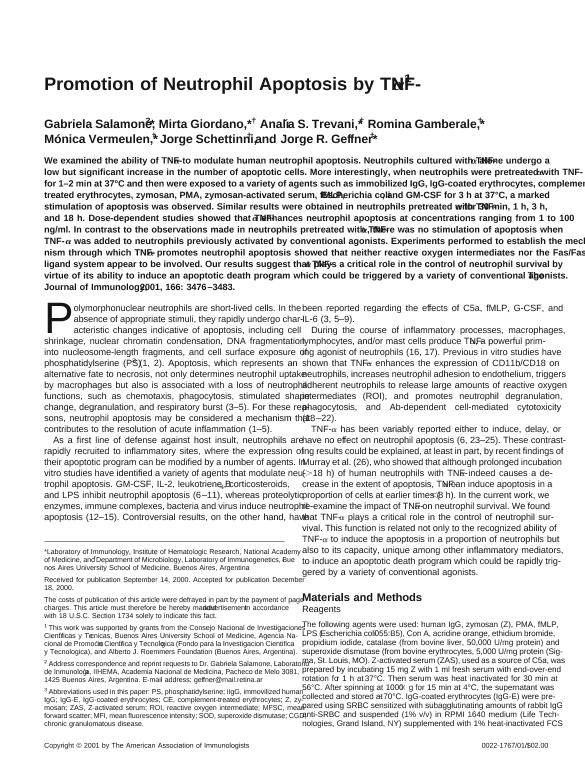
We examined the ability of TNF-α to modulate human neutrophil apoptosis. Neutrophils cultured with TNF-α alone undergo a low but significant increase in the number of apoptotic cells. More interestingly, when neutrophils were pretreated with TNF-α for 1–2 min at 37°C and then were exposed to a variety of agents such as immobilized IgG, IgG-coated erythrocytes, complement-treated erythrocytes, zymosan, PMA, zymosan-activated serum, fMLP, Escherichia coli, and GM-CSF for 3 h at 37°C, a marked stimulation of apoptosis was observed. Similar results were obtained in neutrophils pretreated with TNF-α for 30 min, 1 h, 3 h, and 18 h. Dose-dependent studies showed that TNF-α enhances neutrophil apoptosis at concentrations ranging from 1 to 100 ng/ml. In contrast to the observations made in neutrophils pretreated with TNF-α, there was no stimulation of apoptosis when TNF-α was added to neutrophils previously activated by conventional agonists. Experiments performed to establish the mechanism through which TNF-α promotes neutrophil apoptosis showed that neither reactive oxygen intermediates nor the Fas/Fas ligand system appear to be involved. Our results suggest that TNF-α plays a critical role in the control of neutrophil survival by virtue of its ability to induce an apoptotic death program which could be triggered by a variety of conventional agonists. Polymorphonuclear neutrophils are short-lived cells. In the absence of appropriate stimuli, they rapidly undergo characteristic changes indicative of apoptosis, including cell shrinkage, nuclear chromatin condensation, DNA fragmentation into nucleosome-length fragments, and cell surface exposure of phosphatidylserine (PS)3 (1, 2). Apoptosis, which represents an alternative fate to necrosis, not only determines neutrophil uptake by macrophages but also is associated with a loss of neutrophil functions, such as chemotaxis, phagocytosis, stimulated shape change, degranulation, and respiratory burst (3, 4, 5). For these reasons, neutrophil apoptosis may be considered a mechanism that contributes to the resolution of acute inflammation (1, 2, 3, 4, 5). As a first line of defense against host insult, neutrophils are rapidly recruited to inflammatory sites, where the expression of their apoptotic program can be modified by a number of agents. In vitro studies have identified a variety of agents that modulate neutrophil apoptosis. GM-CSF, IL-2, leukotriene B4, corticosteroids, and LPS inhibit neutrophil apoptosis (6, 7, 8, 9, 10, 11), whereas proteolytic enzymes, immune complexes, bacteria and virus induce neutrophil apoptosis (12, 13, 14, 15). Controversial results, on the other hand, have been reported regarding the effects of C5a, fMLP, G-CSF, and IL-6 (3, 5, 6, 7, 8, 9). During the course of inflammatory processes, macrophages, lymphocytes, and/or mast cells produce TNF-α, a powerful priming agonist of neutrophils (16, 17). Previous in vitro studies have shown that TNF-α enhances the expression of CD11b/CD18 on neutrophils, increases neutrophil adhesion to endothelium, triggers adherent neutrophils to release large amounts of reactive oxygen intermediates (ROI), and promotes neutrophil degranulation, phagocytosis, and Ab-dependent cell-mediated cytotoxicity (18, 19, 20, 21, 22). TNF-α has been variably reported either to induce, delay, or have no effect on neutrophil apoptosis (6, 23, 24, 25). These contrasting results could be explained, at least in part, by recent findings of Murray et al. (26), who showed that although prolonged incubation (>18 h) of human neutrophils with TNF-α indeed causes a decrease in the extent of apoptosis, TNF-α can induce apoptosis in a proportion of cells at earlier times (<8 h). In the current work, we re-examine the impact of TNF-α on neutrophil survival. We found that TNF-α plays a critical role in the control of neutrophil survival. This function is related not only to the recognized ability of TNF-α to induce the apoptosis in a proportion of neutrophils but also to its capacity, unique among other inflammatory mediators, to induce an apoptotic death program which could be rapidly triggered by a variety of conventional agonists.
Archivos asociados

Tamaño:
153.4Kb
Formato:
PDF
Licencia
 Excepto donde se diga explícitamente, este item se publica bajo la siguiente descripción:
Creative Commons Attribution-NonCommercial-ShareAlike 2.5 Unported (CC BY-NC-SA 2.5)
Excepto donde se diga explícitamente, este item se publica bajo la siguiente descripción:
Creative Commons Attribution-NonCommercial-ShareAlike 2.5 Unported (CC BY-NC-SA 2.5)
Identificadores
Colecciones
Articulos(IMEX)
Articulos de INST.DE MEDICINA EXPERIMENTAL
Articulos de INST.DE MEDICINA EXPERIMENTAL
Citación
Salamone, Gabriela Veronica; Giordano, Mirta Nilda; Trevani, Analía Silvina; Gamberale, Romina; Vermeulen, Elba Monica; et al.; Promotion of Neutrophil Apoptosis by TNF- α; American Association of Immunologists; Journal of Immunology; 166; 5; 3-2001; 3476-3483
Compartir


Altmétricas