Artículo
Wolves (Canis lupus) and dogs (Canis familiaris) differ in following human gaze into distant space but respond similar to their packmates' gaze

Fecha de publicación:
08/2016
Editorial:
American Psychological Association
Revista:
Journal of Comparative Psychology
ISSN:
0735-7036
Idioma:
Inglés
Tipo de recurso:
Artículo publicado
Clasificación temática:
Resumen
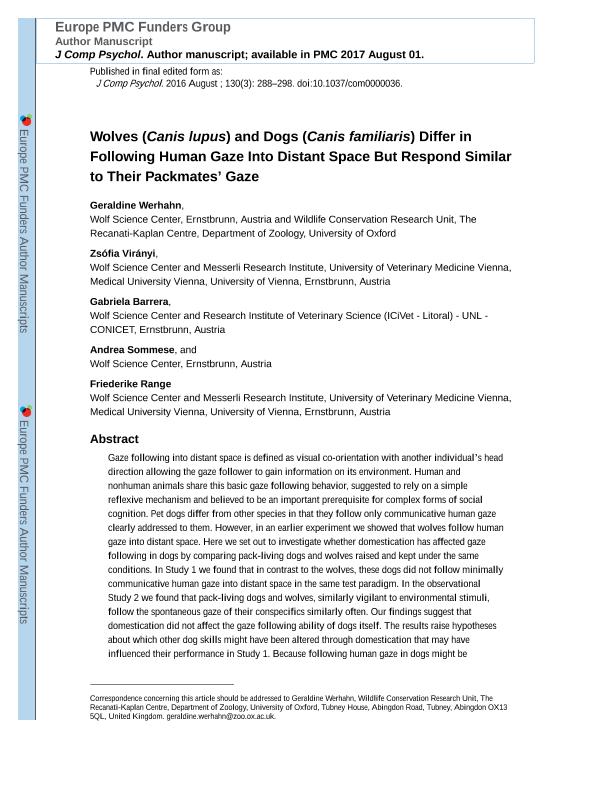
Gaze following into distant space is defined as visual co-orientation with another individual's head direction allowing the gaze follower to gain information on its environment. Human and nonhuman animals share this basic gaze following behavior, suggested to rely on a simple reflexive mechanism and believed to be an important prerequisite for complex forms of social cognition. Pet dogs differ from other species in that they follow only communicative human gaze clearly addressed to them. However, in an earlier experiment we showed that wolves follow human gaze into distant space. Here we set out to investigate whether domestication has affected gaze following in dogs by comparing pack-living dogs and wolves raised and kept under the same conditions. In Study 1 we found that in contrast to the wolves, these dogs did not follow minimally communicative human gaze into distant space in the same test paradigm. In the observational Study 2 we found that pack-living dogs and wolves, similarly vigilant to environmental stimuli, follow the spontaneous gaze of their conspecifics similarly often. Our findings suggest that domestication did not affect the gaze following ability of dogs itself. The results raise hypotheses about which other dog skills might have been altered through domestication that may have influenced their performance in Study 1. Because following human gaze in dogs might be influenced by special evolutionary as well as developmental adaptations to interactions with humans, we suggest that comparing dogs to other animal species might be more informative when done in intraspecific social contexts.
Palabras clave:
Canis Familiaris
,
Canis Lupus
,
Comparative Study
,
Distant Space
,
Gaze Following
Archivos asociados

Tamaño:
696.6Kb
Formato:
PDF
Licencia
 Excepto donde se diga explícitamente, este item se publica bajo la siguiente descripción:
Creative Commons Attribution-NonCommercial-ShareAlike 2.5 Unported (CC BY-NC-SA 2.5)
Excepto donde se diga explícitamente, este item se publica bajo la siguiente descripción:
Creative Commons Attribution-NonCommercial-ShareAlike 2.5 Unported (CC BY-NC-SA 2.5)
Identificadores
Colecciones
Articulos(ICIVET-LITORAL)
Articulos de INST. DE CIENCIAS VETERINARIAS DEL LITORAL
Articulos de INST. DE CIENCIAS VETERINARIAS DEL LITORAL
Citación
Werhahn, Geraldine; Virányi, Zsófia; Barrera, Gabriela Luciana; Sommese, Andrea; Range, Friederike; Wolves (Canis lupus) and dogs (Canis familiaris) differ in following human gaze into distant space but respond similar to their packmates' gaze; American Psychological Association; Journal of Comparative Psychology; 130; 3; 8-2016; 288-298
Compartir


Altmétricas