Artículo
The language of geometry: Fast comprehension of geometrical primitives and rules in human adults and preschoolers
Amalric, Marie; Wang, Liping; Pica, Pierre; Figueira, Santiago ; Sigman, Mariano
; Dehaene, Stanislas
; Sigman, Mariano
; Dehaene, Stanislas
; Sigman, Mariano
; Dehaene, Stanislas
Fecha de publicación:
01/2017
Editorial:
Public Library of Science
Revista:
Plos Computational Biology
e-ISSN:
1553-734X
Idioma:
Inglés
Tipo de recurso:
Artículo publicado
Clasificación temática:
Resumen
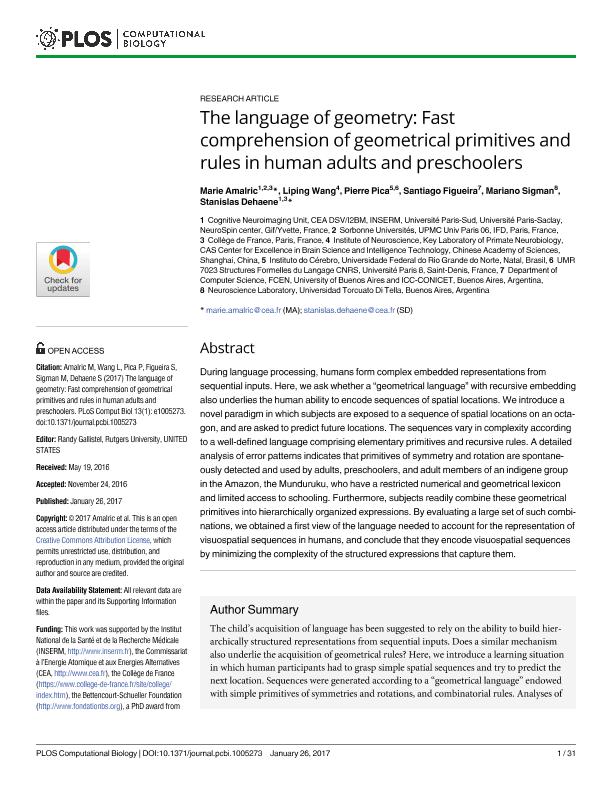
During language processing, humans form complex embedded representations from sequential inputs. Here, we ask whether a “geometrical language” with recursive embedding also underlies the human ability to encode sequences of spatial locations. We introduce a novel paradigm in which subjects are exposed to a sequence of spatial locations on an octagon, and are asked to predict future locations. The sequences vary in complexity according to a well-defined language comprising elementary primitives and recursive rules. A detailed analysis of error patterns indicates that primitives of symmetry and rotation are spontaneously detected and used by adults, preschoolers, and adult members of an indigene group in the Amazon, the Munduruku, who have a restricted numerical and geometrical lexicon and limited access to schooling. Furthermore, subjects readily combine these geometrical primitives into hierarchically organized expressions. By evaluating a large set of such combinations, we obtained a first view of the language needed to account for the representation of visuospatial sequences in humans, and conclude that they encode visuospatial sequences by minimizing the complexity of the structured expressions that capture them.
Palabras clave:
Language
Archivos asociados

Tamaño:
2.741Mb
Formato:
PDF
Licencia
 Excepto donde se diga explícitamente, este item se publica bajo la siguiente descripción:
Creative Commons Attribution-NonCommercial-ShareAlike 2.5 Unported (CC BY-NC-SA 2.5)
Excepto donde se diga explícitamente, este item se publica bajo la siguiente descripción:
Creative Commons Attribution-NonCommercial-ShareAlike 2.5 Unported (CC BY-NC-SA 2.5)
Identificadores
Colecciones
Articulos(ICC)
Articulos de INSTITUTO DE INVESTIGACION EN CIENCIAS DE LA COMPUTACION
Articulos de INSTITUTO DE INVESTIGACION EN CIENCIAS DE LA COMPUTACION
Articulos(SEDE CENTRAL)
Articulos de SEDE CENTRAL
Articulos de SEDE CENTRAL
Citación
Amalric, Marie; Wang, Liping; Pica, Pierre; Figueira, Santiago; Sigman, Mariano; et al.; The language of geometry: Fast comprehension of geometrical primitives and rules in human adults and preschoolers; Public Library of Science; Plos Computational Biology; 13; 1; 1-2017; 1-31; e1005273
Compartir


Altmétricas