Artículo
Evidence of bacillus thuringiensis intra-serovar diversity revealed by bacillus cereus group-specific repetitive extragenic palindromic sequence-based PCR genomic fingerprinting

Fecha de publicación:
01/2012
Editorial:
Karger
Revista:
Journal of Molecular Microbiology and Biotechnology
ISSN:
1464-1801
Idioma:
Inglés
Tipo de recurso:
Artículo publicado
Clasificación temática:
Resumen
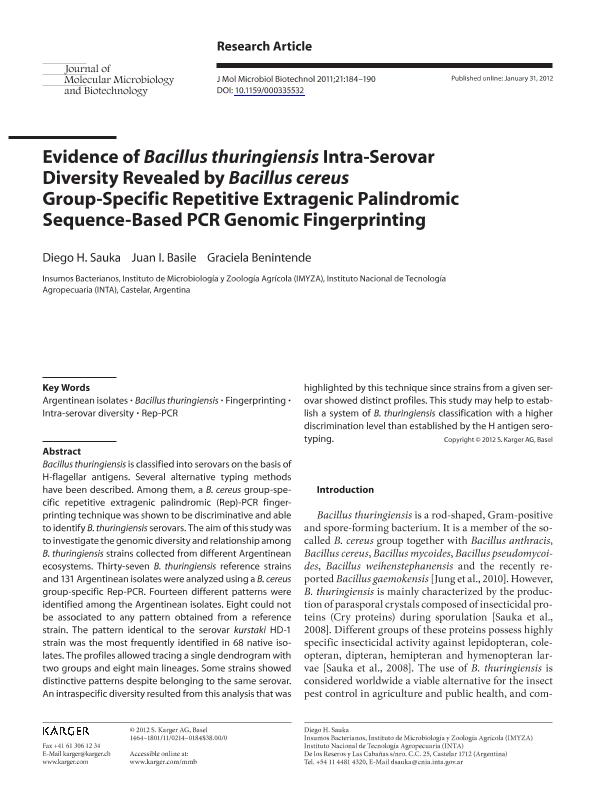
Bacillus thuringiensis is classified into serovars on the basis of H-flagellar antigens. Several alternative typing methods have been described. Among them, a B. cereus group-specific repetitive extragenic palindromic (Rep)-PCR fingerprinting technique was shown to be discriminative and able to identify B. thuringiensis serovars. The aim of this study was to investigate the genomic diversity and relationship among B. thuringiensis strains collected from different Argentinean ecosystems. Thirty-seven B. thuringiensis reference strains and 131 Argentinean isolates were analyzed using a B. cereus group-specific Rep-PCR. Fourteen different patterns were identified among the Argentinean isolates. Eight could not be associated to any pattern obtained from a reference strain. The pattern identical to the serovar kurstaki HD-1 strain was the most frequently identified in 68 native isolates. The profiles allowed tracing a single dendrogram with two groups and eight main lineages. Some strains showed distinctive patterns despite belonging to the same serovar. An intraspecific diversity resulted from this analysis that was highlighted by this technique since strains from a given serovar showed distinct profiles. This study may help to establish a system of B. thuringiensis classification with a higher discrimination level than established by the H antigen serotyping. Copyright © 2012 S. Karger AG, Basel.
Archivos asociados

Tamaño:
439.4Kb
Formato:
PDF
Licencia
 Excepto donde se diga explícitamente, este item se publica bajo la siguiente descripción:
Creative Commons Attribution-NonCommercial-ShareAlike 2.5 Unported (CC BY-NC-SA 2.5)
Excepto donde se diga explícitamente, este item se publica bajo la siguiente descripción:
Creative Commons Attribution-NonCommercial-ShareAlike 2.5 Unported (CC BY-NC-SA 2.5)
Identificadores
Colecciones
Articulos(IMEX)
Articulos de INST.DE MEDICINA EXPERIMENTAL
Articulos de INST.DE MEDICINA EXPERIMENTAL
Citación
Sauka, Diego Herman; Basile, Juan Ignacio; Benintende, Graciela Beatriz; Evidence of bacillus thuringiensis intra-serovar diversity revealed by bacillus cereus group-specific repetitive extragenic palindromic sequence-based PCR genomic fingerprinting; Karger; Journal of Molecular Microbiology and Biotechnology; 21; 3-4; 1-2012; 184-190
Compartir


Altmétricas