Artículo
Experimental and theoretical second harmonic generation and photoluminescence from the pseudo-centrosymmetric dihydrochloride salt dihydrate of trans-1,2-bis(4-pyridyl)ethene
Valdo, Ana Karoline Silva Mendanha; Da Silva, Cameron Capeletti; Maia, Lauro June Queiroz; Sarotti, Ariel Marcelo ; Martins, Felipe T.
; Martins, Felipe T.
Fecha de publicación:
01/2017
Editorial:
Royal Society of Chemistry
Revista:
CrystEngComm
ISSN:
1466-8033
Idioma:
Inglés
Tipo de recurso:
Artículo publicado
Clasificación temática:
Resumen
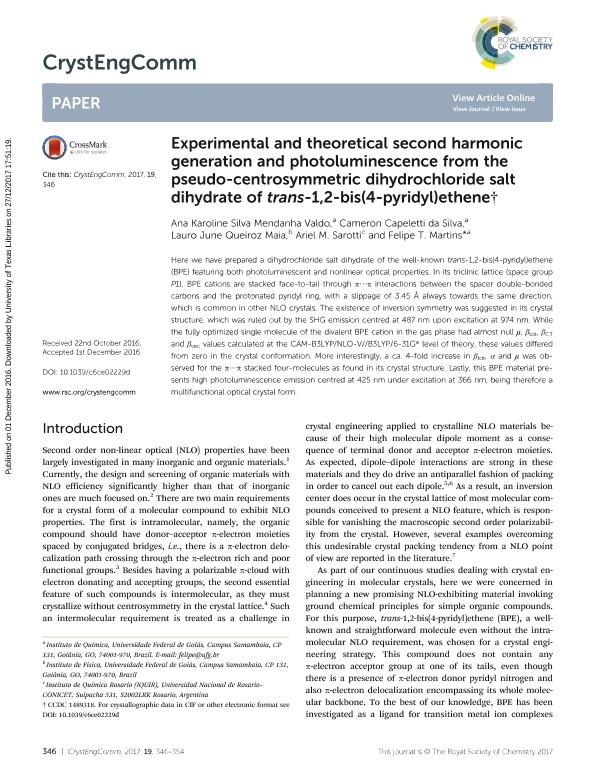
Here we have prepared a dihydrochloride salt dihydrate of the well-known trans-1,2-bis(4-pyridyl)ethene (BPE) featuring both photoluminescent and nonlinear optical properties. In its triclinic lattice (space group P1), BPE cations are stacked face-to-tail through π⋯π interactions between the spacer double-bonded carbons and the protonated pyridyl ring, with a slippage of 3.45 Å always towards the same direction, which is common in other NLO crystals. The existence of inversion symmetry was suggested in its crystal structure, which was ruled out by the SHG emission centred at 487 nm upon excitation at 974 nm. While the fully optimized single molecule of the divalent BPE cation in the gas phase had almost null μ, βtot, βCT and βvec values calculated at the CAM-B3LYP/NLO-V//B3LYP/6-31G* level of theory, these values differed from zero in the crystal conformation. More interestingly, a ca. 4-fold increase in βtot, α and μ was observed for the π⋯π stacked four-molecules as found in its crystal structure. Lastly, this BPE material presents high photoluminescence emission centred at 425 nm under excitation at 366 nm, being therefore a multifunctional optical crystal form.
Palabras clave:
Second Harmonic Generation
,
Photoluminiscence
,
Non Linear Optics
Archivos asociados

Tamaño:
2.564Mb
Formato:
PDF
Licencia
 Excepto donde se diga explícitamente, este item se publica bajo la siguiente descripción:
Creative Commons Attribution-NonCommercial-ShareAlike 2.5 Unported (CC BY-NC-SA 2.5)
Excepto donde se diga explícitamente, este item se publica bajo la siguiente descripción:
Creative Commons Attribution-NonCommercial-ShareAlike 2.5 Unported (CC BY-NC-SA 2.5)
Identificadores
Colecciones
Articulos(IQUIR)
Articulos de INST.DE QUIMICA ROSARIO
Articulos de INST.DE QUIMICA ROSARIO
Citación
Valdo, Ana Karoline Silva Mendanha; Da Silva, Cameron Capeletti; Maia, Lauro June Queiroz; Sarotti, Ariel Marcelo; Martins, Felipe T.; Experimental and theoretical second harmonic generation and photoluminescence from the pseudo-centrosymmetric dihydrochloride salt dihydrate of trans-1,2-bis(4-pyridyl)ethene; Royal Society of Chemistry; CrystEngComm; 19; 2; 1-2017; 346-354
Compartir


Altmétricas