Artículo
Crop management options for maximizing Maize Kernel hardness
Tamagno, Santiago; Greco, Ignacio A.; Almeida, Helbert; Di Paola, Juan C.; Martí Ribes, Francisco; Borras, Lucas
Fecha de publicación:
07/2016
Editorial:
American Society of Agronomy
Revista:
Agronomy Journal
ISSN:
0002-1962
Idioma:
Inglés
Tipo de recurso:
Artículo publicado
Clasificación temática:
Resumen
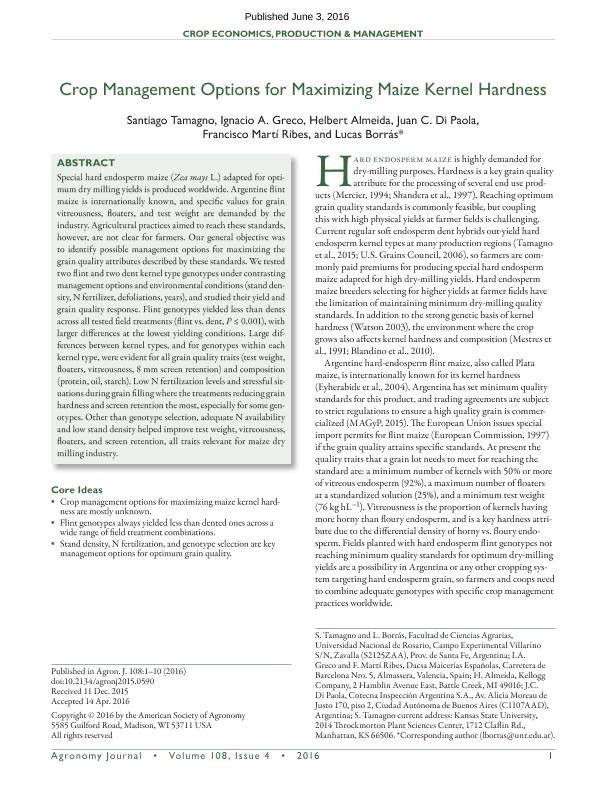
Special hard endosperm maize (Zea mays L.) adapted for optimum dry milling yields is produced worldwide. Argentine flint maize is internationally known, and specific values for grain vitreousness, floaters, and test weight are demanded by the industry. Agricultural practices aimed to reach these standards, however, are not clear for farmers. Our general objective was to identify possible management options for maximizing the grain quality attributes described by these standards. We tested two flint and two dent kernel type genotypes under contrasting management options and environmental conditions (stand density, N fertilizer, defoliations, years), and studied their yield and grain quality response. Flint genotypes yielded less than dents across all tested field treatments (flint vs. dent, P ≤ 0.001), with larger differences at the lowest yielding conditions. Large differences between kernel types, and for genotypes within each kernel type, were evident for all grain quality traits (test weight, floaters, vitreousness, 8 mm screen retention) and composition (protein, oil, starch). Low N fertilization levels and stressful situations during grain filling where the treatments reducing grain hardness and screen retention the most, especially for some genotypes. Other than genotype selection, adequate N availability and low stand density helped improve test weight, vitreousness, floaters, and screen retention, all traits relevant for maize dry milling industry.
Palabras clave:
Maize
,
Grain Quality
,
Dry Milling
,
Herdness
Archivos asociados

Tamaño:
612.8Kb
Formato:
PDF
Licencia
 Excepto donde se diga explícitamente, este item se publica bajo la siguiente descripción:
Creative Commons Attribution-NonCommercial-ShareAlike 2.5 Unported (CC BY-NC-SA 2.5)
Excepto donde se diga explícitamente, este item se publica bajo la siguiente descripción:
Creative Commons Attribution-NonCommercial-ShareAlike 2.5 Unported (CC BY-NC-SA 2.5)
Identificadores
Colecciones
Articulos(IICAR)
Articulos de INST. DE INVESTIGACIONES EN CIENCIAS AGRARIAS DE ROSARIO
Articulos de INST. DE INVESTIGACIONES EN CIENCIAS AGRARIAS DE ROSARIO
Citación
Tamagno, Santiago; Greco, Ignacio A.; Almeida, Helbert; Di Paola, Juan C.; Martí Ribes, Francisco; et al.; Crop management options for maximizing Maize Kernel hardness; American Society of Agronomy; Agronomy Journal; 108; 4; 7-2016; 1561-1570
Compartir


Altmétricas