Artículo
Cryopreservation by slow cooling of rat neuronal cells
Robert, María Celeste ; Juan de Paz, Leonardo; Graf, Daniel A.; Gazzin, Silvia; Tiribelli, Claudio; Bottai, Hebe; Rodriguez, Joaquin Valentin
; Juan de Paz, Leonardo; Graf, Daniel A.; Gazzin, Silvia; Tiribelli, Claudio; Bottai, Hebe; Rodriguez, Joaquin Valentin
Fecha de publicación:
06/2016
Editorial:
Academic Press Inc Elsevier Science
Revista:
Cryobiology
ISSN:
0011-2240
Idioma:
Inglés
Tipo de recurso:
Artículo publicado
Clasificación temática:
Resumen
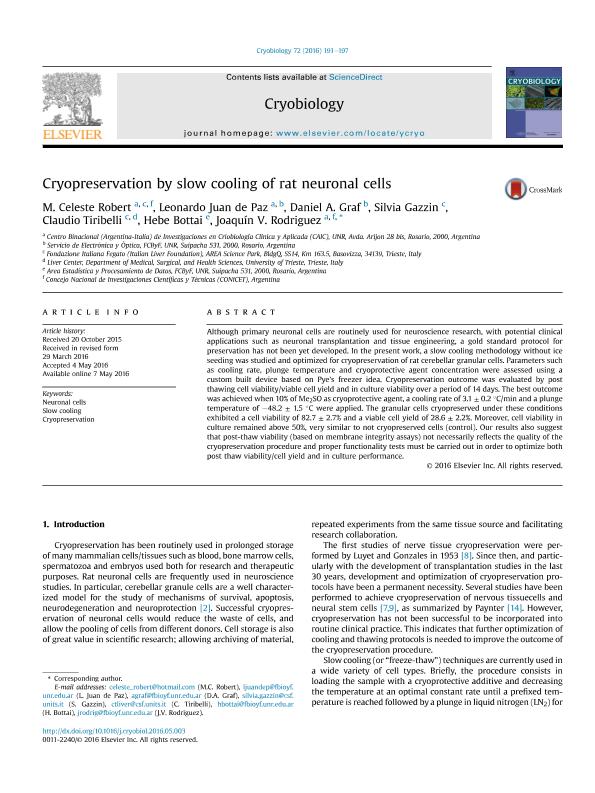
Although primary neuronal cells are routinely used for neuroscience research, with potential clinical applications such as neuronal transplantation and tissue engineering, a gold standard protocol for preservation has not been yet developed. In the present work, a slow cooling methodology without ice seeding was studied and optimized for cryopreservation of rat cerebellar granular cells. Parameters such as cooling rate, plunge temperature and cryoprotective agent concentration were assessed using a custom built device based on Pye's freezer idea. Cryopreservation outcome was evaluated by post thawing cell viability/viable cell yield and in culture viability over a period of 14 days. The best outcome was achieved when 10% of Me2SO as cryoprotective agent, a cooling rate of 3.1 ± 0.2 °C/min and a plunge temperature of -48.2 ± 1.5 °C were applied. The granular cells cryopreserved under these conditions exhibited a cell viability of 82.7 ± 2.7% and a viable cell yield of 28.6 ± 2.2%. Moreover, cell viability in culture remained above 50%, very similar to not cryopreserved cells (control). Our results also suggest that post-thaw viability (based on membrane integrity assays) not necessarily reflects the quality of the cryopreservation procedure and proper functionality tests must be carried out in order to optimize both post thaw viability/cell yield and in culture performance.
Palabras clave:
Cryopreservation
,
Neuronal Cells
,
Slow Cooling
Archivos asociados

Tamaño:
1.058Mb
Formato:
PDF
Licencia
 Excepto donde se diga explícitamente, este item se publica bajo la siguiente descripción:
Creative Commons Attribution-NonCommercial-ShareAlike 2.5 Unported (CC BY-NC-SA 2.5)
Excepto donde se diga explícitamente, este item se publica bajo la siguiente descripción:
Creative Commons Attribution-NonCommercial-ShareAlike 2.5 Unported (CC BY-NC-SA 2.5)
Identificadores
Colecciones
Articulos(CCT - ROSARIO)
Articulos de CTRO.CIENTIFICO TECNOL.CONICET - ROSARIO
Articulos de CTRO.CIENTIFICO TECNOL.CONICET - ROSARIO
Citación
Robert, María Celeste; Juan de Paz, Leonardo; Graf, Daniel A.; Gazzin, Silvia; Tiribelli, Claudio; et al.; Cryopreservation by slow cooling of rat neuronal cells; Academic Press Inc Elsevier Science; Cryobiology; 72; 3; 6-2016; 191-197
Compartir


Altmétricas