Artículo
Nomenclature of the hydrotalcite supergroup: Natural layered double hydroxides

Fecha de publicación:
10/2012
Editorial:
Mineralogical Soc
Revista:
Mineralogical Magazine
ISSN:
0026-461X
Idioma:
Inglés
Tipo de recurso:
Artículo publicado
Clasificación temática:
Resumen
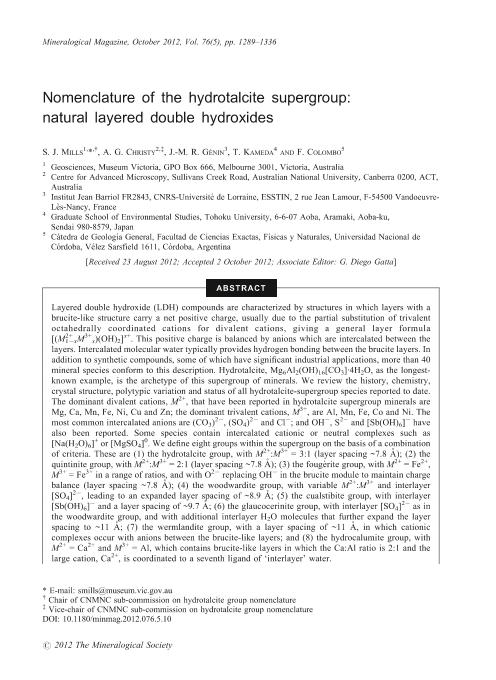
Layered double hydroxide (LDH) compounds are characterized by structures in which layers with a brucite-like structure carry a net positive charge, usually due to the partial substitution of trivalent octahedrally coordinated cations for divalent cations, giving a general layer formula [( M 2+ 1-x M 3+ x )(OH)2] x +. This positive charge is balanced by anions which are intercalated between the layers. Intercalated molecular water typically provides hydrogen bonding between the brucite layers. In addition to synthetic compounds, some of which have significant industrial applications, more than 40 mineral species conform to this description. Hydrotalcite, Mg6Al2(OH) 16[CO3]•4H2O, as the longest-known example, is the archetype of this supergroup of minerals. We review the history, chemistry, crystal structure, polytypic variation and status of all hydrotalcite-supergroup species reported to date. The dominant divalent cations, M 2+, that have been reported in hydrotalcite supergroup minerals are Mg, Ca, Mn, Fe, Ni, Cu and Zn; the dominant trivalent cations, M 3+, are Al, Mn, Fe, Co and Ni. The most common intercalated anions are (CO3)2-, (SO4)2- and Cl -; and OH-, S2- and [Sb(OH)6] - have also been reported. Some species contain intercalated cationic or neutral complexes such as [Na(H2O)6]+ or [MgSO4]0. We define eight groups within the supergroup on the basis of a combination of criteria. These are (1) the hydrotalcite group, with M 2+:M 3+ = 3:1 (layer spacing ∼7.8 Å); (2) the quintinite group, with M 2+:M 3+ = 2:1 (layer spacing ∼7.8 Å); (3) the fougèrite group, with M 2+ = Fe2+, M 3+ = Fe3+ in a range of ratios, and with O2- replacing OH- in the brucite module to maintain charge balance (layer spacing ∼7.8 Å); (4) the woodwardite group, with variable M 2+:M 3+ and interlayer [SO4] 2-, leading to an expanded layer spacing of ∼8.9 Å; (5) the cualstibite group, with interlayer [Sb(OH)6]- and a layer spacing of ∼9.7 Å; (6) the glaucocerinite group, with interlayer [SO4]2- as in the woodwardite group, and with additional interlayer H2O molecules that further expand the layer spacing to ∼11 Å; (7) the wermlandite group, with a layer spacing of ∼11 Å, in which cationic complexes occur with anions between the brucite-like layers; and (8) the hydrocalumite group, with M 2+ = Ca2+ and M 3+ = Al, which contains brucite-like layers in which the Ca:Al ratio is 2:1 and the large cation, Ca2+, is coordinated to a seventh ligand of 'interlayer' water. The principal mineral status changes are as follows. (1) The names manasseite, sjögrenite and barbertonite are discredited; these minerals are the 2H polytypes of hydrotalcite, pyroaurite and stichtite, respectively. Cyanophyllite is discredited as it is the 1M polytype of cualstibite. (2) The mineral formerly described as fougèrite has been found to be an intimate intergrowth of two phases with distinct Fe 2+:Fe3+ ratios. The phase with Fe2+:Fe 3+ = 2:1 retains the name fougèrite; that with Fe 2+:Fe3+ = 1:2 is defined as the new species trébeurdenite. (3) The new minerals omsite (IMA2012-025), Ni 2Fe3+(OH)6[Sb(OH)6], and mössbauerite (IMA2012-049), Fe3+ 6O 4(OH)8[CO3]•3H2O, which are both in the hydrotalcite supergroup are included in the discussion. (4) Jamborite, carrboydite, zincaluminite, motukoreaite, natroglaucocerinite, brugnatellite and muskoxite are identified as questionable species which need further investigation in order to verify their structure and composition. (5) The ranges of compositions currently ascribed to motukoreaite and muskoxite may each represent more than one species. The same applies to the approved species hydrowoodwardite and hydrocalumite. (6) Several unnamed minerals have been reported which are likely to represent additional species within the supergroup. This report has been approved by the Commission on New Minerals, Nomenclature and Classification (CNMNC) of the International Mineralogical Association, voting proposal 12-B. We also propose a compact notation for identifying synthetic LDH phases, for use by chemists as a preferred alternative to the current widespread misuse of mineral names. © 2012 Mineralogical Society.
Archivos asociados

Tamaño:
4.903Mb
Formato:
PDF
Licencia
 Excepto donde se diga explícitamente, este item se publica bajo la siguiente descripción:
Creative Commons Attribution-NonCommercial-ShareAlike 2.5 Unported (CC BY-NC-SA 2.5)
Excepto donde se diga explícitamente, este item se publica bajo la siguiente descripción:
Creative Commons Attribution-NonCommercial-ShareAlike 2.5 Unported (CC BY-NC-SA 2.5)
Identificadores
Colecciones
Articulos(CICTERRA)
Articulos de CENTRO DE INVEST.EN CS.DE LA TIERRA
Articulos de CENTRO DE INVEST.EN CS.DE LA TIERRA
Citación
Mills, S.J.; Christy, A.G.; Génin, J. M. R.; Kameda, T.; Colombo, Fernando; Nomenclature of the hydrotalcite supergroup: Natural layered double hydroxides; Mineralogical Soc; Mineralogical Magazine; 76; 5; 10-2012; 1289-1336
Compartir


Altmétricas