Artículo
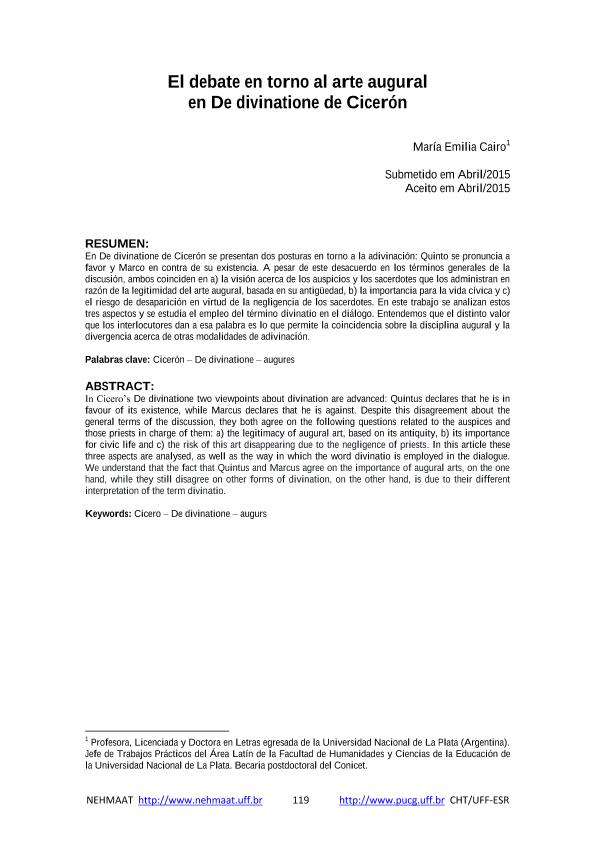
En De divinatione de Cicerón se presentan dos posturas en torno a la adivinación: Quinto se pronuncia a favor y Marco en contra de su existencia. A pesar de este desacuerdo en los términos generales de la discusión, ambos coinciden en a) la visión acerca de los auspicios y los sacerdotes que los administran en razón de la legitimidad del arte augural, basada en su antigüedad, b) la importancia para la vida cívica y c) el riesgo de desaparición en virtud de la negligencia de los sacerdotes. En este trabajo se analizan estos tres aspectos y se estudia el empleo del término divinatio en el diálogo. Entendemos que el distinto valor que los interlocutores dan a esa palabra es lo que permite la coincidencia sobre la disciplina augural y la divergencia acerca de otras modalidades de adivinación. In Cicero‘s De divinatione two viewpoints about divination are advanced: Quintus declares that he is in favour of its existence, while Marcus declares that he is against. Despite this disagreement about the general terms of the discussion, they both agree on the following questions related to the auspices and those priests in charge of them: a) the legitimacy of augural art, based on its antiquity, b) its importance for civic life and c) the risk of this art disappearing due to the negligence of priests. In this article these three aspects are analysed, as well as the way in which the word divinatio is employed in the dialogue. We understand that the fact that Quintus and Marcus agree on the importance of augural arts, on the one
hand, while they still disagree on other forms of divination, on the other hand, is due to their different interpretation of the term divinatio.
El debate en torno al arte augural en De divinatione de Cicerón

Fecha de publicación:
07/2015
Editorial:
Universidade Federal Fluminense. Núcleo de Estudos em História Medieval, Antiga e Arqueologia Transdisiciplinar
Revista:
Revista Mundo Antigo
ISSN:
2238-8788
Idioma:
Español
Tipo de recurso:
Artículo publicado
Clasificación temática:
Resumen
Palabras clave:
Cicerón
,
De Divinatione
,
Augures
Archivos asociados

Tamaño:
604.1Kb
Formato:
PDF
Licencia
 Excepto donde se diga explícitamente, este item se publica bajo la siguiente descripción:
Atribución-NoComercial-SinDerivadas 2.5 Argentina (CC BY-NC-ND 2.5 AR)
Excepto donde se diga explícitamente, este item se publica bajo la siguiente descripción:
Atribución-NoComercial-SinDerivadas 2.5 Argentina (CC BY-NC-ND 2.5 AR)
Identificadores
Colecciones
Articulos(IDIHCS)
Articulos de INST.DE INVEST.EN HUMANIDADES Y CS SOCIALES
Articulos de INST.DE INVEST.EN HUMANIDADES Y CS SOCIALES
Citación
Cairo, María Emilia; El debate en torno al arte augural en De divinatione de Cicerón; Universidade Federal Fluminense. Núcleo de Estudos em História Medieval, Antiga e Arqueologia Transdisiciplinar; Revista Mundo Antigo; IV; 7; 7-2015; 119-140
Compartir

