Mostrar el registro sencillo del ítem
dc.contributor.author
Zacchino, Susana Alicia Stella
dc.contributor.author
Butassi, Estefanía
dc.contributor.author
Cordisco, Estefanía
dc.contributor.author
Svetaz, Laura Andrea
dc.date.available
2018-06-28T17:03:46Z
dc.date.issued
2017-12
dc.identifier.citation
Zacchino, Susana Alicia Stella; Butassi, Estefanía; Cordisco, Estefanía; Svetaz, Laura Andrea; Hybrid combinations containing natural products and antimicrobial drugs that interfere with bacterial and fungal biofilms; Elsevier Gmbh; Phytomedicine; 37; 12-2017; 14-26
dc.identifier.issn
0944-7113
dc.identifier.uri
http://hdl.handle.net/11336/50379
dc.description.abstract
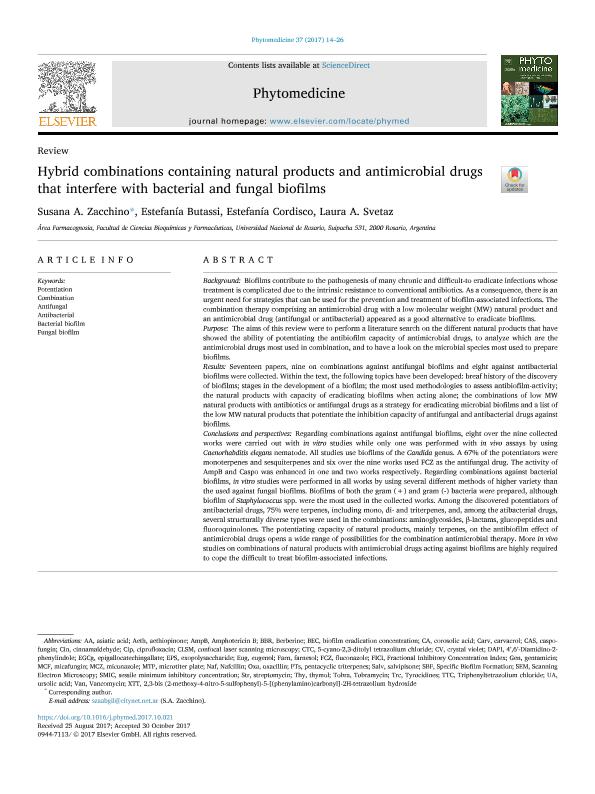
Background: Biofilms contribute to the pathogenesis of many chronic and difficult-to eradicate infections whose treatment is complicated due to the intrinsic resistance to conventional antibiotics. As a consequence, there is an urgent need for strategies that can be used for the prevention and treatment of biofilm-associated infections. The combination therapy comprising an antimicrobial drug with a low molecular weight (MW) natural product and an antimicrobial drug (antifungal or antibacterial) appeared as a good alternative to eradicate biofilms. Purpose: The aims of this review were to perform a literature search on the different natural products that have showed the ability of potentiating the antibiofilm capacity of antimicrobial drugs, to analyze which are the antimicrobial drugs most used in combination, and to have a look on the microbial species most used to prepare biofilms. Results: Seventeen papers, nine on combinations against antifungal biofilms and eight against antibacterial biofilms were collected. Within the text, the following topics have been developed: breaf history of the discovery of biofilms; stages in the development of a biofilm; the most used methodologies to assess antibiofilm-activity; the natural products with capacity of eradicating biofilms when acting alone; the combinations of low MW natural products with antibiotics or antifungal drugs as a strategy for eradicating microbial biofilms and a list of the low MW natural products that potentiate the inhibition capacity of antifungal and antibacterial drugs against biofilms. Conclusions and perspectives: Regarding combinations against antifungal biofilms, eight over the nine collected works were carried out with in vitro studies while only one was performed with in vivo assays by using Caenorhabditis elegans nematode. All studies use biofilms of the Candida genus. A 67% of the potentiators were monoterpenes and sesquiterpenes and six over the nine works used FCZ as the antifungal drug. The activity of AmpB and Caspo was enhanced in one and two works respectively. Regarding combinations against bacterial biofilms, in vitro studies were performed in all works by using several different methods of higher variety than the used against fungal biofilms. Biofilms of both the gram (+) and gram (-) bacteria were prepared, although biofilm of Staphylococcus spp. were the most used in the collected works. Among the discovered potentiators of antibacterial drugs, 75% were terpenes, including mono, di- and triterpenes, and, among the atibacterial drugs, several structurally diverse types were used in the combinations: aminoglycosides, β-lactams, glucopeptides and fluoroquinolones. The potentiating capacity of natural products, mainly terpenes, on the antibiofilm effect of antimicrobial drugs opens a wide range of possibilities for the combination antimicrobial therapy. More in vivo studies on combinations of natural products with antimicrobial drugs acting against biofilms are highly required to cope the difficult to treat biofilm-associated infections.
dc.format
application/pdf
dc.language.iso
eng
dc.publisher
Elsevier Gmbh
dc.rights
info:eu-repo/semantics/openAccess
dc.rights.uri
https://creativecommons.org/licenses/by-nc-nd/2.5/ar/
dc.subject
Antibacterial
dc.subject
Antifungal
dc.subject
Bacterial Biofilm
dc.subject
Combination
dc.subject
Fungal Biofilm
dc.subject
Potentiation
dc.subject.classification
Otras Ciencias Químicas
dc.subject.classification
Ciencias Químicas
dc.subject.classification
CIENCIAS NATURALES Y EXACTAS
dc.title
Hybrid combinations containing natural products and antimicrobial drugs that interfere with bacterial and fungal biofilms
dc.type
info:eu-repo/semantics/article
dc.type
info:ar-repo/semantics/artículo
dc.type
info:eu-repo/semantics/publishedVersion
dc.date.updated
2018-06-28T14:14:16Z
dc.journal.volume
37
dc.journal.pagination
14-26
dc.journal.pais
Alemania
dc.description.fil
Fil: Zacchino, Susana Alicia Stella. Universidad Nacional de Rosario. Facultad de Ciencias Bioquímicas y Farmacéuticas; Argentina
dc.description.fil
Fil: Butassi, Estefanía. Universidad Nacional de Rosario. Facultad de Ciencias Bioquímicas y Farmacéuticas; Argentina. Consejo Nacional de Investigaciones Científicas y Técnicas; Argentina
dc.description.fil
Fil: Cordisco, Estefanía. Universidad Nacional de Rosario. Facultad de Ciencias Bioquímicas y Farmacéuticas; Argentina
dc.description.fil
Fil: Svetaz, Laura Andrea. Universidad Nacional de Rosario. Facultad de Ciencias Bioquímicas y Farmacéuticas; Argentina. Consejo Nacional de Investigaciones Científicas y Técnicas; Argentina
dc.journal.title
Phytomedicine
dc.relation.alternativeid
info:eu-repo/semantics/altIdentifier/doi/http://dx.doi.org/10.1016/j.phymed.2017.10.021
dc.relation.alternativeid
info:eu-repo/semantics/altIdentifier/url/https://www.sciencedirect.com/science/article/pii/S0944711317301599
Archivos asociados

Tamaño:
2.074Mb
Formato:
PDF