Artículo
Strain path dependence of anisotropic microstructure evolution on low Stacking Fault Energy F138 steel
de Vincentis, Natalia Soledad ; Avalos, Martina Cecilia
; Kliauga, A.; Brokmeier, H. G.; Bolmaro, Raul Eduardo
; Avalos, Martina Cecilia
; Kliauga, A.; Brokmeier, H. G.; Bolmaro, Raul Eduardo
; Avalos, Martina Cecilia
; Kliauga, A.; Brokmeier, H. G.; Bolmaro, Raul Eduardo
Fecha de publicación:
06/2017
Editorial:
Elsevier Science Sa
Revista:
Materials Science and Engineering A: Structural Materials: Properties, Microstructure and Processing
ISSN:
0921-5093
Idioma:
Inglés
Tipo de recurso:
Artículo publicado
Clasificación temática:
Resumen
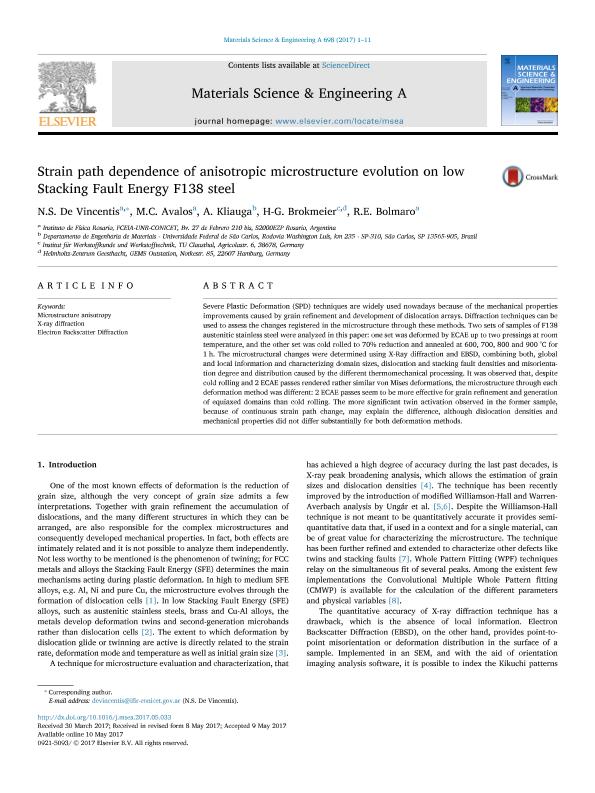
Severe Plastic Deformation (SPD) techniques are widely used nowadays because of the mechanical properties improvements caused by grain refinement and development of dislocation arrays. Diffraction techniques can be used to assess the changes registered in the microstructure through these methods. Two sets of samples of F138 austenitic stainless steel were analyzed in this paper: one set was deformed by ECAE up to two pressings at room temperature, and the other set was cold rolled to 70% reduction and annealed at 600, 700, 800 and 900 °C for 1 h. The microstructural changes were determined using X-Ray diffraction and EBSD, combining both, global and local information and characterizing domain sizes, dislocation and stacking fault densities and misorientation degree and distribution caused by the different thermomechanical processing. It was observed that, despite cold rolling and 2 ECAE passes rendered rather similar von Mises deformations, the microstructure through each deformation method was different: 2 ECAE passes seem to be more effective for grain refinement and generation of equiaxed domains than cold rolling. The more significant twin activation observed in the former sample, because of continuous strain path change, may explain the difference, although dislocation densities and mechanical properties did not differ substantially for both deformation methods.
Archivos asociados

Tamaño:
1.964Mb
Formato:
PDF
Licencia
 Excepto donde se diga explícitamente, este item se publica bajo la siguiente descripción:
Creative Commons Attribution-NonCommercial-ShareAlike 2.5 Unported (CC BY-NC-SA 2.5)
Excepto donde se diga explícitamente, este item se publica bajo la siguiente descripción:
Creative Commons Attribution-NonCommercial-ShareAlike 2.5 Unported (CC BY-NC-SA 2.5)
Identificadores
Colecciones
Articulos(IFIR)
Articulos de INST.DE FISICA DE ROSARIO (I)
Articulos de INST.DE FISICA DE ROSARIO (I)
Citación
de Vincentis, Natalia Soledad; Avalos, Martina Cecilia; Kliauga, A.; Brokmeier, H. G.; Bolmaro, Raul Eduardo; Strain path dependence of anisotropic microstructure evolution on low Stacking Fault Energy F138 steel; Elsevier Science Sa; Materials Science and Engineering A: Structural Materials: Properties, Microstructure and Processing; 698; 6-2017; 1-11
Compartir


Altmétricas