Mostrar el registro sencillo del ítem
dc.contributor.author
Dirihan, Serdar
dc.contributor.author
Helander, Marjo
dc.contributor.author
Väre, Henry
dc.contributor.author
Gundel, Pedro Emilio
dc.contributor.author
Garibaldi, Lucas Alejandro
dc.contributor.author
Irisarri, Jorge Gonzalo Nicolás
dc.contributor.author
Saloniemi, Irma
dc.contributor.author
Saikkonen, Kari
dc.date.available
2018-06-26T17:07:26Z
dc.date.issued
2016-11
dc.identifier.citation
Dirihan, Serdar; Helander, Marjo; Väre, Henry; Gundel, Pedro Emilio; Garibaldi, Lucas Alejandro; et al.; Geographic variation in festuca rubra L. ploidy levels and systemic fungal endophyte frequencies; Public Library of Science; Plos One; 11; 11; 11-2016; 1-16
dc.identifier.issn
1932-6203
dc.identifier.uri
http://hdl.handle.net/11336/50091
dc.description.abstract
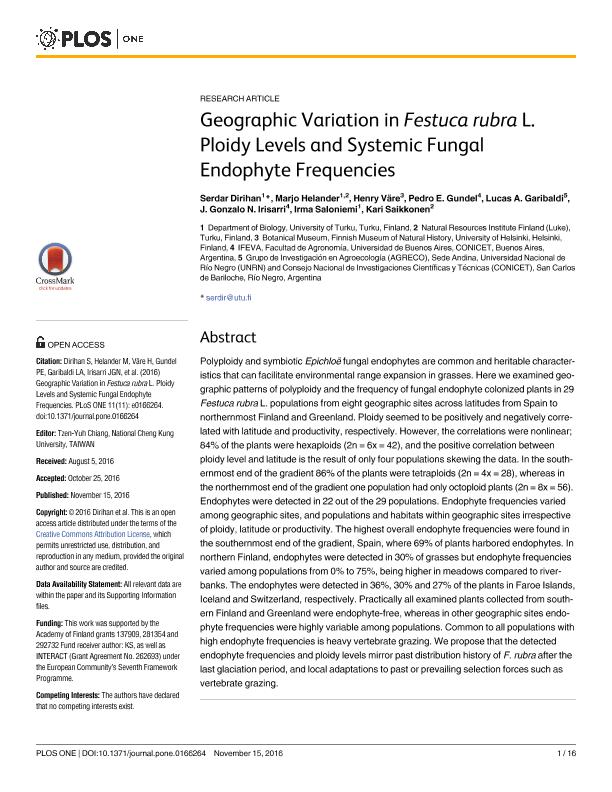
Polyploidy and symbiotic Epichloë fungal endophytes are common and heritable characteristics that can facilitate environmental range expansion in grasses. Here we examined geographic patterns of polyploidy and the frequency of fungal endophyte colonized plants in 29 Festuca rubra L. populations from eight geographic sites across latitudes from Spain to northernmost Finland and Greenland. Ploidy seemed to be positively and negatively correlated with latitude and productivity, respectively. However, the correlations were nonlinear; 84% of the plants were hexaploids (2n = 6x = 42), and the positive correlation between ploidy level and latitude is the result of only four populations skewing the data. In the southernmost end of the gradient 86% of the plants were tetraploids (2n = 4x = 28), whereas in the northernmost end of the gradient one population had only octoploid plants (2n = 8x = 56). Endophytes were detected in 22 out of the 29 populations. Endophyte frequencies varied among geographic sites, and populations and habitats within geographic sites irrespective of ploidy, latitude or productivity. The highest overall endophyte frequencies were found in the southernmost end of the gradient, Spain, where 69% of plants harbored endophytes. In northern Finland, endophytes were detected in 30% of grasses but endophyte frequencies varied among populations from 0% to 75%, being higher in meadows compared to riverbanks. The endophytes were detected in 36%, 30% and 27% of the plants in Faroe Islands, Iceland and Switzerland, respectively. Practically all examined plants collected from southern Finland and Greenland were endophyte-free, whereas in other geographic sites endophyte frequencies were highly variable among populations. Common to all populations with high endophyte frequencies is heavy vertebrate grazing. We propose that the detected endophyte frequencies and ploidy levels mirror past distribution history of F. rubra after the last glaciation period, and local adaptations to past or prevailing selection forces such as vertebrate grazing.
dc.format
application/pdf
dc.language.iso
eng
dc.publisher
Public Library of Science
dc.rights
info:eu-repo/semantics/openAccess
dc.rights.uri
https://creativecommons.org/licenses/by-nc-sa/2.5/ar/
dc.subject
Biogeography
dc.subject
Cytogeography
dc.subject
Festuca Rubra
dc.subject
Fungal Endophyte
dc.subject
Geographic Mosaics
dc.subject
Latitudinal Gradients
dc.subject
Ndvi
dc.subject
Ploidy
dc.subject
Symbiosis
dc.subject.classification
Otras Ciencias Biológicas
dc.subject.classification
Ciencias Biológicas
dc.subject.classification
CIENCIAS NATURALES Y EXACTAS
dc.subject.classification
Agricultura
dc.subject.classification
Agricultura, Silvicultura y Pesca
dc.subject.classification
CIENCIAS AGRÍCOLAS
dc.subject.classification
Otras Producción Animal y Lechería
dc.subject.classification
Producción Animal y Lechería
dc.subject.classification
CIENCIAS AGRÍCOLAS
dc.title
Geographic variation in festuca rubra L. ploidy levels and systemic fungal endophyte frequencies
dc.type
info:eu-repo/semantics/article
dc.type
info:ar-repo/semantics/artículo
dc.type
info:eu-repo/semantics/publishedVersion
dc.date.updated
2018-06-22T14:39:53Z
dc.journal.volume
11
dc.journal.number
11
dc.journal.pagination
1-16
dc.journal.pais
Estados Unidos
dc.journal.ciudad
San Francisco
dc.description.fil
Fil: Dirihan, Serdar. University of Turku; Finlandia
dc.description.fil
Fil: Helander, Marjo. University of Turku; Finlandia
dc.description.fil
Fil: Väre, Henry. University Of Helsinski; Finlandia
dc.description.fil
Fil: Gundel, Pedro Emilio. Consejo Nacional de Investigaciones Científicas y Técnicas. Oficina de Coordinación Administrativa Parque Centenario. Instituto de Investigaciones Fisiológicas y Ecológicas Vinculadas a la Agricultura. Universidad de Buenos Aires. Facultad de Agronomía. Instituto de Investigaciones Fisiológicas y Ecológicas Vinculadas a la Agricultura; Argentina
dc.description.fil
Fil: Garibaldi, Lucas Alejandro. Consejo Nacional de Investigaciones Científicas y Técnicas; Argentina. Universidad Nacional de Río Negro; Argentina
dc.description.fil
Fil: Irisarri, Jorge Gonzalo Nicolás. Consejo Nacional de Investigaciones Científicas y Técnicas. Oficina de Coordinación Administrativa Parque Centenario. Instituto de Investigaciones Fisiológicas y Ecológicas Vinculadas a la Agricultura. Universidad de Buenos Aires. Facultad de Agronomía. Instituto de Investigaciones Fisiológicas y Ecológicas Vinculadas a la Agricultura; Argentina
dc.description.fil
Fil: Saloniemi, Irma. University of Turku; Finlandia
dc.description.fil
Fil: Saikkonen, Kari. Natural Resources Institute Finland; Finlandia
dc.journal.title
Plos One
dc.relation.alternativeid
info:eu-repo/semantics/altIdentifier/doi/https://dx.doi.org/10.1371/journal.pone.0166264
dc.relation.alternativeid
info:eu-repo/semantics/altIdentifier/url/http://journals.plos.org/plosone/article?id=10.1371/journal.pone.0166264
Archivos asociados

Tamaño:
2.299Mb
Formato:
PDF