Mostrar el registro sencillo del ítem
dc.contributor.author
Zarate, Sandra Cristina
dc.contributor.author
Stevnsner, Tinna
dc.contributor.author
Gredilla, Ricardo
dc.date.available
2018-06-15T14:37:07Z
dc.date.issued
2017-12
dc.identifier.citation
Zarate, Sandra Cristina; Stevnsner, Tinna; Gredilla, Ricardo; Role of estrogen and other sex hormones in brain aging: Neuroprotection and DNA repair; Frontiers Research Foundation; Frontiers in Aging Neuroscience; 9; 12-2017; 1-22; 430
dc.identifier.issn
1663-4365
dc.identifier.uri
http://hdl.handle.net/11336/48760
dc.description.abstract
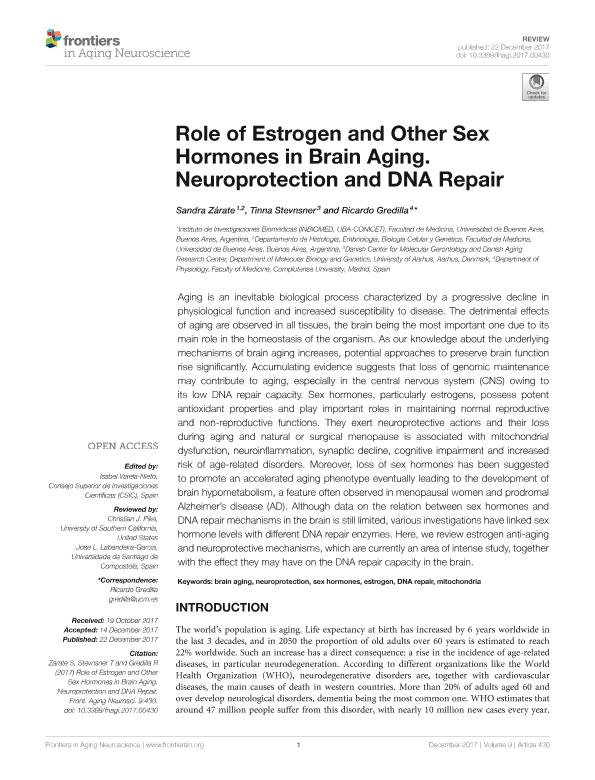
Aging is an inevitable biological process characterized by a progressive decline in physiological function and increased susceptibility to disease. The detrimental effects of aging are observed in all tissues, the brain being the most important one due to its main role in the homeostasis of the organism. As our knowledge about the underlying mechanisms of brain aging increases, potential approaches to preserve brain function rise significantly. Accumulating evidence suggests that loss of genomic maintenance may contribute to aging, especially in the central nervous system (CNS) owing to its low DNA repair capacity. Sex hormones, particularly estrogens, possess potent antioxidant properties and play important roles in maintaining normal reproductive and non-reproductive functions. They exert neuroprotective actions and their loss during aging and natural or surgical menopause is associated with mitochondrial dysfunction, neuroinflammation, synaptic decline, cognitive impairment and increased risk of age-related disorders. Moreover, loss of sex hormones has been suggested to promote an accelerated aging phenotype eventually leading to the development of brain hypometabolism, a feature often observed in menopausal women and prodromal Alzheimer's disease (AD). Although data on the relation between sex hormones and DNA repair mechanisms in the brain is still limited, various investigations have linked sex hormone levels with different DNA repair enzymes. Here, we review estrogen anti-aging and neuroprotective mechanisms, which are currently an area of intense study, together with the effect they may have on the DNA repair capacity in the brain.
dc.format
application/pdf
dc.language.iso
eng
dc.publisher
Frontiers Research Foundation
dc.rights
info:eu-repo/semantics/openAccess
dc.rights.uri
https://creativecommons.org/licenses/by/2.5/ar/
dc.subject
Brain Aging
dc.subject
Dna Repair
dc.subject
Estrogen
dc.subject
Mitochondria
dc.subject
Neuroprotection
dc.subject
Sex Hormones
dc.subject.classification
Inmunología
dc.subject.classification
Medicina Básica
dc.subject.classification
CIENCIAS MÉDICAS Y DE LA SALUD
dc.title
Role of estrogen and other sex hormones in brain aging: Neuroprotection and DNA repair
dc.type
info:eu-repo/semantics/article
dc.type
info:ar-repo/semantics/artículo
dc.type
info:eu-repo/semantics/publishedVersion
dc.date.updated
2018-06-06T13:46:54Z
dc.journal.volume
9
dc.journal.pagination
1-22; 430
dc.journal.pais
Suiza
dc.journal.ciudad
Lausana
dc.description.fil
Fil: Zarate, Sandra Cristina. Consejo Nacional de Investigaciones Científicas y Técnicas. Oficina de Coordinación Administrativa Houssay. Instituto de Investigaciones Biomédicas. Universidad de Buenos Aires. Facultad de Medicina. Instituto de Investigaciones Biomédicas; Argentina
dc.description.fil
Fil: Stevnsner, Tinna. University of Aarhus; Dinamarca
dc.description.fil
Fil: Gredilla, Ricardo. Universidad Complutense de Madrid; España
dc.journal.title
Frontiers in Aging Neuroscience
dc.relation.alternativeid
info:eu-repo/semantics/altIdentifier/url/https://www.frontiersin.org/articles/10.3389/fnagi.2017.00430/full
dc.relation.alternativeid
info:eu-repo/semantics/altIdentifier/doi/http://dx.doi.org/10.3389/fnagi.2017.00430
Archivos asociados

Tamaño:
2.007Mb
Formato:
PDF