Artículo
The relationship between executive functions and fluid intelligence in euthymic Bipolar Disorder patients
Goitia, Belén ; Manes, Facundo Francisco
; Torralva, Teresa; Sigman, Mariano
; Duncan, John; Cetkovich, Marcelo; Roca, María
; Manes, Facundo Francisco
; Torralva, Teresa; Sigman, Mariano
; Duncan, John; Cetkovich, Marcelo; Roca, María
; Manes, Facundo Francisco
; Torralva, Teresa; Sigman, Mariano
; Duncan, John; Cetkovich, Marcelo; Roca, María
Fecha de publicación:
11/2017
Editorial:
Elsevier Ireland
Revista:
Psychiatry Research
ISSN:
0165-1781
Idioma:
Inglés
Tipo de recurso:
Artículo publicado
Clasificación temática:
Resumen
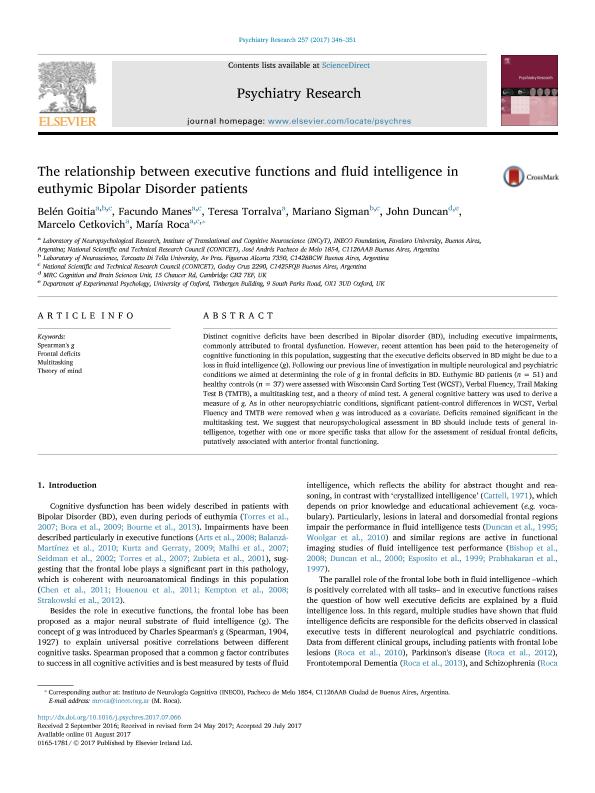
Distinct cognitive deficits have been described in Bipolar disorder (BD), including executive impairments, commonly attributed to frontal dysfunction. However, recent attention has been paid to the heterogeneity of cognitive functioning in this population, suggesting that the executive deficits observed in BD might be due to a loss in fluid intelligence (g). Following our previous line of investigation in multiple neurological and psychiatric conditions we aimed at determining the role of g in frontal deficits in BD. Euthymic BD patients (n = 51) and healthy controls (n = 37) were assessed with Wisconsin Card Sorting Test (WCST), Verbal Fluency, Trail Making Test B (TMTB), a multitasking test, and a theory of mind test. A general cognitive battery was used to derive a measure of g. As in other neuropsychiatric conditions, significant patient-control differences in WCST, Verbal Fluency and TMTB were removed when g was introduced as a covariate. Deficits remained significant in the multitasking test. We suggest that neuropsychological assessment in BD should include tests of general intelligence, together with one or more specific tasks that allow for the assessment of residual frontal deficits, putatively associated with anterior frontal functioning.
Palabras clave:
Frontal Deficits
,
Multitasking
,
Spearman'S G
,
Theory of Mind
Archivos asociados

Tamaño:
237.5Kb
Formato:
PDF
Licencia
 Excepto donde se diga explícitamente, este item se publica bajo la siguiente descripción:
Creative Commons Attribution-NonCommercial-ShareAlike 2.5 Unported (CC BY-NC-SA 2.5)
Excepto donde se diga explícitamente, este item se publica bajo la siguiente descripción:
Creative Commons Attribution-NonCommercial-ShareAlike 2.5 Unported (CC BY-NC-SA 2.5)
Identificadores
Colecciones
Articulos(OCA HOUSSAY)
Articulos de OFICINA DE COORDINACION ADMINISTRATIVA HOUSSAY
Articulos de OFICINA DE COORDINACION ADMINISTRATIVA HOUSSAY
Articulos(SEDE CENTRAL)
Articulos de SEDE CENTRAL
Articulos de SEDE CENTRAL
Citación
Goitia, Belén; Manes, Facundo Francisco; Torralva, Teresa; Sigman, Mariano; Duncan, John; et al.; The relationship between executive functions and fluid intelligence in euthymic Bipolar Disorder patients; Elsevier Ireland; Psychiatry Research; 257; 11-2017; 346-351
Compartir


Altmétricas