Artículo
Unraveling the Apparent Dimerization Tendency in Small Mo n Clusters with n = 3–10

Fecha de publicación:
09/2016
Editorial:
American Chemical Society
Revista:
Journal of Physical Chemistry C
ISSN:
1932-7447
Idioma:
Inglés
Tipo de recurso:
Artículo publicado
Clasificación temática:
Resumen
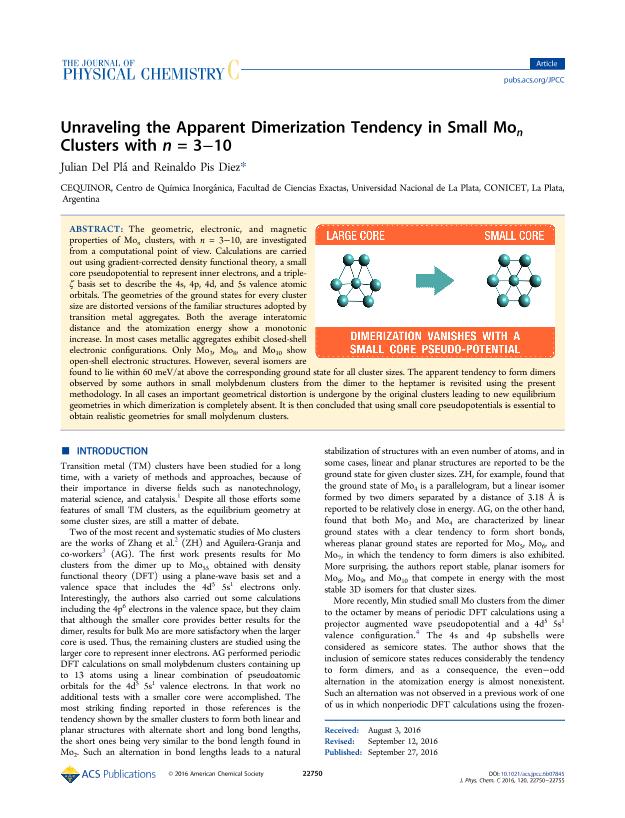
The geometric, electronic, and magnetic properties of Mon clusters, with n = 3–10, are investigated from a computational point of view. Calculations are carried out using gradient-corrected density functional theory, a small core pseudopotential to represent inner electrons, and a triple-ζ basis set to describe the 4s, 4p, 4d, and 5s valence atomic orbitals. The geometries of the ground states for every cluster size are distorted versions of the familiar structures adopted by transition metal aggregates. Both the average interatomic distance and the atomization energy show a monotonic increase. In most cases metallic aggregates exhibit closed-shell electronic configurations. Only Mo3, Mo8, and Mo10 show open-shell electronic structures. However, several isomers are found to lie within 60 meV/at above the corresponding ground state for all cluster sizes. The apparent tendency to form dimers observed by some authors in small molybdenum clusters from the dimer to the heptamer is revisited using the present methodology. In all cases an important geometrical distortion is undergone by the original clusters leading to new equilibrium geometries in which dimerization is completely absent. It is then concluded that using small core pseudopotentials is essential to obtain realistic geometries for small molydenum clusters.
Archivos asociados

Tamaño:
1.547Mb
Formato:
PDF
Licencia
 Excepto donde se diga explícitamente, este item se publica bajo la siguiente descripción:
Creative Commons Attribution-NonCommercial-ShareAlike 2.5 Unported (CC BY-NC-SA 2.5)
Excepto donde se diga explícitamente, este item se publica bajo la siguiente descripción:
Creative Commons Attribution-NonCommercial-ShareAlike 2.5 Unported (CC BY-NC-SA 2.5)
Identificadores
Colecciones
Articulos(CEQUINOR)
Articulos de CENTRO DE QUIMICA INORGANICA "DR. PEDRO J. AYMONINO"
Articulos de CENTRO DE QUIMICA INORGANICA "DR. PEDRO J. AYMONINO"
Citación
del Pla, Julian; Pis Diez, Reinaldo; Unraveling the Apparent Dimerization Tendency in Small Mo n Clusters with n = 3–10; American Chemical Society; Journal of Physical Chemistry C; 120; 39; 9-2016; 22750-22755
Compartir


Altmétricas