Artículo
Proprioceptive Body Illusions Modulate the Visual Perception of Reaching Distance

Fecha de publicación:
25/06/2015
Editorial:
Public Library of Science
Revista:
Plos One
ISSN:
1932-6203
Idioma:
Inglés
Tipo de recurso:
Artículo publicado
Clasificación temática:
Resumen
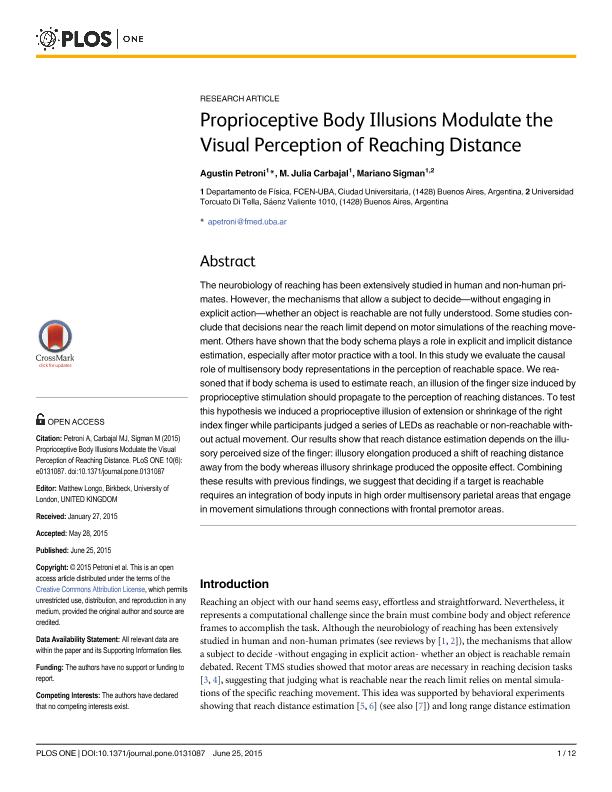
The neurobiology of reaching has been extensively studied in human and non-human primates. However, the mechanisms that allow a subject to decide?without engaging in explicit action?whether an object is reachable are not fully understood. Some studies conclude that decisions near the reach limit depend on motor simulations of the reaching movement. Others have shown that the body schema plays a role in explicit and implicit distance estimation, especially after motor practice with a tool. In this study we evaluate the causal role of multisensory body representations in the perception of reachable space. We reasoned that if body schema is used to estimate reach, an illusion of the finger size induced by proprioceptive stimulation should propagate to the perception of reaching distances. To test this hypothesis we induced a proprioceptive illusion of extension or shrinkage of the right index finger while participants judged a series of LEDs as reachable or non-reachable without actual movement. Our results show that reach distance estimation depends on the illusory perceived size of the finger: illusory elongation produced a shift of reaching distance away from the body whereas illusory shrinkage produced the opposite effect. Combining these results with previous findings, we suggest that deciding if a target is reachable requires an integration of body inputs in high order multisensory parietal areas that engage in movement simulations through connections with frontal premotor areas.
Palabras clave:
Vision
,
Triceps
,
Reaction Time
,
Psycological Parameters
Archivos asociados

Tamaño:
395.8Kb
Formato:
PDF
Licencia
 Excepto donde se diga explícitamente, este item se publica bajo la siguiente descripción:
Creative Commons Attribution-NonCommercial-ShareAlike 2.5 Unported (CC BY-NC-SA 2.5)
Excepto donde se diga explícitamente, este item se publica bajo la siguiente descripción:
Creative Commons Attribution-NonCommercial-ShareAlike 2.5 Unported (CC BY-NC-SA 2.5)
Identificadores
Colecciones
Articulos(IFIBA)
Articulos de INST.DE FISICA DE BUENOS AIRES
Articulos de INST.DE FISICA DE BUENOS AIRES
Citación
Petroni, Agutin; Carbajal, María Julia; Sigman, Mariano; Proprioceptive Body Illusions Modulate the Visual Perception of Reaching Distance; Public Library of Science; Plos One; 10; 6; 25-6-2015; 1-12; e0131087
Compartir


Altmétricas