Artículo
Maximum Likelihood Sequence Detection Receivers for Nonlinear Optical Channels

Fecha de publicación:
03/2015
Editorial:
Hindawi Publishing Corporation
Revista:
Journal of Electrical and Computer Engineering
ISSN:
2090-0155
Idioma:
Inglés
Tipo de recurso:
Artículo publicado
Clasificación temática:
Resumen
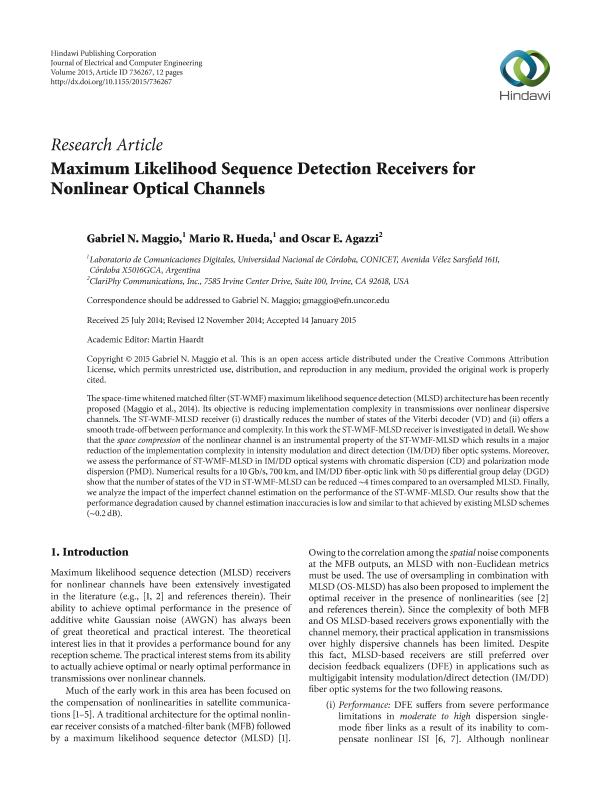
The space-time whitened matched filter (ST-WMF) maximum likelihood sequence detection (MLSD) architecture has been recently proposed (Maggio et al., 2014). Its objective is reducing implementation complexity in transmissions over nonlinear dispersive channels. The ST-WMF-MLSD receiver (i) drastically reduces the number of states of the Viterbi decoder (VD) and (ii) offers a smooth trade-off between performance and complexity. In this work the ST-WMF-MLSD receiver is investigated in detail. We show that the space compression of the nonlinear channel is an instrumental property of the ST-WMF-MLSD which results in a major reduction of the implementation complexity in intensity modulation and direct detection (IM/DD) fiber optic systems. Moreover, we assess the performance of ST-WMF-MLSD in IM/DD optical systems with chromatic dispersion (CD) and polarization mode dispersion (PMD). Numerical results for a 10 Gb/s, 700 km, and IM/DD fiber-optic link with 50 ps differential group delay (DGD) show that the number of states of the VD in ST-WMF-MLSD can be reduced ~4 times compared to an oversampled MLSD. Finally, we analyze the impact of the imperfect channel estimation on the performance of the ST-WMF-MLSD. Our results show that the performance degradation caused by channel estimation inaccuracies is low and similar to that achieved by existing MLSD schemes (~0.2 dB).
Palabras clave:
St-Wmf
,
Mlsd
,
St-Wmf-Mlsd Receiver
,
Im/Dd
,
Chromatic Dispersion
Archivos asociados

Tamaño:
1.737Mb
Formato:
PDF
Licencia
 Excepto donde se diga explícitamente, este item se publica bajo la siguiente descripción:
Creative Commons Attribution 2.5 Unported (CC BY 2.5)
Excepto donde se diga explícitamente, este item se publica bajo la siguiente descripción:
Creative Commons Attribution 2.5 Unported (CC BY 2.5)
Identificadores
Colecciones
Articulos(CCT - CORDOBA)
Articulos de CTRO.CIENTIFICO TECNOL.CONICET - CORDOBA
Articulos de CTRO.CIENTIFICO TECNOL.CONICET - CORDOBA
Citación
Maggio, Gabriel Nicolás; Hueda, Mario Rafael; Agazzi, Oscar Ernesto; Maximum Likelihood Sequence Detection Receivers for Nonlinear Optical Channels; Hindawi Publishing Corporation; Journal of Electrical and Computer Engineering; 2015; 736267; 3-2015; 1-12
Compartir


Altmétricas