Artículo
Transiently trapped entanglements in model polymer networks
Acosta, Rodolfo Héctor ; Monti, Gustavo Alberto
; Villar, Marcelo Armando
; Valles, Enrique Marcelo
; Vega, Daniel Alberto
; Monti, Gustavo Alberto
; Villar, Marcelo Armando
; Valles, Enrique Marcelo
; Vega, Daniel Alberto
; Monti, Gustavo Alberto
; Villar, Marcelo Armando
; Valles, Enrique Marcelo
; Vega, Daniel Alberto
Fecha de publicación:
06/2009
Editorial:
American Chemical Society
Revista:
Macromolecules
ISSN:
0024-9297
Idioma:
Inglés
Tipo de recurso:
Artículo publicado
Clasificación temática:
Resumen
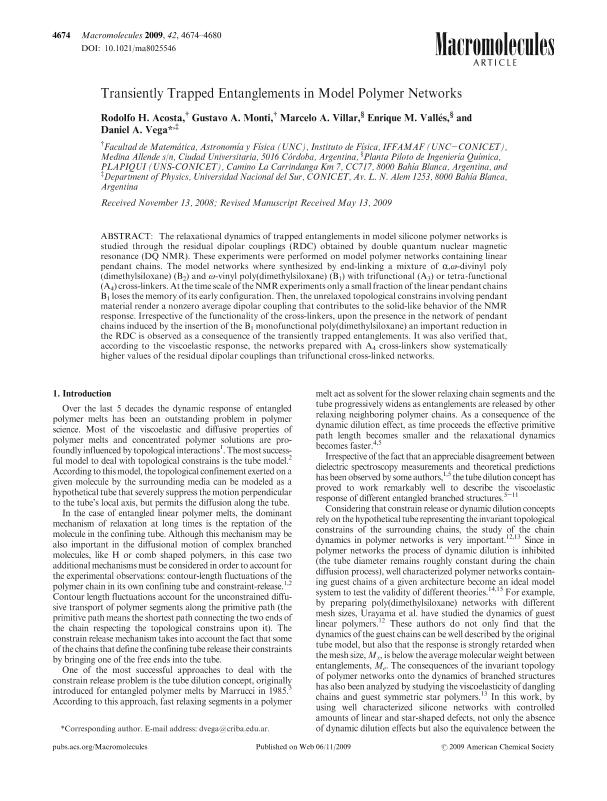
The relaxational dynamics of trapped entanglements in model silicone polymer networks is studied through the residual dipolar couplings (RDC) obtained by double quantum nuclear magnetic resonance (DQ NMR). These experiments were performed on model polymer networks containing linear pendant chains. The model networks where synthesized by end-linking a mixture of α,ω-divinyl poly(dimethylsiloxane) (B2) and ω-vinyl poly(dimethylsiloxane) (B1) with trifunctional (A3) or tetra-functional (A4) cross-linkers. At the time scale of the NMR experiments only a small fraction of the linear pendant chains B1 loses the memory of its early configuration. Then, the unrelaxed topological constrains involving pendant material render a nonzero average dipolar coupling that contributes to the solid-like behavior of the NMR response. Irrespective of the functionality of the cross-linkers, upon the presence in the network of pendant chains induced by the insertion of the B1 monofunctional poly(dimethylsiloxane) an important reduction in the RDC is observed as a consequence of the transiently trapped entanglements. It was also verified that, according to the viscoelastic response, the networks prepared with A4 cross-linkers show systematically higher values of the residual dipolar couplings than trifunctional cross-linked networks.
Archivos asociados

Tamaño:
1.035Mb
Formato:
PDF
Licencia
 Excepto donde se diga explícitamente, este item se publica bajo la siguiente descripción:
Creative Commons Attribution-NonCommercial-ShareAlike 2.5 Unported (CC BY-NC-SA 2.5)
Excepto donde se diga explícitamente, este item se publica bajo la siguiente descripción:
Creative Commons Attribution-NonCommercial-ShareAlike 2.5 Unported (CC BY-NC-SA 2.5)
Identificadores
Colecciones
Articulos(IFEG)
Articulos de INST.DE FISICA ENRIQUE GAVIOLA
Articulos de INST.DE FISICA ENRIQUE GAVIOLA
Articulos(IFISUR)
Articulos de INSTITUTO DE FISICA DEL SUR
Articulos de INSTITUTO DE FISICA DEL SUR
Articulos(PLAPIQUI)
Articulos de PLANTA PILOTO DE INGENIERIA QUIMICA (I)
Articulos de PLANTA PILOTO DE INGENIERIA QUIMICA (I)
Citación
Acosta, Rodolfo Héctor; Monti, Gustavo Alberto; Villar, Marcelo Armando; Valles, Enrique Marcelo; Vega, Daniel Alberto; Transiently trapped entanglements in model polymer networks; American Chemical Society; Macromolecules; 42; 13; 6-2009; 4674-4680
Compartir


Altmétricas