Artículo
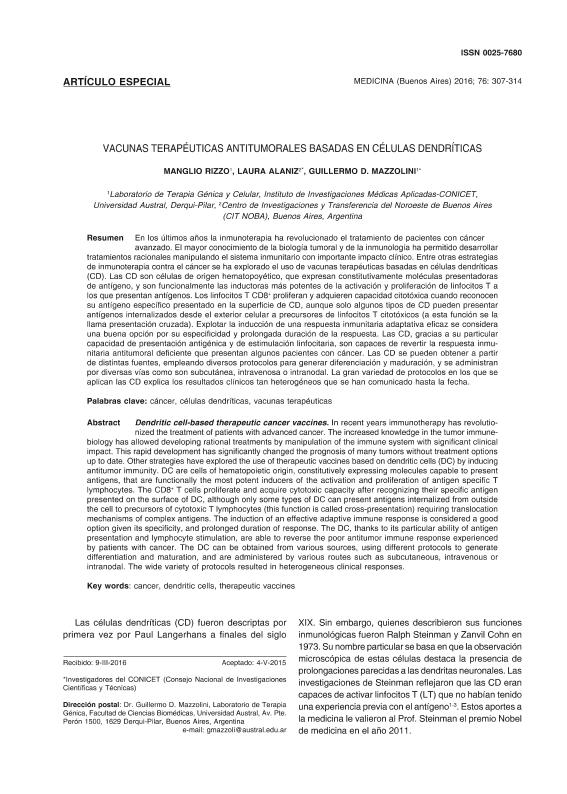
En los últimos años la inmunoterapia ha revolucionado el tratamiento de pacientes con cáncer avanzado. El mayor conocimiento de la biología tumoral y de la inmunología ha permitido desarrollar tratamientos racionales manipulando el sistema inmunitario con importante impacto clínico. Entre otras estrategias de inmunoterapia contra el cáncer se ha explorado el uso de vacunas terapéuticas basadas en células dendríticas (CD). Las CD son células de origen hematopoyético, que expresan constitutivamente moléculas presentadoras de antígeno, y son funcionalmente las inductoras más potentes de la activación y proliferación de linfocitos T a los que presentan antígenos. Los linfocitos T CD8+ proliferan y adquieren capacidad citotóxica cuando reconocen su antígeno específico presentado en la superficie de CD, aunque solo algunos tipos de CD pueden presentar antígenos internalizados desde el exterior celular a precursores de linfocitos T citotóxicos (a esta función se la llama presentación cruzada). Explotar la inducción de una respuesta inmunitaria adaptativa eficaz se considera una buena opción por su especificidad y prolongada duración de la respuesta. Las CD, gracias a su particular capacidad de presentación antigénica y de estimulación linfocitaria, son capaces de revertir la respuesta inmunitaria antitumoral deficiente que presentan algunos pacientes con cáncer. Las CD se pueden obtener a partir de distintas fuentes, empleando diversos protocolos para generar diferenciación y maduración, y se administran por diversas vías como son subcutánea, intravenosa o intranodal. La gran variedad de protocolos en los que se aplican las CD explica los resultados clínicos tan heterogéneos que se han comunicado hasta la fecha. In recent years immunotherapy has revolutionized the treatment of patients with advanced cancer. The increased knowledge in the tumor immune-biology has allowed developing rational treatments by manipulation of the immune system with significant clinical impact. This rapid development has significantly changed the prognosis of many tumors without treatment options up to date. Other strategies have explored the use of therapeutic vaccines based on dendritic cells (DC) by inducing antitumor immunity. DC are cells of hematopoietic origin, constitutively expressing molecules capable to present antigens, that are functionally the most potent inducers of the activation and proliferation of antigen specific T lymphocytes. The CD8+ T cells proliferate and acquire cytotoxic capacity after recognizing their specific antigen presented on the surface of DC, although only some types of DC can present antigens internalized from outside the cell to precursors of cytotoxic T lymphocytes (this function is called cross-presentation) requiring translocation mechanisms of complex antigens. The induction of an effective adaptive immune response is considered a good option given its specificity, and prolonged duration of response. The DC, thanks to its particular ability of antigen presentation and lymphocyte stimulation, are able to reverse the poor antitumor immune response experienced by patients with cancer. The DC can be obtained from various sources, using different protocols to generate differentiation and maturation, and are administered by various routes such as subcutaneous, intravenous or intranodal. The wide variety of protocols resulted in heterogeneous clinical responses.
Vacunas terapéuticas antitumorales basadas en células dendríticas
Título:
Dendritic cell-based therapeutic cancer vaccines

Fecha de publicación:
05/2016
Editorial:
Medicina (Buenos Aires)
Revista:
Medicina (Buenos Aires)
ISSN:
0025-7680
e-ISSN:
1669-9106
Idioma:
Español
Tipo de recurso:
Artículo publicado
Clasificación temática:
Resumen
Palabras clave:
Dendritic Cells
,
Immunotherapy
,
Cancer
,
Vaccines
Archivos asociados

Tamaño:
710.2Kb
Formato:
PDF
Licencia
 Excepto donde se diga explícitamente, este item se publica bajo la siguiente descripción:
Creative Commons Attribution-NonCommercial-ShareAlike 2.5 Unported (CC BY-NC-SA 2.5)
Excepto donde se diga explícitamente, este item se publica bajo la siguiente descripción:
Creative Commons Attribution-NonCommercial-ShareAlike 2.5 Unported (CC BY-NC-SA 2.5)
Identificadores
Colecciones
Articulos(IIMT)
Articulos de INSTITUTO DE INVESTIGACIONES EN MEDICINA TRASLACIONAL
Articulos de INSTITUTO DE INVESTIGACIONES EN MEDICINA TRASLACIONAL
Citación
Rizzo, Manglio Miguel; Alaniz, Laura Daniela; Mazzolini Rizzo, Guillermo Daniel; Vacunas terapéuticas antitumorales basadas en células dendríticas; Medicina (Buenos Aires); Medicina (Buenos Aires); 76; 5; 5-2016; 307-314
Compartir

