Artículo
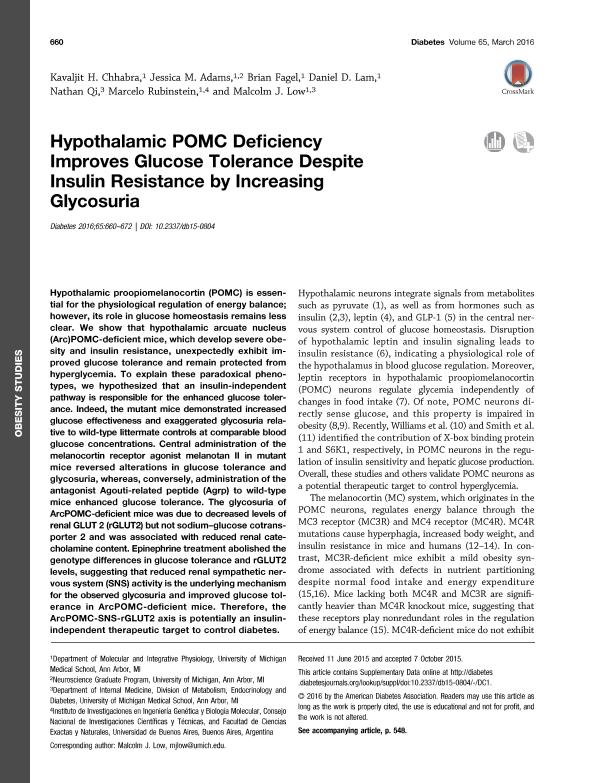
Hypothalamic POMC Deficiency Improves Glucose Tolerance Despite Insulin Resistance by Increasing Glycosuria
Chhabra, Kavaljit H.; Adams, Jessica M.; Fagel, Brian; Lam, Daniel D.; Qi, Nathan; Rubinstein, Marcelo ; Low, Malcolm J.
; Low, Malcolm J.
Fecha de publicación:
03/2016
Editorial:
American Diabetes Association
Revista:
Diabetes
ISSN:
0012-1797
Idioma:
Inglés
Tipo de recurso:
Artículo publicado
Clasificación temática:
Resumen
Hypothalamic proopiomelanocortin (POMC) is essential for the physiological regulation of energy balance; however, its role in glucose homeostasis remains less clear. We show that hypothalamic arcuate nucleus (Arc)POMC-deficient mice, which develop severe obesity and insulin resistance, unexpectedly exhibit improved glucose tolerance and remain protected from hyperglycemia. To explain these paradoxical phenotypes, we hypothesized that an insulin-independent pathway is responsible for the enhanced glucose tolerance. Indeed, the mutant mice demonstrated increased glucose effectiveness and exaggerated glycosuria relative to wild-type littermate controls at comparable blood glucose concentrations. Central administration of the melanocortin receptor agonist melanotan II in mutant mice reversed alterations in glucose tolerance and glycosuria, whereas, conversely, administration of the antagonist Agouti-related peptide (Agrp) to wild-type mice enhanced glucose tolerance. The glycosuria of ArcPOMC-deficient mice was due to decreased levels of renal GLUT 2 (rGLUT2) but not sodium–glucose cotransporter 2 and was associated with reduced renal catecholamine content. Epinephrine treatment abolished the genotype differences in glucose tolerance and rGLUT2 levels, suggesting that reduced renal sympathetic nervous system (SNS) activity is the underlying mechanism for the observed glycosuria and improved glucose tolerance in ArcPOMC-deficient mice. Therefore, the ArcPOMC-SNS-rGLUT2 axis is potentially an insulin-independent therapeutic target to control diabetes
Palabras clave:
Pomc
,
Diabetes
,
Hypothalamus
,
Glucosuria
Archivos asociados

Tamaño:
2.181Mb
Formato:
PDF
Licencia
 Excepto donde se diga explícitamente, este item se publica bajo la siguiente descripción:
Creative Commons Attribution-NonCommercial-ShareAlike 2.5 Unported (CC BY-NC-SA 2.5)
Excepto donde se diga explícitamente, este item se publica bajo la siguiente descripción:
Creative Commons Attribution-NonCommercial-ShareAlike 2.5 Unported (CC BY-NC-SA 2.5)
Identificadores
Colecciones
Articulos(INGEBI)
Articulos de INST.DE INVEST.EN ING.GENETICA Y BIOL.MOLECULAR "DR. HECTOR N TORRES"
Articulos de INST.DE INVEST.EN ING.GENETICA Y BIOL.MOLECULAR "DR. HECTOR N TORRES"
Citación
Chhabra, Kavaljit H.; Adams, Jessica M.; Fagel, Brian; Lam, Daniel D.; Qi, Nathan; et al.; Hypothalamic POMC Deficiency Improves Glucose Tolerance Despite Insulin Resistance by Increasing Glycosuria; American Diabetes Association; Diabetes; 65; 3; 3-2016; 660-672
Compartir


Altmétricas