Artículo
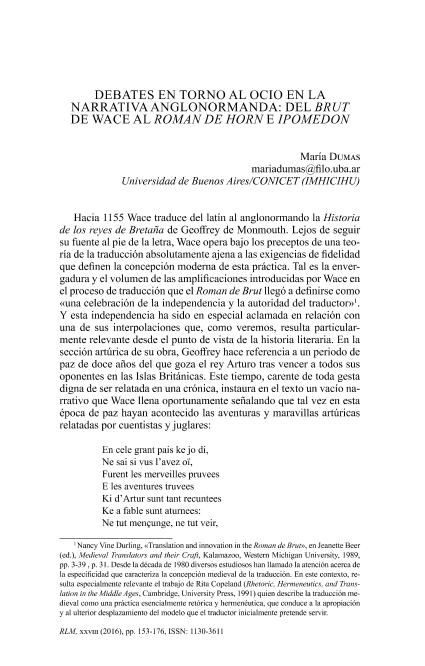
El trabajo analiza la recepción del problema planteado por el ocio, la recreantise, en la narrativa caballeresca de la Inglaterra anglonormanda. Esta cuestión, introducida por Wace en el Brut, fue abordada de manera célebre por Chrétien de Troyes en su primer roman, Erec et Enide. Sin embargo, como se desprende de la lectura del Roman de Horn de Thomas y de Ipomedon de Hue de Rotelande, en el ámbito insular este debate también goza de gran vitalidad, aunque recibirá un tratamiento diferente. La representación de un héroe ocioso lleva tanto a Thomas como a Hue a problematizar, por distintas vías, las convenciones narrativas propuestas por el roman en tanto género. La resistencia manifestada por ambos autores hacia este modelo genérico será determinante en el desarrollo ulterior del género, tanto en dialecto anglonormando como en inglés medio, y constituye un testimonio de gran valor sobre las peculiaridades de la recepción del roman en la Inglaterra del siglo XII. The aim of this article is to analyze how the problem of idleness, i.e. recreantise, is addressed in Anglo-Norman chivalric literature. This question, introduced by Wace in his Brut, was notably handled by Chré- tien de Troyes in his first romance, Erec et Enide. However, as it becomes evident from Thomas’s Roman de Horn and Hue de Rotelande’s Ipomedon, this discussion was also quite lively in the insular context. Representing an idle hero leads both Thomas and Hue to challenge, in different ways, the narrative conventions of the romance genre. The resistance evinced by the two authors towards this generic model would be highly influential on the later development of the genre in England, both in Anglo-Norman and Middle English, and affords a valuable testimony to the peculiarities of the reception of romance in twelfth-century England.
Debates en torno al ocio en la narrativa anglonormanda: del Brut de Wace al Roman de Horn e Ipomedon
Título:
Discussing idleness in anglo-norman narrative: from Wace’s Brut to the Roman de Horn and Ipomedon

Fecha de publicación:
12/2016
Editorial:
Universidad de Alcalá
Revista:
Revista de Literatura Medieval
ISSN:
1130-3611
Idioma:
Español
Tipo de recurso:
Artículo publicado
Clasificación temática:
Resumen
Palabras clave:
Roman Anglonormando
,
Ocio
,
Horn
,
Ipomedon
Archivos asociados

Tamaño:
317.3Kb
Formato:
PDF
Licencia
 Excepto donde se diga explícitamente, este item se publica bajo la siguiente descripción:
Creative Commons Attribution-NonCommercial-ShareAlike 2.5 Unported (CC BY-NC-SA 2.5)
Excepto donde se diga explícitamente, este item se publica bajo la siguiente descripción:
Creative Commons Attribution-NonCommercial-ShareAlike 2.5 Unported (CC BY-NC-SA 2.5)
Identificadores
Colecciones
Articulos(IMHICIHU)
Articulos de INST.MULTIDISCIP.DE HISTORIA Y CS.HUMANAS
Articulos de INST.MULTIDISCIP.DE HISTORIA Y CS.HUMANAS
Citación
Dumas, María; Debates en torno al ocio en la narrativa anglonormanda: del Brut de Wace al Roman de Horn e Ipomedon; Universidad de Alcalá; Revista de Literatura Medieval; XXVIII; 12-2016; 153-176
Compartir

