Artículo
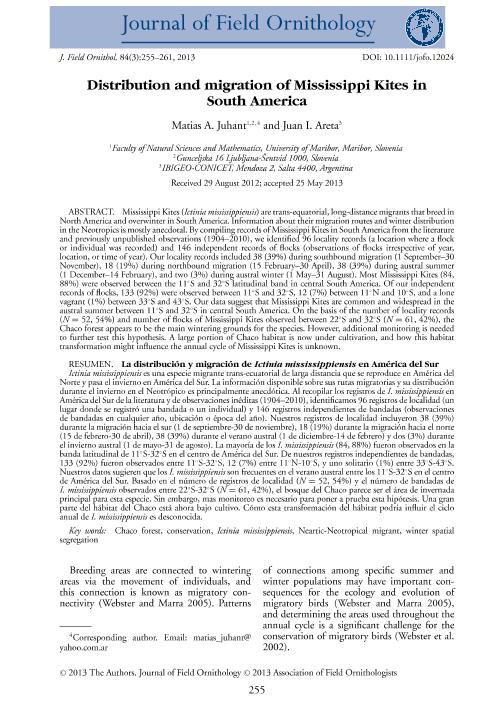
Mississippi Kites (Ictinia mississippiensis) are trans-equatorial, long-distance migrants that breed in North America and overwinter in South America. Information about their migration routes and winter distribution in theNeotropics ismostly anecdotal. By compiling records ofMississippi Kites in South America from the literature and previously unpublished observations (1904-2010), we identified 96 locality records (a location where a flock or individual was recorded) and 146 independent records of flocks (observations of flocks irrespective of year, location, or time of year). Our locality records included 38 (39%) during southbound migration (1 September-30 November), 18 (19%) during northbound migration (15 February-30 April), 38 (39%) during austral summer (1 December-14 February), and two (3%) during austral winter (1 May-31 August). Most Mississippi Kites (84, 88%) were observed between the 11◦S and 32◦S latitudinal band in central South America. Of our independent records of flocks, 133 (92%) were observed between 11◦S and 32◦S, 12 (7%) between 11◦N and 10◦S, and a lone vagrant (1%) between 33◦S and 43◦S. Our data suggest that Mississippi Kites are common and widespread in the austral summer between 11◦S and 32◦S in central South America. On the basis of the number of locality records (N = 52, 54%) and number of flocks of Mississippi Kites observed between 22◦S and 32◦S (N = 61, 42%), the Chaco forest appears to be the main wintering grounds for the species. However, additional monitoring is needed to further test this hypothesis. A large portion of Chaco habitat is now under cultivation, and how this habitat transformation might influence the annual cycle of Mississippi Kites is unknown. Ictinia mississippiensis es una especie migrante trans-ecuatorial de larga distancia que se reproduce en América del Norte y pasa el invierno en América del Sur. La información disponible sobre sus rutas migratorias y su distribución durante el invierno en el Neotrópico es principalmente anecdótica. Al recopilar los registros de I. mississippiensis en América del Sur de la literatura y de observaciones inéditas (1904–2010), identificamos 96 registros de localidad (un lugar donde se registró una bandada o un individual) y 146 registros independientes de bandadas (observaciones de bandadas en cualquier año, ubicación o época del año). Nuestros registros de localidad incluyeron 38 (39%) durante la migración hacia el sur (1 de septiembre-30 de noviembre), 18 (19%) durante la migración hacia el norte (15 de febrero-30 de abril), 38 (39%) durante el verano austral (1 de diciembre-14 de febrero) y dos (3%) durante el invierno austral (1 de mayo-31 de agosto). La mayorıa de los I. mississippiensis (84, 88%) fueron observados en la banda latitudinal de 11◦S-32◦S en el centro de América del Sur. De nuestros registros independientes de bandadas, 133 (92%) fueron observados entre 11◦S-32◦S, 12 (7%) entre 11◦N-10◦S, y uno solitario (1%) entre 33◦S-43◦S. Nuestros datos sugieren que los I. mississippiensis son frecuentes en el verano austral entre los 11◦ S-32◦ S en el centro de América del Sur. Basado en el número de registros de localidad (N = 52, 54%) y el número de bandadas de I. mississippiensis observados entre 22◦S-32◦S (N = 61, 42%), el bosque del Chaco parece ser el área de invernada principal para esta especie. Sin embargo, mas monitoreo es necesario para poner a prueba esta hipótesis. Una gran parte del hábitat del Chaco está ahora bajo cultivo. Como esta transformación del hábitat podría influir el ciclo anual de I. mississippiensis es desconocida.
Distribution and migration of the Mississippi Kites in South America
Título:
La distribución y migración de Ictinia mississippiensis en América del Sur

Fecha de publicación:
08/2013
Editorial:
Wiley Blackwell Publishing, Inc
Revista:
Journal Of Field Ornithology
ISSN:
0273-8570
Idioma:
Inglés
Tipo de recurso:
Artículo publicado
Clasificación temática:
Resumen
Archivos asociados

Tamaño:
527.7Kb
Formato:
PDF
Licencia
 Excepto donde se diga explícitamente, este item se publica bajo la siguiente descripción:
Atribución-NoComercial-SinDerivadas 2.5 Argentina (CC BY-NC-ND 2.5 AR)
Excepto donde se diga explícitamente, este item se publica bajo la siguiente descripción:
Atribución-NoComercial-SinDerivadas 2.5 Argentina (CC BY-NC-ND 2.5 AR)
Identificadores
Colecciones
Articulos(IBIGEO)
Articulos de INST.DE BIO Y GEOCIENCIAS DEL NOA
Articulos de INST.DE BIO Y GEOCIENCIAS DEL NOA
Citación
Juhant, Matias A.; Areta, Juan Ignacio; Distribution and migration of the Mississippi Kites in South America; Wiley Blackwell Publishing, Inc; Journal Of Field Ornithology; 84; 3; 8-2013; 255-261
Compartir


Altmétricas