Artículo
Critical role of canonical transient receptor potential channel 7 in initiation of seizures

Fecha de publicación:
07/2014
Editorial:
National Academy of Sciences
Revista:
Proceedings of the National Academy of Sciences of The United States of America
ISSN:
0027-8424
Idioma:
Inglés
Tipo de recurso:
Artículo publicado
Clasificación temática:
Resumen
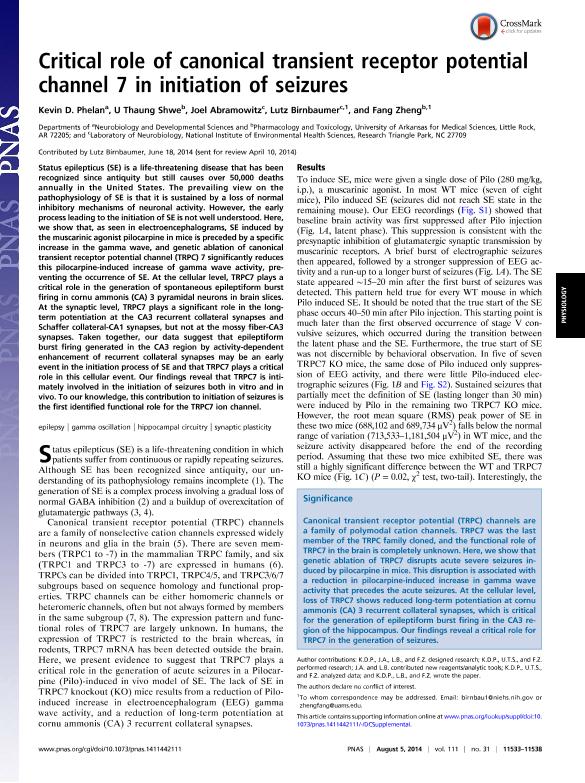
Status epilepticus (SE) is a life-threatening disease that has been recognized since antiquity but still causes over 50,000 deaths annually in the United States. The prevailing view on the pathophysiology of SE is that it is sustained by a loss of normal inhibitory mechanisms of neuronal activity. However, the early process leading to the initiation of SE is not well understood. Here, we show that, as seen in electroencephalograms, SE induced by the muscarinic agonist pilocarpine in mice is preceded by a specific increase in the gamma wave, and genetic ablation of canonical transient receptor potential channel (TRPC) 7 significantly reduces this pilocarpine-induced increase of gamma wave activity, preventing the occurrence of SE. At the cellular level, TRPC7 plays a critical role in the generation of spontaneous epileptiform burst firing in cornu ammonis (CA) 3 pyramidal neurons in brain slices. At the synaptic level, TRPC7 plays a significant role in the long-term potentiation at the CA3 recurrent collateral synapses and Schaffer collateral-CA1 synapses, but not at the mossy fiber-CA3 synapses. Taken together, our data suggest that epileptiform burst firing generated in the CA3 region by activity-dependent enhancement of recurrent collateral synapses may be an early event in the initiation process of SE and that TRPC7 plays a critical role in this cellular event. Our findings reveal that TRPC7 is intimately involved in the initiation of seizures both in vitro and in vivo. To our knowledge, this contribution to initiation of seizures is the first identified functional role for the TRPC7 ion channel.
Palabras clave:
Epilepsy
,
Gamma Oscillation
,
Hippocampal Circuitry
,
Synaptic Plasticity
Archivos asociados

Tamaño:
1.300Mb
Formato:
PDF
Licencia
 Excepto donde se diga explícitamente, este item se publica bajo la siguiente descripción:
Creative Commons Attribution-NonCommercial-ShareAlike 2.5 Unported (CC BY-NC-SA 2.5)
Excepto donde se diga explícitamente, este item se publica bajo la siguiente descripción:
Creative Commons Attribution-NonCommercial-ShareAlike 2.5 Unported (CC BY-NC-SA 2.5)
Identificadores
Colecciones
Articulos(IIB-INTECH)
Articulos de INST.DE INVEST.BIOTECNOLOGICAS - INSTITUTO TECNOLOGICO CHASCOMUS
Articulos de INST.DE INVEST.BIOTECNOLOGICAS - INSTITUTO TECNOLOGICO CHASCOMUS
Citación
Phelan, K. D.; Shwe, U. T.; Abramowitz, J.; Birnbaumer, Lutz; Zheng, F.; Critical role of canonical transient receptor potential channel 7 in initiation of seizures; National Academy of Sciences; Proceedings of the National Academy of Sciences of The United States of America; 111; 31; 7-2014; 11533-11538
Compartir


Altmétricas