Artículo
Solar ultraviolet radiation and ozone depletion-driven climate change: effects on terrestrial ecosystems
Bornman, J. F.; Barnes, P. W.; Robinson, S. A.; Ballare, Carlos Luis ; Flint, S. D.; Caldwell, M. M.
; Flint, S. D.; Caldwell, M. M.
Fecha de publicación:
01/2015
Editorial:
Royal Society of Chemistry
Revista:
Photochemical and Photobiological Sciences
ISSN:
1474-905X
Idioma:
Inglés
Tipo de recurso:
Artículo publicado
Clasificación temática:
Resumen
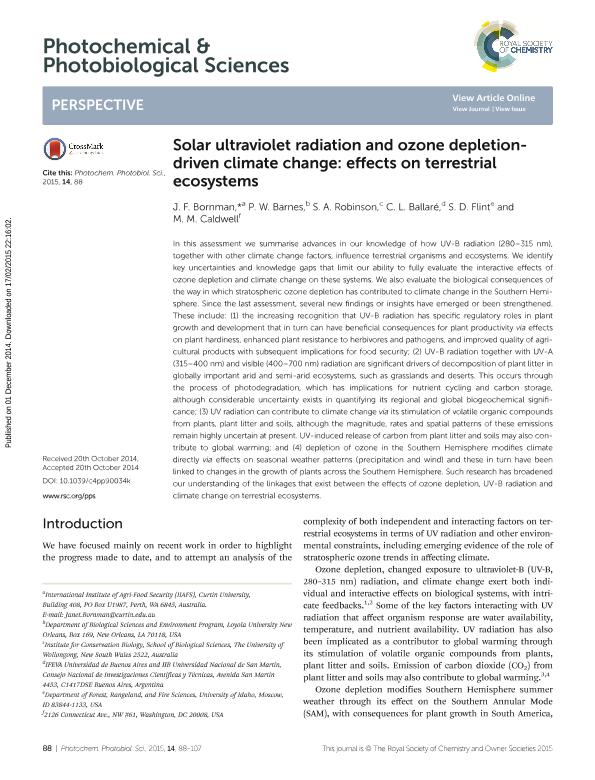
In this assessment we summarise advances in our knowledge of how UV-B radiation (280-315 nm), together with other climate change factors, influence terrestrial organisms and ecosystems. We identify key uncertainties and knowledge gaps that limit our ability to fully evaluate the interactive effects of ozone depletion and climate change on these systems. We also evaluate the biological consequences of the way in which stratospheric ozone depletion has contributed to climate change in the Southern Hemisphere. Since the last assessment, several new findings or insights have emerged or been strengthened. These include: (1) the increasing recognition that UV-B radiation has specific regulatory roles in plant growth and development that in turn can have beneficial consequences for plant productivity via effects on plant hardiness, enhanced plant resistance to herbivores and pathogens, and improved quality of agricultural products with subsequent implications for food security; (2) UV-B radiation together with UV-A (315-400 nm) and visible (400-700 nm) radiation are significant drivers of decomposition of plant litter in globally important arid and semi-arid ecosystems, such as grasslands and deserts. This occurs through the process of photodegradation, which has implications for nutrient cycling and carbon storage, although considerable uncertainty exists in quantifying its regional and global biogeochemical significance; (3) UV radiation can contribute to climate change via its stimulation of volatile organic compounds from plants, plant litter and soils, although the magnitude, rates and spatial patterns of these emissions remain highly uncertain at present. UV-induced release of carbon from plant litter and soils may also contribute to global warming; and (4) depletion of ozone in the Southern Hemisphere modifies climate directly via effects on seasonal weather patterns (precipitation and wind) and these in turn have been linked to changes in the growth of plants across the Southern Hemisphere. Such research has broadened our understanding of the linkages that exist between the effects of ozone depletion, UV-B radiation and climate change on terrestrial ecosystems.
Palabras clave:
Uv-B
,
Climate Change
,
Ecosystem
Archivos asociados

Tamaño:
2.952Mb
Formato:
PDF
Licencia
 Excepto donde se diga explícitamente, este item se publica bajo la siguiente descripción:
Creative Commons Attribution 2.5 Unported (CC BY 2.5)
Excepto donde se diga explícitamente, este item se publica bajo la siguiente descripción:
Creative Commons Attribution 2.5 Unported (CC BY 2.5)
Identificadores
Colecciones
Articulos(IFEVA)
Articulos de INST.D/INV.FISIOLOGICAS Y ECO.VINCULADAS A L/AGRIC
Articulos de INST.D/INV.FISIOLOGICAS Y ECO.VINCULADAS A L/AGRIC
Citación
Bornman, J. F.; Barnes, P. W.; Robinson, S. A.; Ballare, Carlos Luis; Flint, S. D.; et al.; Solar ultraviolet radiation and ozone depletion-driven climate change: effects on terrestrial ecosystems; Royal Society of Chemistry; Photochemical and Photobiological Sciences; 14; 1; 1-2015; 88-107
Compartir

