Artículo
Modeling He-rich subdwarfs through the hot-flasher scenario

Fecha de publicación:
12/2008
Editorial:
EDP Sciences
Revista:
Astronomy and Astrophysics
ISSN:
0004-6361
Idioma:
Inglés
Tipo de recurso:
Artículo publicado
Clasificación temática:
Resumen
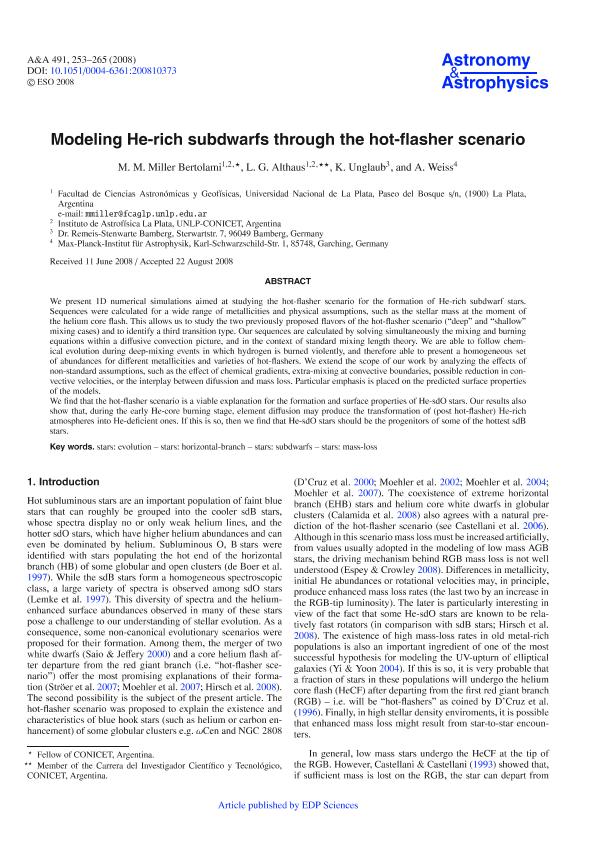
We present 1D numerical simulations aimed at studying the hot-flasher scenario for the formation of He-rich subdwarf stars. Sequences were calculated for a wide range of metallicities and physical assumptions, such as the stellar mass at the moment of the helium core flash. This allows us to study the two previously proposed flavors of the hot-flasher scenario ("deep" and "shallow" mixing cases) and to identify a third transition type. Our sequences are calculated by solving simultaneously the mixing and burning equations within a diffusive convection picture, and in the context of standard mixing length theory. We are able to follow chemical evolution during deep-mixing events in which hydrogen is burned violently, and therefore able to present a homogeneous set of abundances for different metallicities and varieties of hot-flashers. We extend the scope of our work by analyzing the effects of non-standard assumptions, such as the effect of chemical gradients, extra-mixing at convective boundaries, possible reduction in convective velocities, or the interplay between difussion and mass loss. Particular emphasis is placed on the predicted surface properties of the models. We find that the hot-flasher scenario is a viable explanation for the formation and surface properties of He-sdO stars. Our results also show that, during the early He-core burning stage, element diffusion may produce the transformation of (post hot-flasher) He-rich atmospheres into He-deficient ones. If this is so, then we find that He-sdO stars should be the progenitors of some of the hottest sdB stars.
Palabras clave:
Evolution of Stars
,
Horizontal-Branch Stars
,
Subdwarfs
,
Mass Loss
Archivos asociados

Tamaño:
1.309Mb
Formato:
PDF
Licencia
 Excepto donde se diga explícitamente, este item se publica bajo la siguiente descripción:
Creative Commons Attribution-NonCommercial-ShareAlike 2.5 Unported (CC BY-NC-SA 2.5)
Excepto donde se diga explícitamente, este item se publica bajo la siguiente descripción:
Creative Commons Attribution-NonCommercial-ShareAlike 2.5 Unported (CC BY-NC-SA 2.5)
Identificadores
Colecciones
Articulos(IALP)
Articulos de INST.DE ASTROFISICA LA PLATA
Articulos de INST.DE ASTROFISICA LA PLATA
Citación
Miller Bertolami, Marcelo Miguel; Althaus, Leandro Gabriel; Unglaub, K.; Weiss, A.; Modeling He-rich subdwarfs through the hot-flasher scenario; EDP Sciences; Astronomy and Astrophysics; 491; 1; 12-2008; 253-265
Compartir


Altmétricas