Artículo
Maize physiological responses to heat stress and hormonal plant growth regulators related to ethylene metabolism

Fecha de publicación:
09/2013
Editorial:
Alliance of Crop, Soil and Environmental Science Societies
Revista:
Crop Science
ISSN:
0011-183X
Idioma:
Inglés
Tipo de recurso:
Artículo publicado
Clasificación temática:
Resumen
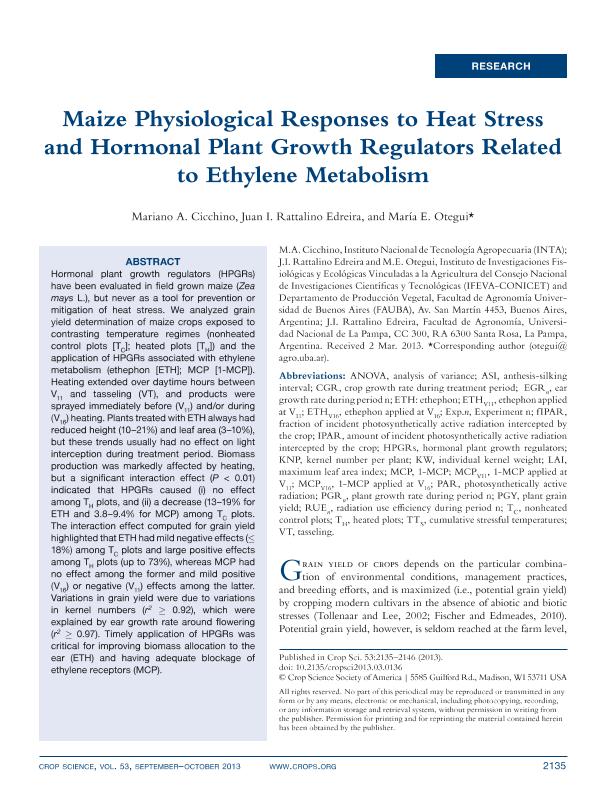
Hormonal plant growth regulators (HPGRs) have been evaluated in field grown maize (Zea mays L.), but never as a tool for prevention or mitigation of heat stress. We analyzed grain yield determination of maize crops exposed to contrasting temperature regimes (nonheated control plots [TC]; heated plots [TH]) and the application of HPGRs associated with ethylene metabolism (ethephon [ETH]; MCP [1-MCP]). Heating extended over daytime hours between V11 and tasseling (VT), and products were sprayed immediately before (V11) and/or during (V16) heating. Plants treated with ETH always had reduced height (10-21%) and leaf area (3-10%), but these trends usually had no effect on light interception during treatment period. Biomass production was markedly affected by heating, but a significant interaction effect (P < 0.01) indicated that HPGRs caused (i) no effect among TH plots, and (ii) a decrease (13-19% for ETH and 3.8-9.4% for MCP) among TC plots. The interaction effect computed for grain yield highlighted that ETH had mild negative effects (≤ 18%) among TC plots and large positive effects among TH plots (up to 73%), whereas MCP had no effect among the former and mild positive (V16) or negative (V11) effects among the latter. Variations in grain yield were due to variations in kernel numbers (r2 ≥ 0.92), which were explained by ear growth rate around flowering (r2 ≥ 0.97). Timely application of HPGRs was critical for improving biomass allocation to the ear (ETH) and having adequate blockage of ethylene receptors (MCP).
Palabras clave:
Maize
,
Heat Stress
,
Hormonal Plant Growth Regulators
,
Ethylene
Archivos asociados

Tamaño:
379.2Kb
Formato:
PDF
Licencia
 Excepto donde se diga explícitamente, este item se publica bajo la siguiente descripción:
Creative Commons Attribution-NonCommercial-ShareAlike 2.5 Unported (CC BY-NC-SA 2.5)
Excepto donde se diga explícitamente, este item se publica bajo la siguiente descripción:
Creative Commons Attribution-NonCommercial-ShareAlike 2.5 Unported (CC BY-NC-SA 2.5)
Identificadores
Colecciones
Articulos(IFEVA)
Articulos de INST.D/INV.FISIOLOGICAS Y ECO.VINCULADAS A L/AGRIC
Articulos de INST.D/INV.FISIOLOGICAS Y ECO.VINCULADAS A L/AGRIC
Articulos(SEDE CENTRAL)
Articulos de SEDE CENTRAL
Articulos de SEDE CENTRAL
Citación
Cicchino, Mariano A.; Rattalino Edreira, Juan Ignacio; Otegui, Maria Elena; Maize physiological responses to heat stress and hormonal plant growth regulators related to ethylene metabolism; Alliance of Crop, Soil and Environmental Science Societies; Crop Science; 53; 5; 9-2013; 2135-2146
Compartir


Altmétricas